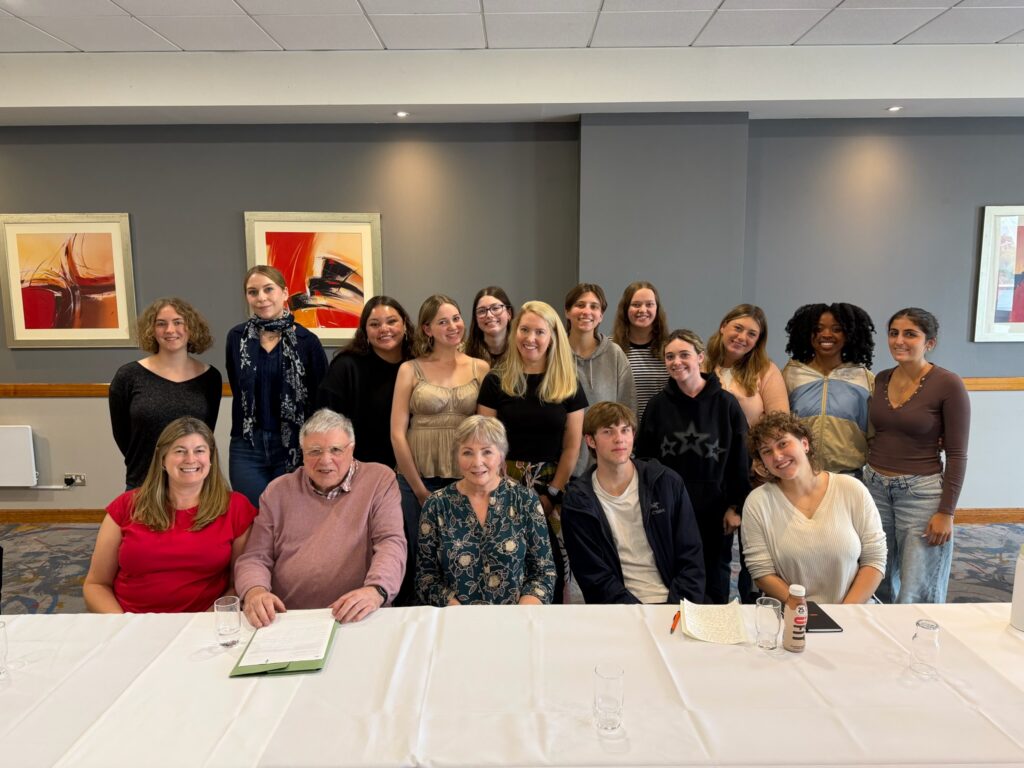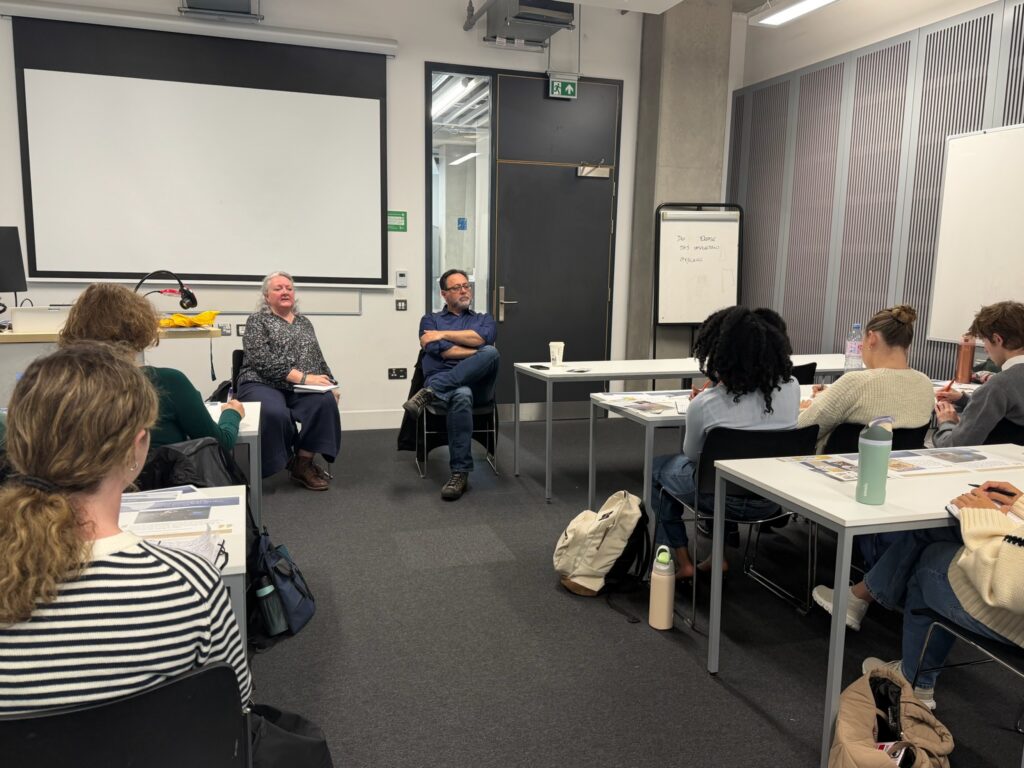
An Irish Goodbye: Ryder’s Reflection

Entering this unforgettable travel and immersion opportunity as a Peace and Justice Studies major, I had predicted that I would learn more about core concepts integral to my studies which did occur, however I was completely floored by how in-depth and exemplified many of the peacebuilding tools were here. What has always been extremely compelling for me and a lens I have hoped to explore is the intersection between the arts and social change. As someone eager to research this further, there were a multitude of moments where I got to see the creative side to peacebuilding. Whether it was learning about the protest songs highlighted in exhibits at the Free Derry Museum like “We Shall Overcome”, learning about the preservation of traditional Irish music even against threats by police over its usage in bars, or hearing about the punk subculture as a way of dismantling divided identities, I found this area of my field of study to be eye-opening on how creative peacebuilding methods can get as a means of mobilizing change. One example in specific that stuck out the most to me was ‘The House’, a project that Dr. Katy Radford worked closely on, symbolizing the experiences of victims of ‘The Troubles’ uniquely through different scenes spread throughout a home. Eggshells on the floor symbolizing tensions, women juggling in the kitchen to represent the stress women were under, personal anecdotes from the conflict inscribed on furniture, and other theatrical elements all composed this project allowing viewers to see the chaos of ‘The Troubles’ through a different lens. 

To me, my greatest takeaway was understanding how the different creative strategies to peacebuilding across the span of the trip illuminated the infinitely diverse approaches organizations take to tackle issues in post-conflict societies. Spending an evening at Corrymeela, seeing the power of games like “Red, Blue, Green” and their name game as mechanisms of bringing people together to foster a sense of understanding of differing perspectives and identities, it helped reinforce to me that peacebuilding doesn’t need to follow a structured archetype. Even organizations like Healing Through Remembering cleverly using everyday objects to uncover deeper experiences and histories in an exhibit to spark a sense of understanding of perspectives reminded me of how important creativity can be in fueling empathy. 

Another element of this experience that was fascinating to see was the power of stepping up, people taking charge to make an impact in their communities. The commitment of so many leaders of organizations like Linda Ervine of Turas, the Irish language school, starting a program because nobody else did and working to foster community through shared learning of language was very inspiring to me. Hearing stories of initiatives like The Junction and JoinHer Network reminds me of the power of being the person to step up and make a change, demonstrating that we have the power to invent the future we want to see. Meeting individuals like Lee (an ex-British soldier) and learning about the experiences of those involved in the conflict, the diffusion of personal stories and the willingness for people to share them truly has the ability to move others and educate younger generations on the seriousness of violent escalation. These personal stories are some of the most valuable parts of the entire experience and being able to ask these individuals meaningful questions has instilled in me a greater sense of the human cost of conflict, and how perspectives can be so different. 

My greatest challenges across the course in all honesty, came from a place of emotional sensitivity and the overload of information that accompanied my travels. While foundational to my newfound grasp of the conflict and its multidimensionality, hearing stories coming from the deepest emotional chambers of the speakers were admittedly difficult to listen to considering such violent and intense subject matter was often transparently intertwined into their honest accounts. Meeting with people directly tied to the conflict allowed me to comprehend the human cost of it all, seeing that both sides were victimized. As someone who considers himself to be sensitive to the core, I felt the weight of everything on a grand scale, with the stories of killings and sexual violence often carrying into my little pockets of analysis as I would lay in bed trying to defy jetlag. With such long days and a wide catalogue of knowledge to pick up on, there were definitely moments that felt somewhat daunting as I scrambled to interpret everything I had heard accurately. However, the acceleration of the course helped to push me out of my comfort zone, allowing a newfound sense of academic determination and stronger active listening skills. The magnum opus of challenges for me had to be the fact that my umbrella broke and would fly in various different directions at the mercy of the wind, leaving me rain-soaked at many times, however I think I managed to embrace the look. 

There were lots of surprises on the trip that challenged what I had expected before going into it, many of which have reshaped how I view conflict but also my relationship to peer collaboration. Before the course I was terrified at the thought of knowing few people beforehand and entering a country halfway across the globe, especially one that I had yet to ever visit. However, my experience saw me making new lifelong friends and engaging in dialogue with my peers that brought creative new perspectives to light during our reflections. It was truly such an honor to travel with my peers and my companions, and my view of the conflict has been greatly reshaped due to them (so if you are reading this, thank you for everything). What stuck out to me the most is how there are still many structural barriers that perpetuate division among communities. Examples include the ongoing segregation of schools (According to the speakers at Lagan College, roughly 93% of schools are still segregated) and the roles of first minister and deputy first minister having to be fulfilled by either a unionist or nationalist at Stormont. Equally surprising to me, was the amount of grassroots organizations and initiatives taken to pursue a future where division is dismantled and shared identity is encouraged. Organizations like Turas, the Northern Ireland Women’s Coalition, Corrymeela, ACT Initiative, and The Junction all inspired me to want to start my own project to positively impact the communities around me. 

There is endless gratitude for everything that I got to experience during this period of my life in Northern Ireland, and I encourage everyone to examine the grassroots organizations all around in our own communities. Taking my knowledge from this trip, I hope to implement some of the strategies we’ve encountered utilized by these groups into my own life and involvement in peacebuilding. Thank you to everyone who made this trip happen, it has changed me for good. 
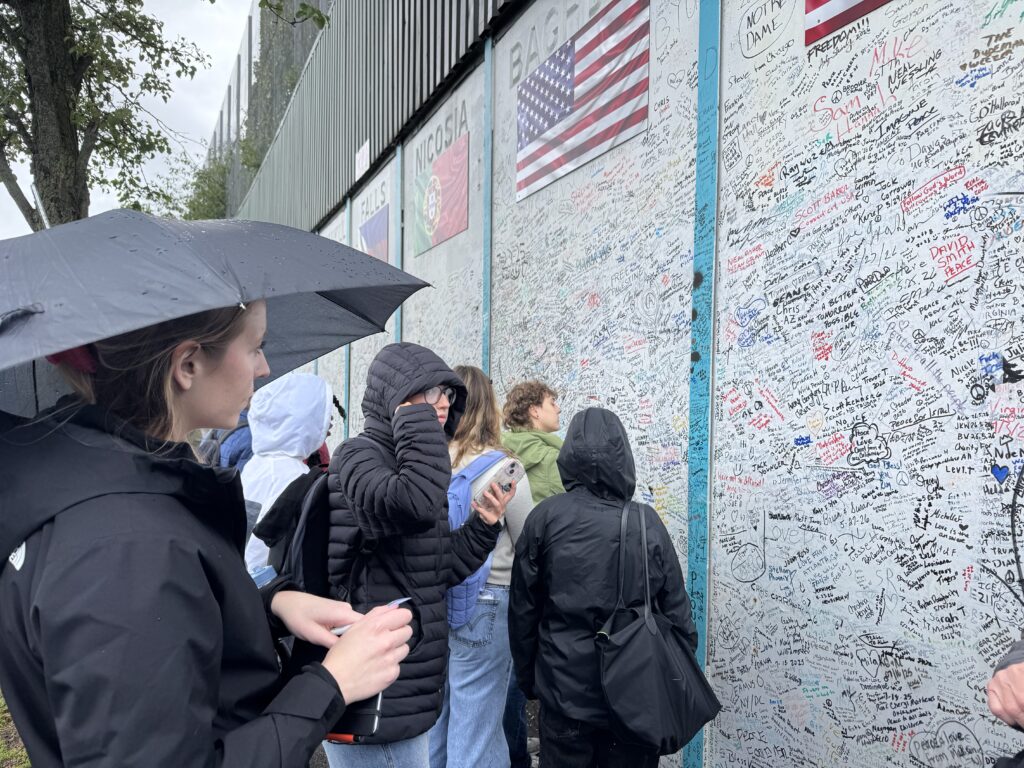
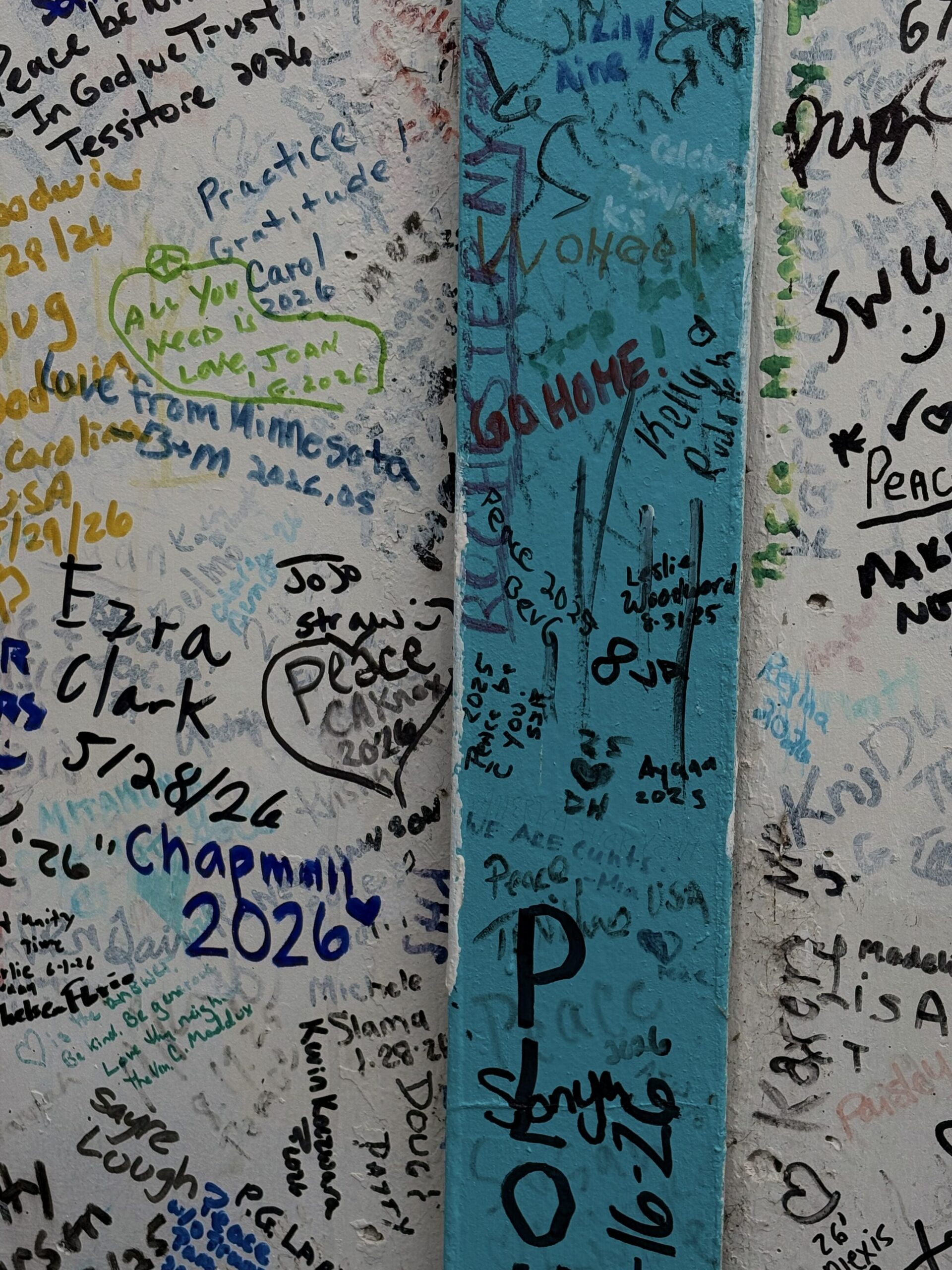
A photo of a peace wall in Belfast, with students signing their names
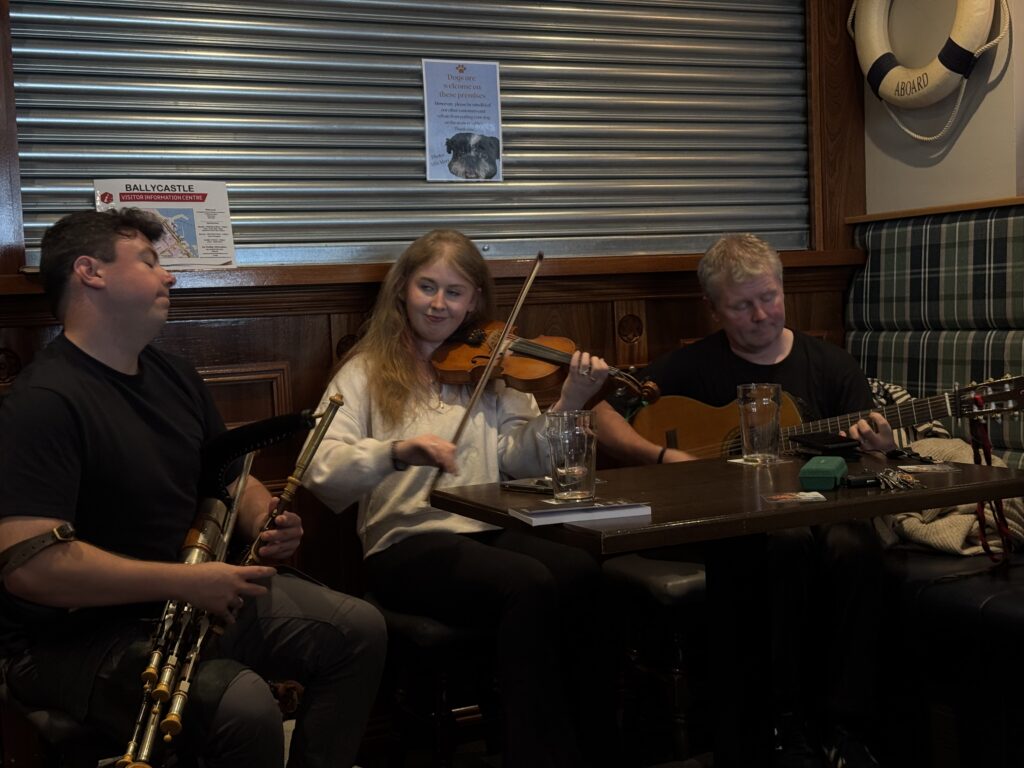
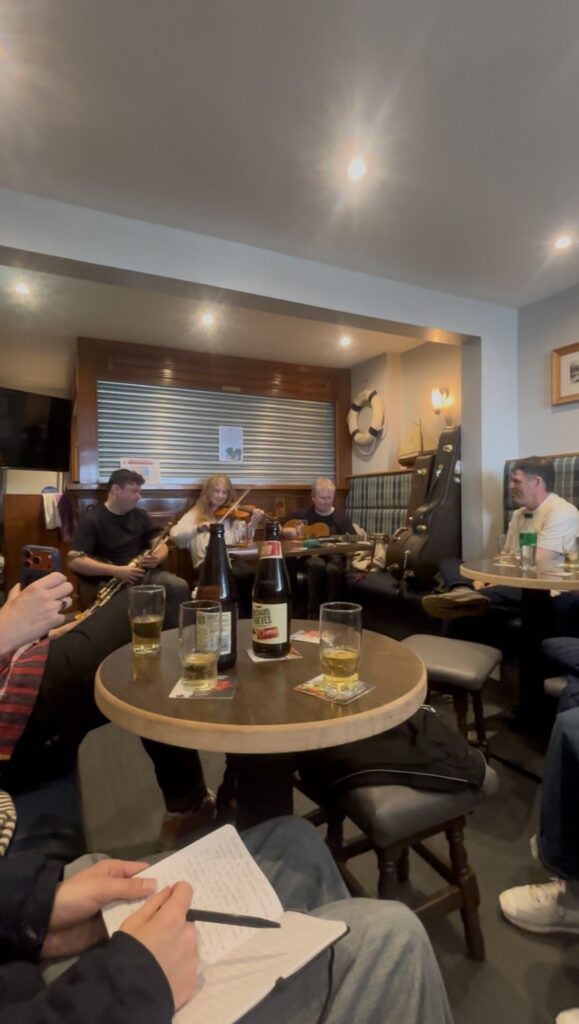
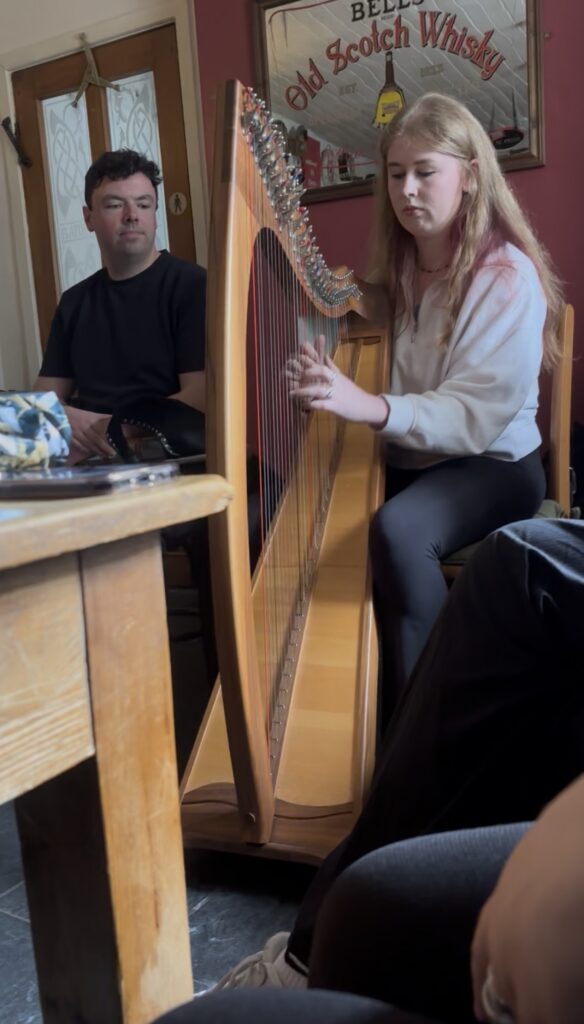
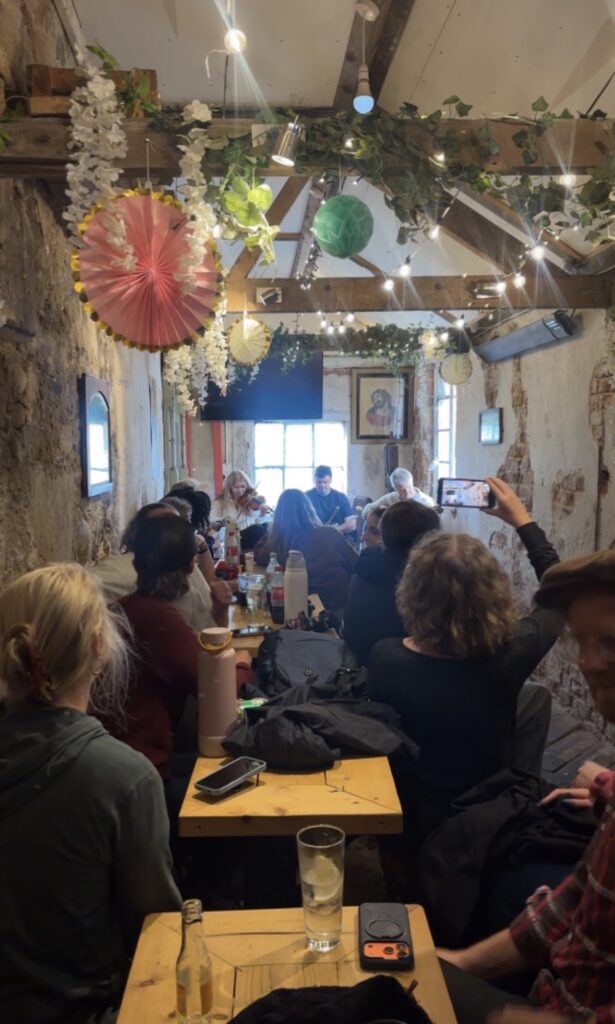
A photo of traditional Irish musicians
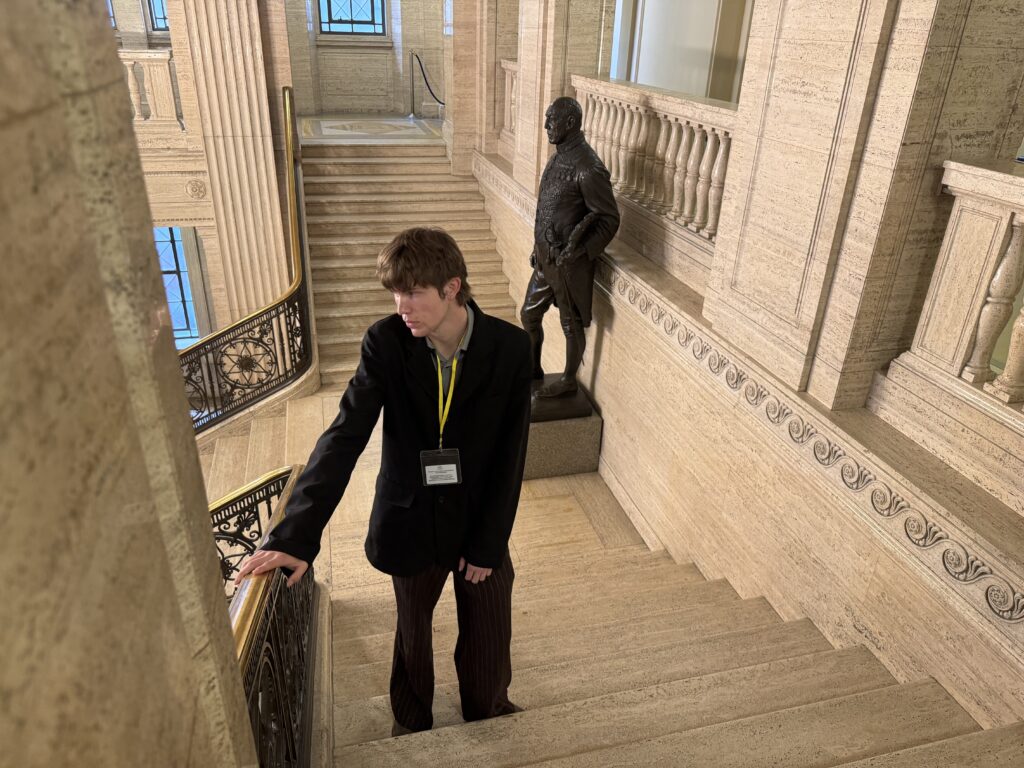
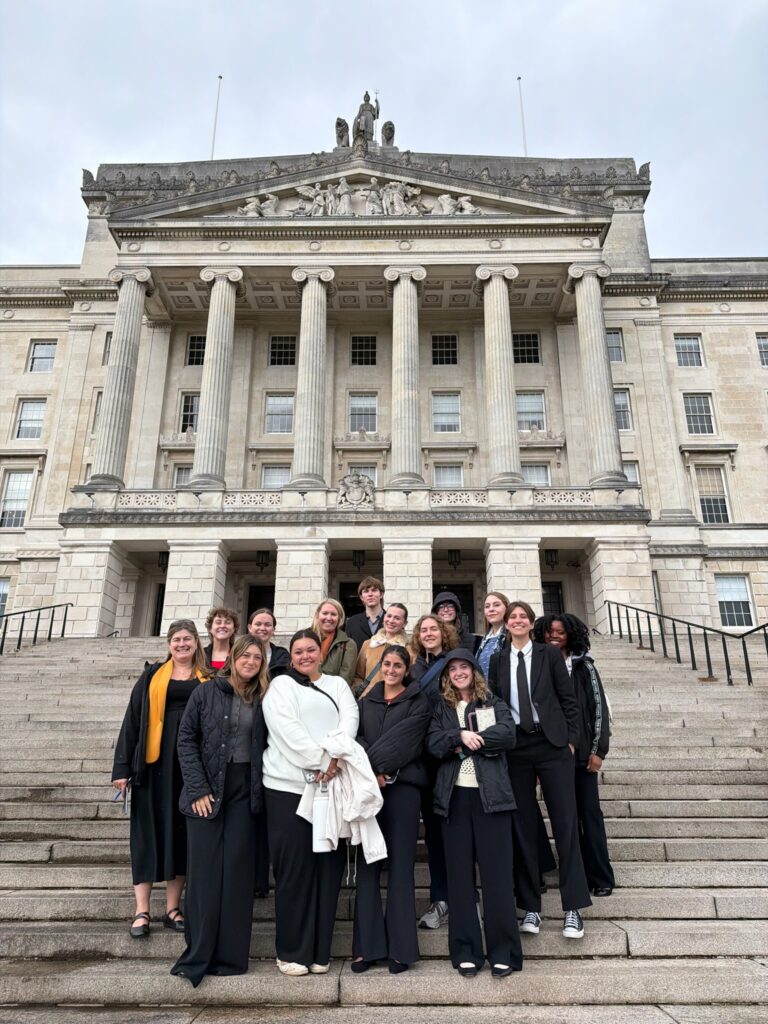
A photo of me at Stormont on the stairwell
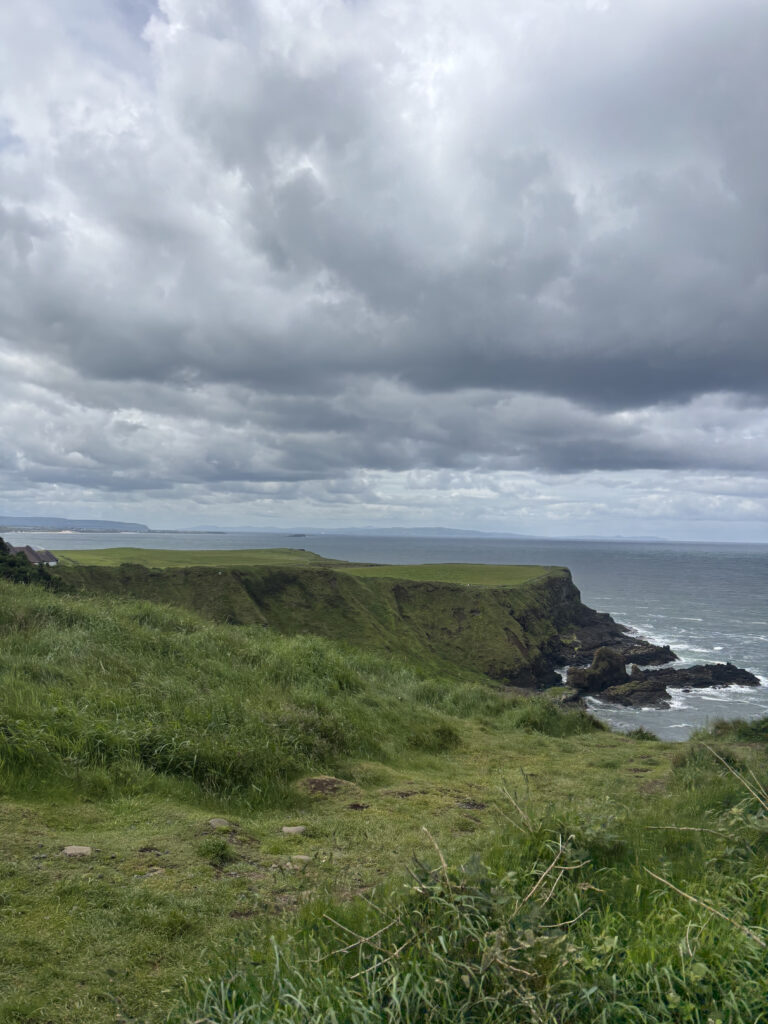
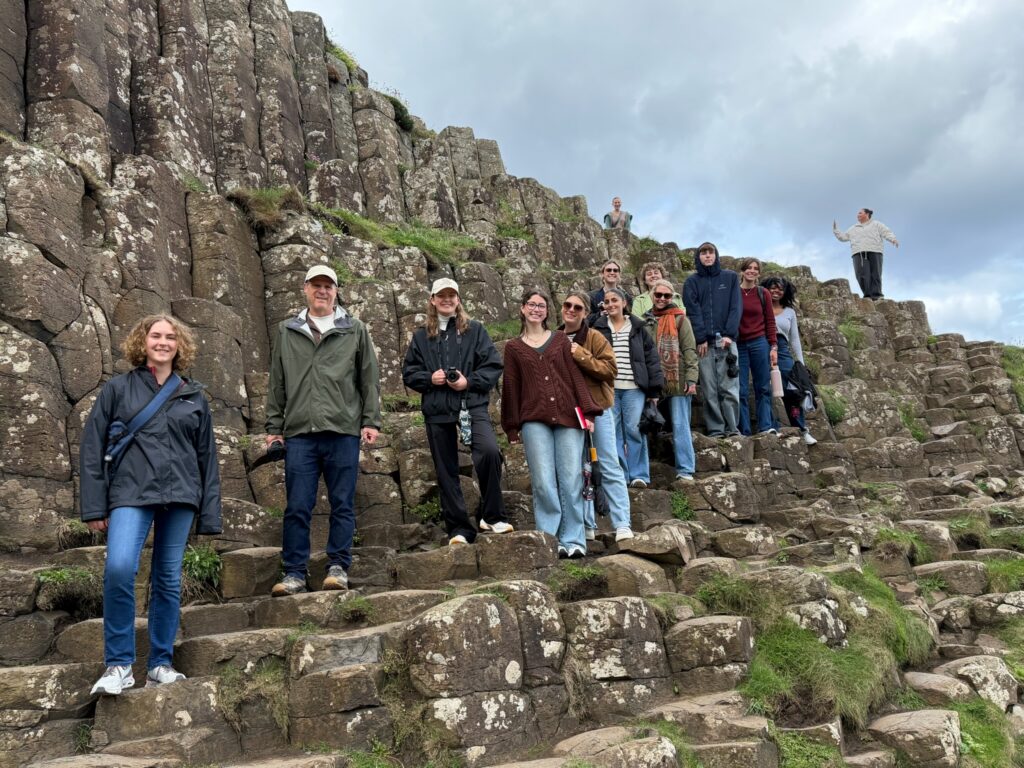
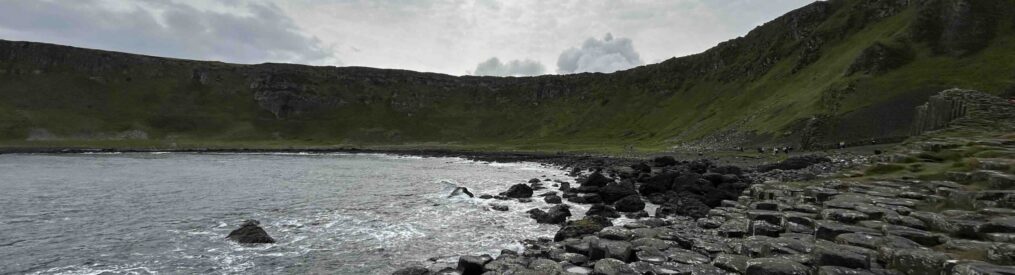
A photo of Giant’s Causeway
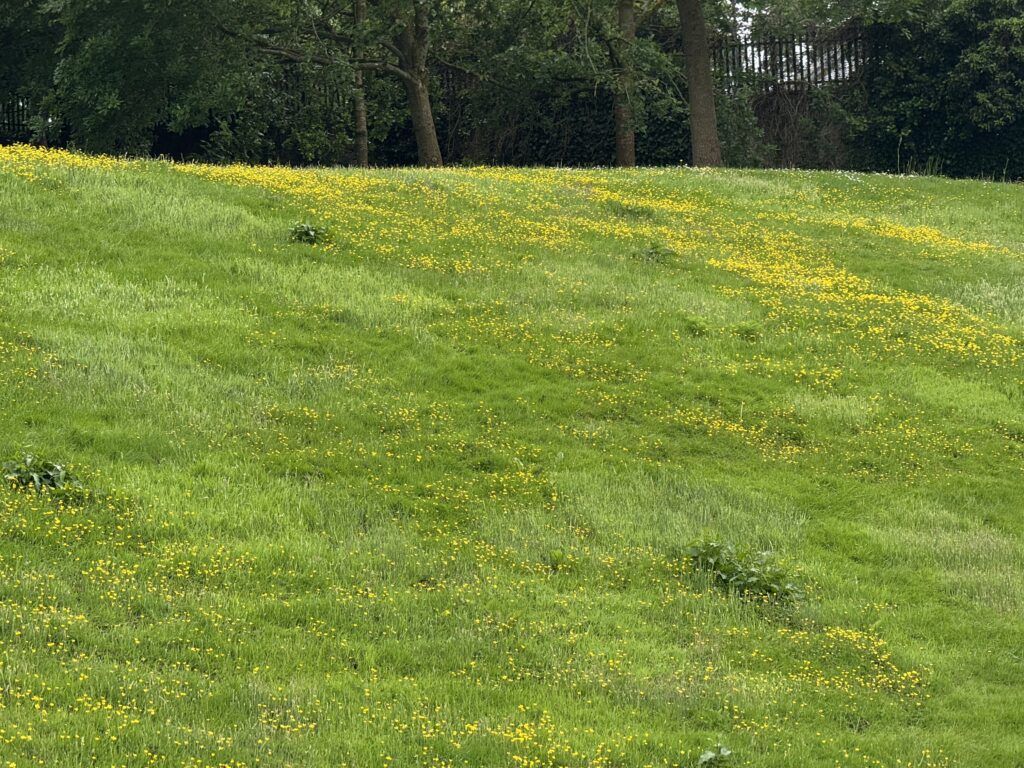
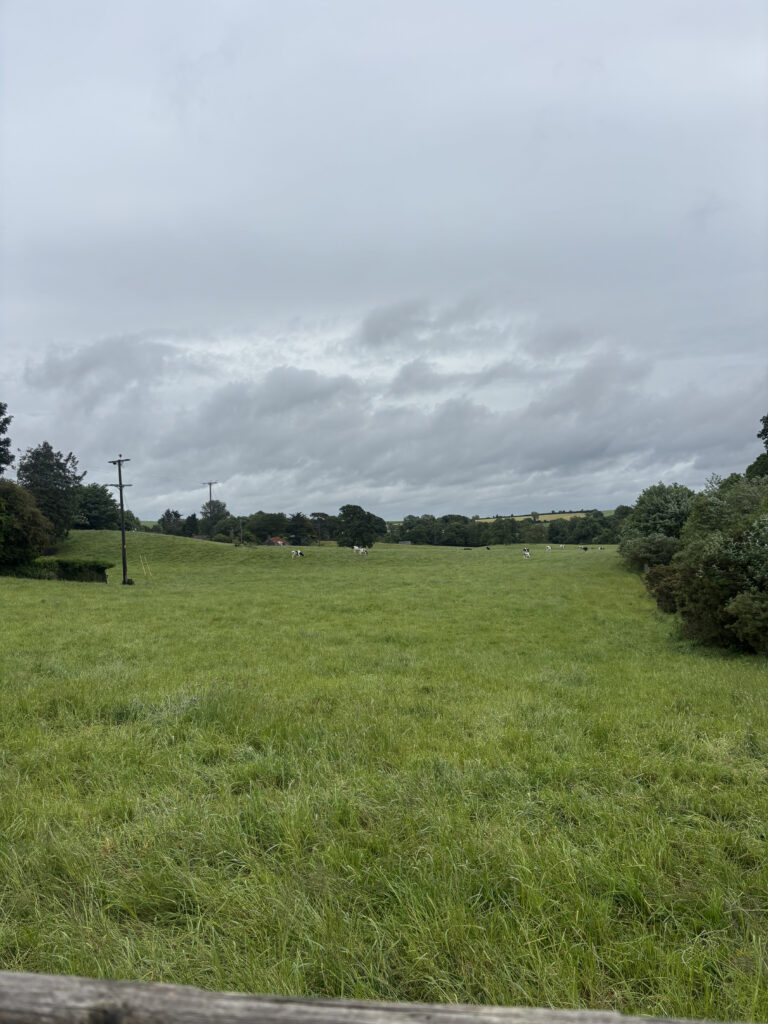
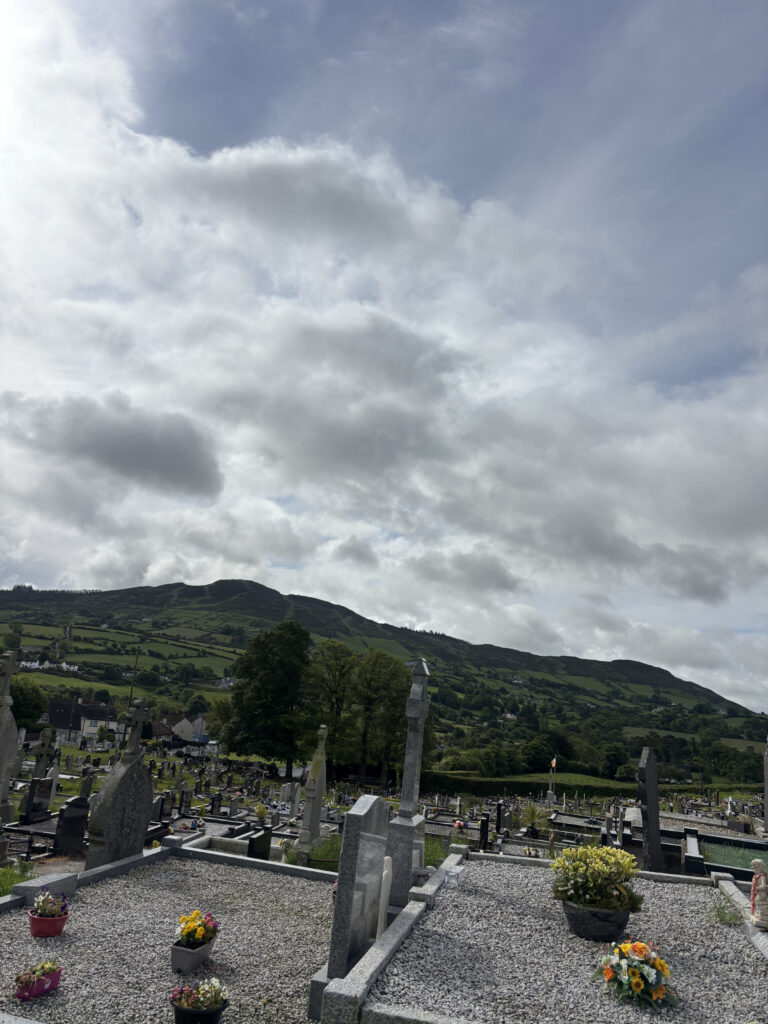
A photo of the hillside in Derry

Reflective Blog Post

Looking back on this trip to Northern Ireland, I can honestly say it changed the way I think about peace, conflict, and the role that communication plays in shaping society. Before coming on this trip, I mostly viewed peace as simply the absence of violence. After visiting Belfast, Derry, and the different organizations we met with, I realized that peace is much more complicated than that. A place can appear peaceful on the surface while still carrying the emotional, social, and political effects of conflict. Seeing this firsthand made many of the concepts we discussed in class feel real rather than just theoretical.

One of the biggest academic highlights for me was visiting the peace walls. I expected them to represent peace, but instead I found them confusing and even contradictory. The walls were originally built to reduce violence, yet they still physically separate communities decades after the Good Friday Agreement. Learning that many residents still want the walls to remain because they make them feel safer showed me how deeply fear can continue long after active conflict ends. That experience completely changed my understanding of peacebuilding. I realized that ending violence does not automatically eliminate mistrust or trauma.

Another experience that stood out to me was visiting integrated schools. I found myself thinking about the students more than anything else. Some students chose to attend these schools, while others were there because their parents wanted them to be. It made me wonder whether reconciliation is something people genuinely choose for themselves or something they gradually learn through their environment. Watching students from different backgrounds learn together gave me hope, but it also showed me that changing relationships between communities is a slow process that requires patience and consistent effort.

The visit to Corrymeela was another highlight because it demonstrated what intentional peacebuilding looks like. Unlike the peace walls, which separate communities, Corrymeela creates opportunities for dialogue and understanding. I appreciated that it was built as a neutral space where people from different backgrounds could come together with mutual respect. Before visiting, I assumed reconciliation happened mainly through political agreements, but Corrymeela showed me that lasting peace depends on everyday conversations, listening, and relationship-building between ordinary people.

The Free Derry Museum was probably the most emotional experience of the trip. Seeing photographs, videos, and personal stories made the history of the Troubles feel much more real than simply reading about it. It reminded me that historical events are not just dates in a textbook, they are experiences that continue to affect families and communities for generations. That visit helped me better understand the concept of intergenerational trauma and how memory continues to shape identity long after violence has ended.
As a Biology major, I initially questioned how a Peace Studies course would relate to my future career. By the end of the trip, I realized that medicine and healthcare are about much more than treating physical illness. Patients’ experiences are influenced by their families, communities, culture, and past trauma. Understanding those factors can make someone a more compassionate healthcare provider. Whether I eventually become a physician or pursue another healthcare profession, I know I will care for people whose lives have been shaped by experiences very different from my own. This course reminded me that listening carefully, respecting different perspectives, and understanding a person’s background are just as important as scientific knowledge.
One of my biggest personal challenges during the trip was processing everything we were learning while also reflecting on my own reactions. Many of the sites were emotionally heavy, especially hearing personal stories from people who had lived through the conflict. I found myself thinking about how easily division can become normalized within a society and how difficult rebuilding trust can be. At the same time, I was encouraged by the people and organizations dedicated to creating a more peaceful future. That balance between hope and sadness was something I did not expect before traveling.

Reading through my own daily reflections and those of my classmates, I noticed that many of us experienced similar moments of surprise, curiosity, and empathy, even though we often focused on different aspects of each visit. Seeing everyone interpret the same experiences differently reminded me that perspective plays a huge role in communication and conflict resolution. There is rarely only one way to understand a place or a story.

Overall, this trip challenged many of my assumptions and broadened both my academic and personal perspective. It reinforced that peace is not simply the absence of conflict but an ongoing process that requires communication, empathy, and intentional effort. It also reminded me that understanding people’s lived experiences is valuable regardless of the career path I pursue. This experience will stay with me long after this course because it changed how I think about conflict, healing, and the responsibility we all have to better understand one another.

Northern Ireland – Grace’s Highlights & Reflections

The biggest highlight of the trip, personally, was spending about a day and a half on the coast. I’m not a big fan of cities, so getting to spend some time out on the coast was really nice. Going from the beautiful Corrymeela to stunning Giant’s Causeway was so much fun, and learning about the myth behind the creation of Giant’s Causeway satisfied the mythology-lover part of me (https://www.nationaltrust.org.uk/visit/northern-ireland/giants-causeway). Speaking of Corrymeela, playing the zero-sum game with my classmates was an experience to say the least (https://www.corrymeela.org/). Beyond the fact that none of us are likely to forget the chaos that was playing that game, it made me realize just how close we’d all gotten in just four days. Some people knew each other coming into the trip and others, like me, didn’t really know anyone. But over the course of 12 days we came together and became a close-knit little group of friends. Another highlight was when Susana, Dr. LaBelle, and I were able to help rescue a pigeon that had been hit by a car. Unrelated to why we were in Northern Ireland, being able to contribute to the saving of a life, no matter how small, is incredibly rewarding. Academically, one of the highlights was when I was able to recognize a pattern of facework management amongst the people we were talking to. I learned about facework management in an intercultural communication class, and being able to recognize that what the former paramilitary members and police officers were doing was facework has made me more confident in my ability to apply the concepts I’m learning in classes to practical, real-life situations. Going on this trip also gave me the opportunity to learn more about Northern Ireland’s history, and the country’s major conflict, from people who lived through the conflict and whose lives and work are still influenced by it today. It was mentioned several times by my classmates that our history classes didn’t teach us about the conflict in Northern Ireland or really anything about the country’s history. Having this opportunity to learn about Northern Ireland’s history makes me more curious to learn about the histories of other countries; Northern Ireland’s conflict and process to peace has taught me much already, I’m sure there are many more lessons to be learned from countries around the world.

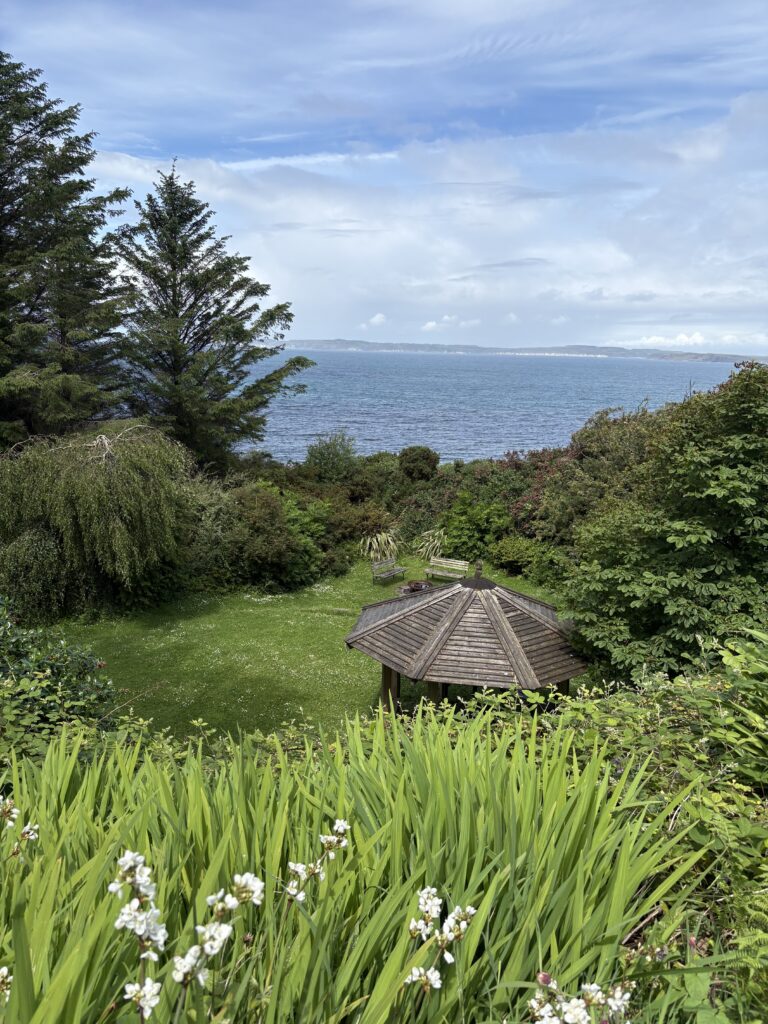
View from Corrymeela. Photo by Grace 6/4

And it’s more important now than ever that we look to individuals and communities across the world for the solutions to humanity’s ever growing problems. One of such problems is a rise in anti-immigration and racist sentiment that, if Northern Ireland’s recent protests are any indication, is leading to violence and growing global tensions. The evening of June 9th, our last week in Northern Ireland, was the start of anti-immigration rioting across Northern Ireland in response to a stabbing the prior day (https://www.cbsnews.com/news/belfast-immigration-protest-stabbing-attack/). While the days of rioting culminated in a peaceful anti-racism counterprotest on June 13th, several homes were burned, and many lives and businesses were disrupted by the riots. While the riots contributed to our group’s discussions of persisting division and violence in Northern Ireland, it is in the country’s response to these riots that I find evidence of the enduring impact of the past conflict on Northern Ireland today. The first night of rioting, our group observed businesses closing early and security at our hotel. By the next day, public transportation systems were being shut down for the evenings. Many in our group found these measures to be a bit over the top. After all, we’re relatively used to riots and protests in the United States, and shutting down entire cities because of rioting isn’t something we’re very familiar with. The point was also raised that by shutting down the country the government was playing into the rioters hands by adding to the fear that many were already feeling. I believe this response is an example of the nationwide trans-generational trauma born of the past conflict or the Troubles. Trans-generational trauma is when generations who didn’t directly experience the trauma still experience symptoms of traumatization (O’Neil et al., 2015). I think that, in the case of the race riots, the government and the public saw the riots through the combined lens of the direct and trans-generational trauma of Northern Ireland’s past conflict. Whether or not this is part of the reasoning behind the response to the riots, I believe it’s important to address the trans-generational trauma in Northern Ireland in order for the country to be able to move further into a peaceful and cooperative future. 

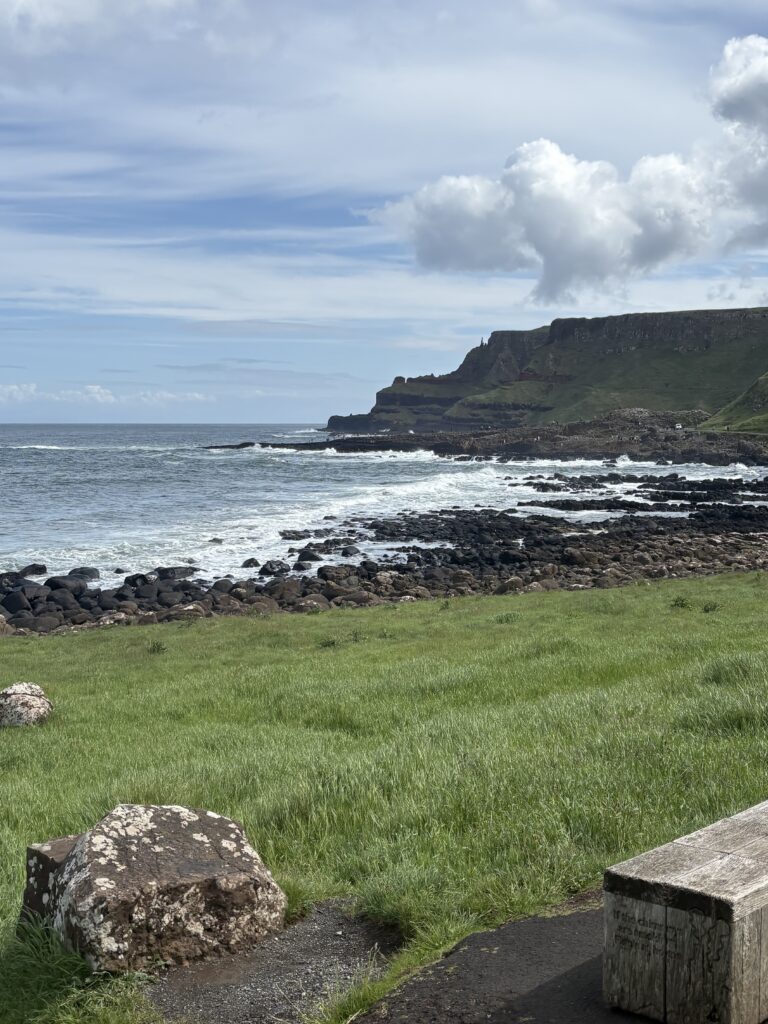
Giant’s Causeway. Photo by Grace 6/5

As a Global Communication & World Language (Spanish emphasis) and a Peace & Justice Studies double major, this trip reaffirmed my choices of majors as the best paths towards my future goals. Part of why I had chosen to go on this trip to Northern Ireland was because we were studying peace communication–a perfect combination of my double majors. And I’m so grateful I went, for so many reasons. One being that I learned how the cultural differences between communities in Northern Ireland led to conflict and division that still exists today. And, perhaps most importantly, I learned that the way those cultural differences have been and are being communicated play a role in the past, present, and future state of Northern Ireland. With an interest in going into international non-profit or diplomatic work, it’s important for me to understand that the way people communicate across different types of borders has an impact on the state of positive, peaceful progress. And, on a more practical level, this trip gave me the opportunity to speak with Bebhinn McKinley, a former good relations officer in Northern Ireland. Bebhinn advised me that, if I’m interested in going into the work that I am, I should pursue a certification in mediation. I’ve known that getting certified in mediation is possible through a Peace & Justice Studies class at Chapman, but I’ve never had strong feelings about getting it. That’s changed. This trip has shown me that the resources I have at my fingertips, from my majors to my classes to my professors, are exactly what I need to chase my goals.

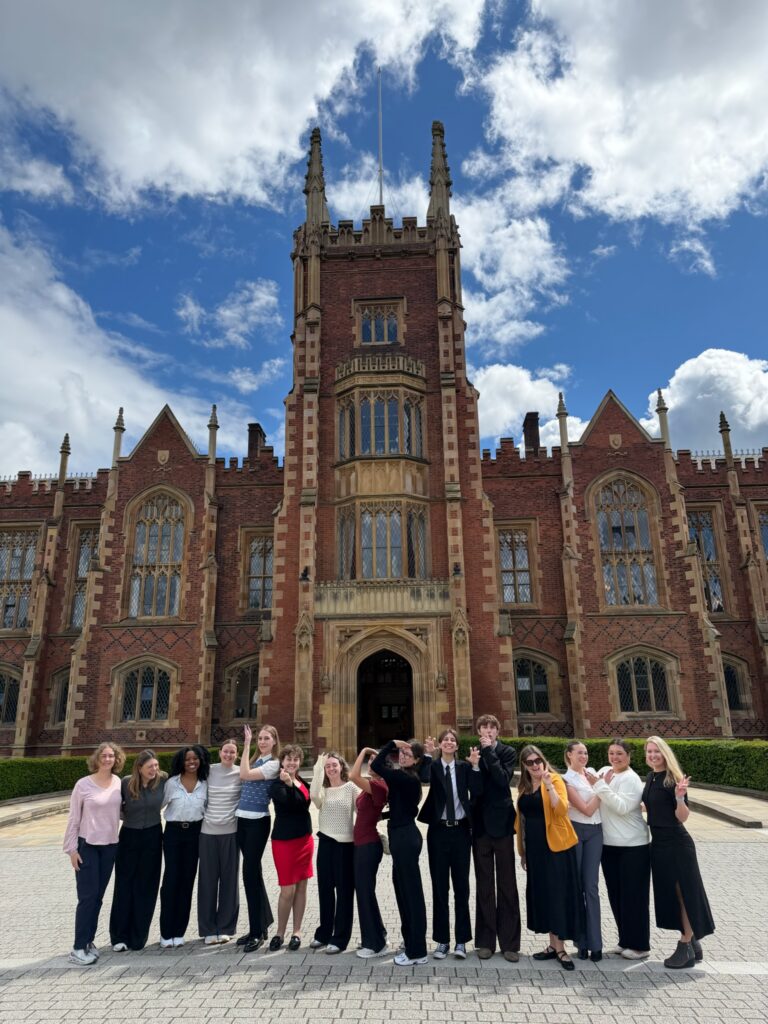
Our Class at Stormont. Photo by Daniel W. 6/10

And it’s not just the people and information I have access to that will help me in the future. The challenges I faced on this trip are their own form of resources for me to take and grow from. I think the biggest challenge I faced was staying motivated and organized. From the moment we arrived in Belfast on our first day, we were on the move and learning. While we had one break-day when we went to Giant’s Causeway and Ballycastle, our time in Belfast and Derry/Londonderry was constantly filled with walking around the cities and meeting with various different community members and leaders. We packed so much into just under two weeks, and while everyone we spoke to had important stories and information to impart upon us, it was mentally exhausting at times. Keeping track of the different perspectives and biases we came across made keeping the facts straight rather difficult. Powering through the mental overload was more tiring than I had thought it would be. Looking back on it, I think it was a positive experience for me. If in the future I’m in a similar situation, now I know that I can make it through the confusion and tiredness, and come out having had an amazing experience in the end. A challenge of equal difficulty was navigating how to travel–and internationally, no less–by myself for the first time. It was nerve-racking, and I’m not sure my anxiety calmed down until I was with the group at the hotel in Belfast, but I made it through without any hiccups, and I already felt more confident navigating the airport on my way back home. The challenges I faced on this trip have only made me stronger and more confident as I look to a future filled with possibility.

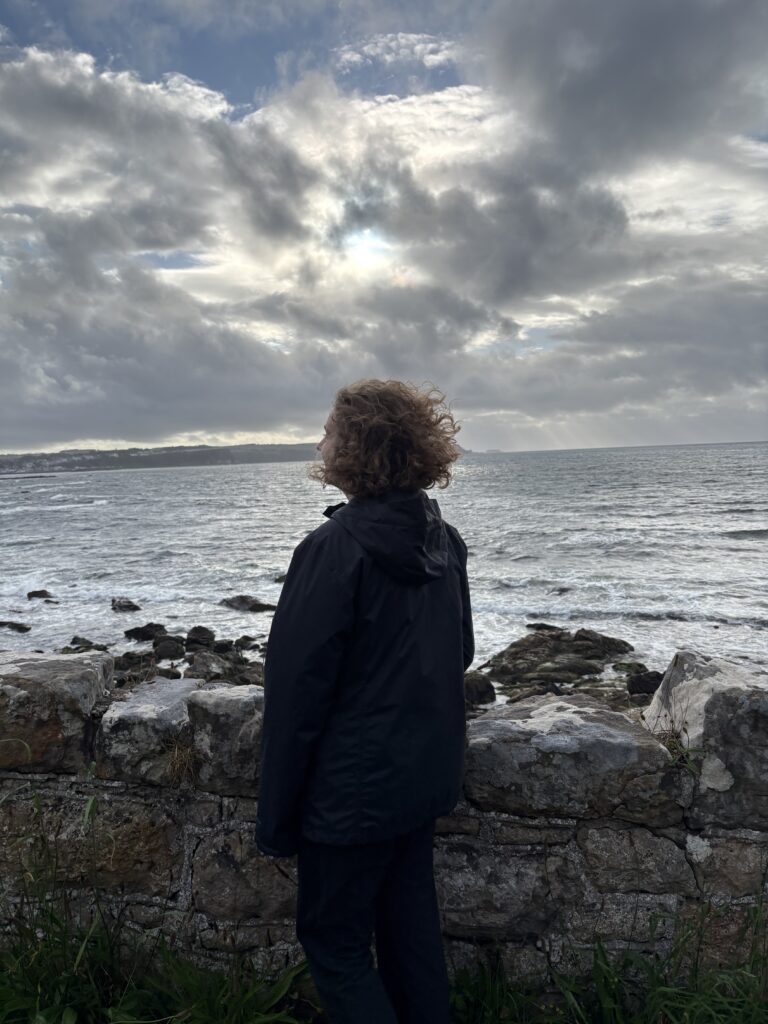
Grace on the coast. Photo by Uche N. 6/5

Reference

O’Neill, S., Armour, C., Bolton, D., Bunting, B., Corry, C., Devine, B., Ennis, E., Ferry, F., McKenna, Á., McLafferty, M., & Murphy, S. (2015). Towards a better future: The trans-generational impact of the Troubles on mental health. Belfast: Commission for Victims and Survivors. https://www.cvsni.org/wp-content/uploads/2022/11/2015-Research-Towards-A-Better-Future-The-Trans-generational-Impact-of-the-Troubles-on-Mental-Health.pdf

June 4th and 5th- Border Region, Giants Causeway, and Traditional Music Walk

Hello, My name is Faith Dunscombe and I did June 4th and 5th of our Ireland trip! On June 4th of our trip in Northern Ireland, we stopped on the Border Region getting to Derry/London Derry. When talking to a British Soldier about this area, in which he emphasized it as the “Gate Way to Hell.” This was because this area was heavily militarized to reduce paramilitary attacks or the smuggling in of arms. This was the only main road because most other roads were blocked off, causing everyone to have to go through this checkpoint. This area was used mainly up until 2007. 

                  Photo Taken by Faith Dunscombe (6/4)

The British Soldier, Lee Lavis, talked about how there would be a helicopter pad in that grass area, and most helicopters would be coming in and out of this area, stopping at this checkpoint. Behind this grass area was the building that housed all the British soldiers in it. Food, clothing, and beds were all at the military base, and how the British soldiers ensured safety was by having 2 helicopters to a patrol at a time, or people by foot as well. 

This area was mainly the IRA army against the Royal Ulster Constabulary according to the Lee Lavis. The British army helped the Royal Ulster Constabulary establish bases since they could not do it on their own. Which led to the British controlling the watchtowers, helicopter pads, and heavily fortified military bases. 

Relating this back to what we have been learning in our class, I would like to talk about the reading, Working Together in a Divided Society: A Study of Intergroup Communication in the Northern Ireland Workplace”, authored by researchers Owen Hargie, David Dickson, and Seanenne Nelson. This reading taught me many things about the inter communication between different sides, but also the deeply rooted, not talked about, rules that the people of Northern Ireland started taking on. In these heavily militarized areas, there was lots of fear, anxiety, and hyperawareness of what was going on. People in nearby areas were then starting to avoid a couple subjects when conversing with people they are not familiar with. They avoided talking about politics, religion, their historical background, or what schools their family or children are attending. All these subjects would be dead give aways for what side of the conflict they were on, and it could have led to more violence and anxiety, so people avoided the conversation overall. Instead of asking these questions, there were plenty of other ways one could go about finding which side someone was on. Pronunciation, for example, was a big give away, in which if you were on the Catholic side, you usually pronounced your H’s like “Haitch,” but if you were on the Protestants side, it was usually pronounced “Aitch.” (Hargie et al., 2003)

This is just one example of the many things people looked out for in Northern Ireland during their jobs, which had people from both sides within it.  These people would work their 9-5 jobs, working together, then go home to their segregated lives. Their jobs were like a neutral zone, that should have acted to bridge the way to more integration and acceptance of differences, but it just led to more silence, and ways around being segregated. 

For more information on the Border region: https://www.bbc.com/news/articles/crrkzkrqed2o

Photo Taken by Faith Dunscombe (6/4)

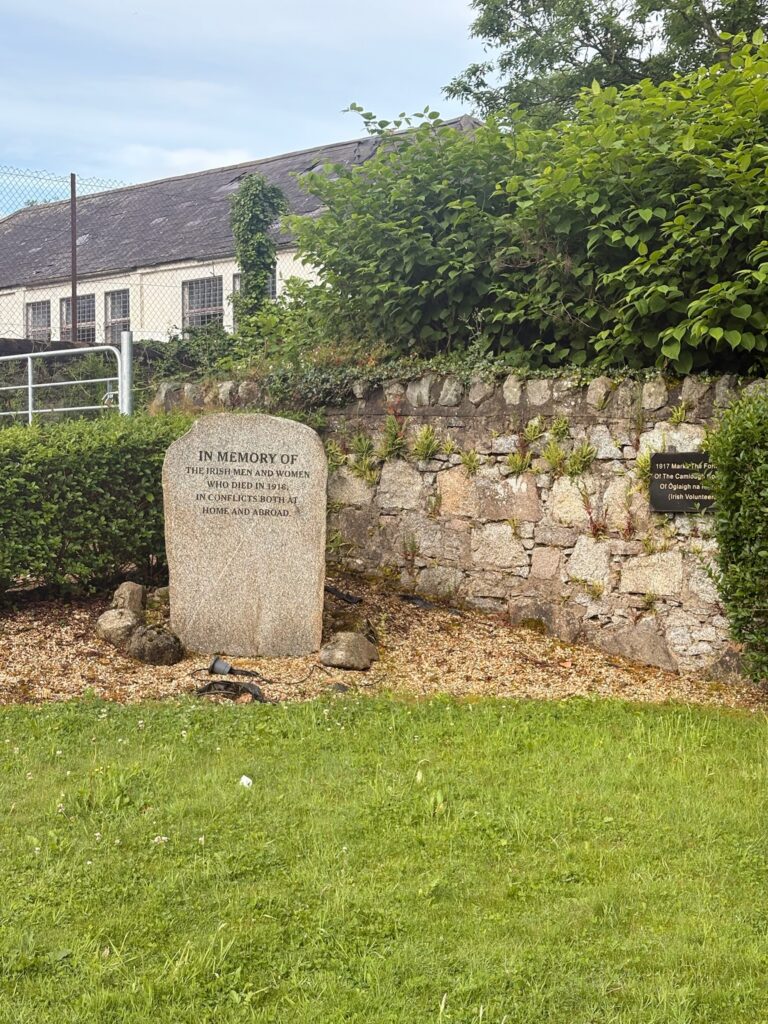
After we were done talking about the deep history within the border region, Declan Murphy, a politician, then took us to the Wee Garden. This Garden was made in 2016, and it commemorates all the people who fought, or were lost during the conflict. Declan Murphy talks about how a lot of people just wanted to forget about the war, but there was so many good people lost during it, so it was important that they had a landmark to look back on and remember the people who could not be there with them today.

Photo Taken by Faith Dunscombe (6/4)

Next, we were then taken to the cemetery. In this cemetery, Declan and Lee talked about the many more lives lost during this hard time. They talked about how the British army were under so much pressure, and they thought that if they could criminalize the people, it would lessen the war, which did not work. It led to hunger strikes, which Declan talked about one of his colleagues Raymond McCreesh, who he went to school with. Declan and Raymond were both criminalized by the British, but Raymond ultimately died due to the hunger strikes. It just goes to show how personal this war was getting, and how so many people lost good friends and family members during this conflict. Declan was only released after the Good Friday Agreement was curated, and has been out since, being able to tell us his story. 

The Parasocial Contact Hypothesis, which states that if there is personal contact between two different groups, prejudice can be reduced (Schiappa et al., 2005). This Theory is not very prevalent within these times that Declan and Lee are illustrating. There is so much war, and segregating, making this theory very hard to take place. 

June 5th, Giants Causeway 

Photo taken by Faith Dunscombe (6/5)

Photo taken by Daniel Wehrenfennig (6/5)

During our travels to Derry/London Derry, we stopped at Giants Causeway. This place was so beautiful and filled with greenery and water on the horizon. It allowed for us, the students, to get a break from the constant everyday learning, but also still do something fun and filled with tourist pictures! 

Daniel Wehrenfennig, one of our Professors and CIEL guides told us a story first before we took our excursion to the rocks. This story is said that Finn McCool, a giant, built pathway to Scotland, but found out that there was another way bigger giant on the other island (Scotland.) Finn’s Wife thinks quickly, and dresses up Finn as a baby. When the other giant comes over to Ireland, he sees Finn and thinks if this baby is already this big, then the father must be much bigger than him, so the giant flees back to Scotland. Now, there is just these steppingstones left over from his pathway to Scotland, known today as Giants Causeway. 

To learn more about this; https://citytoursbelfast.com/giants-causeway-story

To finish up our more relaxing days, we learned all about traditional music and dancing. 

Photo Taken by Faith Dunscombe (6/5)

Photo Taken by Faith Dunscombe (6/5)

The three lovely musicians taught us about the organization called the Comhaltas Ceoltóirí Éireann. This organization is used to preserve traditional Irish music and commemorate how much music has brought together people during many hard times, especially during the conflict. The most common places you will find traditional music (or more well known as trad) is in a bar. Traditional music is played most every day to carry out its traditions and allow the future generations to also learn about it and enjoy its rhythm. Traditional musicians tend to be super close together since a bar is packed full of people, and just to feel the music and dance it out. 

The musicians played a couple of pieces for us in the first two bars, in which they were super high beat, and fun to listen to. One thing they told us to do is when you get super into the music, you can say “hip” which is a traditional thing to do when listening or playing Irish music. While it is something fun to do, it could also be a way that the musicians are going to change key, and the word “hip” signifies that they are going to change key soon, so the others should be more cautious to ensure they are staying within rhythm and key. 

In the second bar, the harp and Ellen pipes were played briefly. Both were so unique, and the musicians played them very beautifully. The harp was very elegant, while the Ellen pipes had such a unique sound to them, I had never heard in person before. 

For more information: https://comhaltas.ie

In the Last bar, we learned about traditional dancing. 

Photo Taken by Faith Dunscombe (6/5)

Traditional Dancing has more than one category to it, in which most people outside of Ireland think it is the stiff arms and leg dancing that is traditional. While this is one of the categories to dancing, there is another one called Set dancing, which we learned and tried. It consisted of lots of hopping, cuffing, and turning around. This dancing could be carried out alone, or with a dance partner. We learned with a dance partner, which made it fun with a lot of mistakes on the learning curve. 

These two days first focused on the segregated societies that took place during the troubles, then how they used music and dancing to be able to bring people together and live out happy lives.  Stereotyping is extremely prevalent and ingrained into the people of Irelands brains due to so many years of war. In one of the readings defining stereotyping, it entails more. “…defined stereotypes as ‘pictures in our heads’ when we think about a particular social group.” (Shibboleth Authentication Request, 2026) We put these initial thoughts of how people are in our heads, but like the Northern Ireland people, they are all the same. They go to a 9-5 job and can keep conversations non-controversial by avoiding certain subjects. These people are much more similar than they realize, and it was hard for them to overcome it when they had these deeply rooted political beliefs. 

Traditional Music and Dancing is one of the ways they can bring people together and just be one group enjoying each other. This can cause the Parasocial Contact Hypothesis to really become integrated within the people of Ireland and help them realize their differences are not as big as they seem. Us being hand in hand while learning Set dancing is the perfect example for how to break those walls down and learn about something that they both have heritage within. 

References: 

Comhaltas Globally Promotes Traditional Irish Music Dance Culture for Students, Educators, Visitors, Musicians & Journalists. (n.d.). Comhaltas.ie. https://comhaltas.ie

Hargie, O., Dickson, D., & Nelson, S. (2003). Working Together in a Divided Society. Journal of Business and Technical Communication17(3), 285–318. https://doi.org/10.1177/1050651903017003002

Schiappa, E., Gregg, P. B., & Hewes, D. E. (2005). The Parasocial Contact Hypothesis. Communication Monographs72(1), 92–115. https://doi.org/10.1080/0363775052000342544

Shibboleth Authentication Request. (2026). Oclc.org. https://research-ebsco-coJunem.chapman.idm.oclc.org/c/wnnu3f/ebook-viewer/epub/bx556y7xx5/section/nav34?route=details

‌Simpson, M. (2025, December 3). Irish border: A century since it was confirmed – what happened?https://www.bbc.com/news/articles/crrkzkrqed2o

Story, G. C. (n.d.). The Giant’s Causeway Story | Myths & Legends. City Tours Belfast. https://citytoursbelfast.com/giants-causeway-story

June 10th and 11th: Stormont and Final Discussion

June 10th – Stormont Visit

Hi! My name is Sam Rokoszewski and I am a 4th year Health communications major. I am covering Day 10 of our trip, this was the day we travelled to Stormont, as well as our final meeting on Day 11 with Bebhinn McKinley. Unfortunately, all of the politicians were in assembly meetings this day as there were anti-immigration protests the night prior and they had to find a way to combat them the following day.

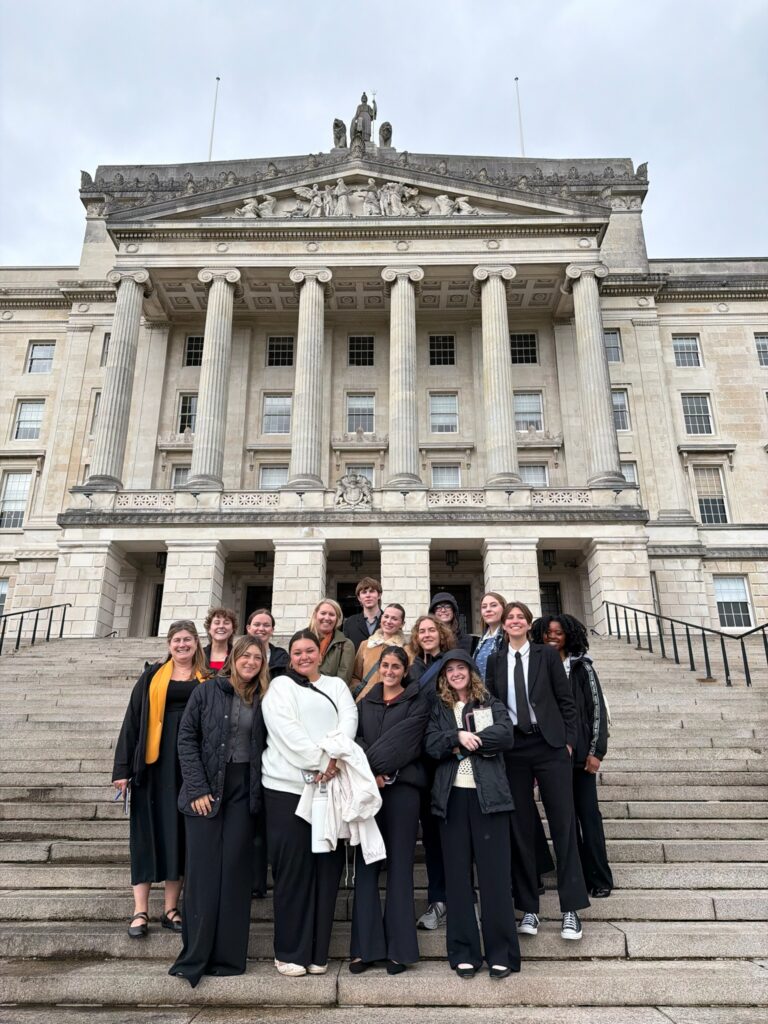
Stormont is an old estate that was taken over by Parliament in 1932 located in Belfast the capital of Northern Ireland. The Parliament of Northern Ireland inhabited many other spaces in Belfast before deciding to take this estate. They paid 20,000 pounds for the grounds at the time. The Prince of Wales was the individual who came to properly open Stormont as a Parliament building which is why the road leading to the estate is named Prince of Wales Avenue. 

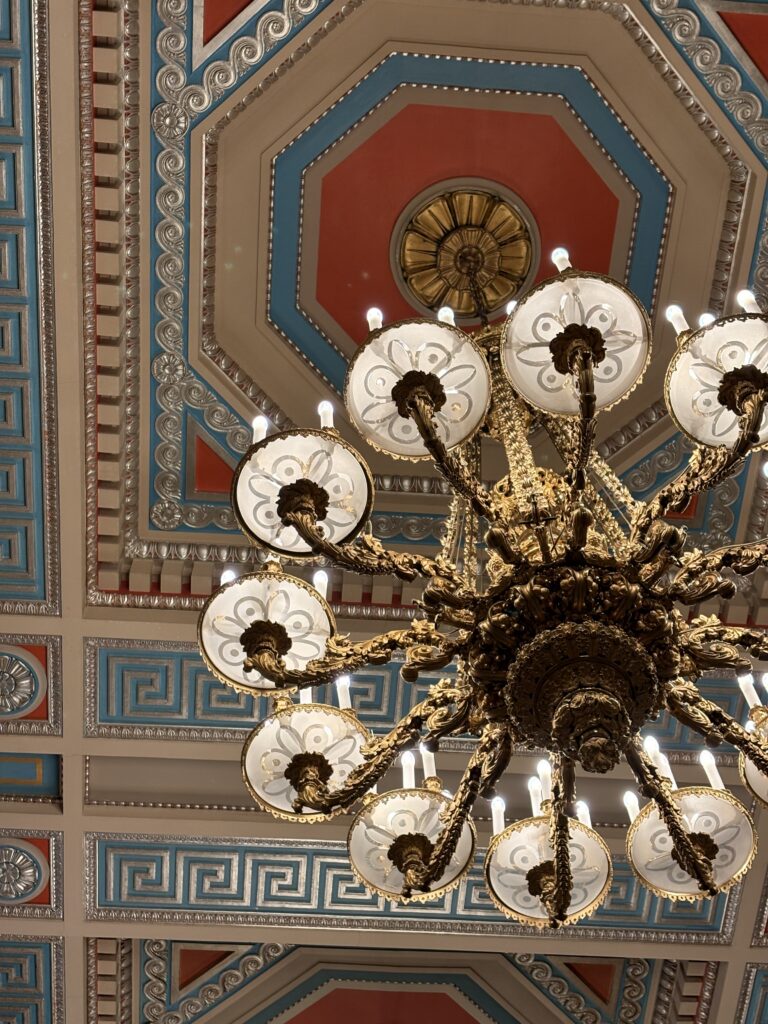
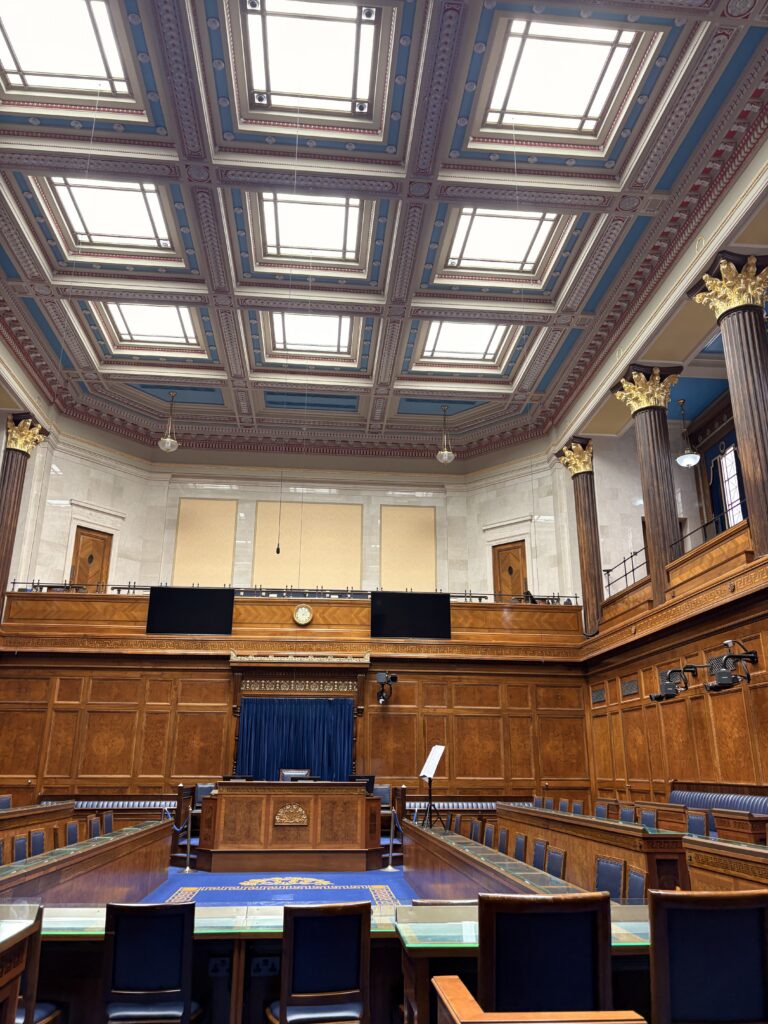
The building has fire proof and dust proof paint as you see in the picture below. There are 4 chandeliers made of 24 karat gold hanging from the ceiling as well in the grand hall. There is also a greek key design to the paint on the ceiling and it is an “unbroken, interlocking pattern made it a symbol of both unity and infinity.” (Calder). This is perfect for the Parliament building as it continues to emphasize the need for unity within the building. Within the Grand Hall there are paintings of former first ministers, deputy ministers and speakers all of which are accompanied by a plaque letting you know who they are and what they have done. 

This is a photo of the ceiling in the Grand Hall. Photo taken by Sam Rokoszewski.

There are six stories to the building, the second floor is dedicated to the senate chamber and the first floor is for the assembly and house of commons. 

Within the senate chamber there is a table in the center of the room with governing oppositions on opposite sides of the table. There are 27 senators that sit within this chamber of parliament. From 1932 to 1972 the senate was shut down due to the conflict that was occurring within Northern Ireland. After the conflict there were committees created to address specific issues that need to be addressed within their parliament. Some being education and healthcare. 

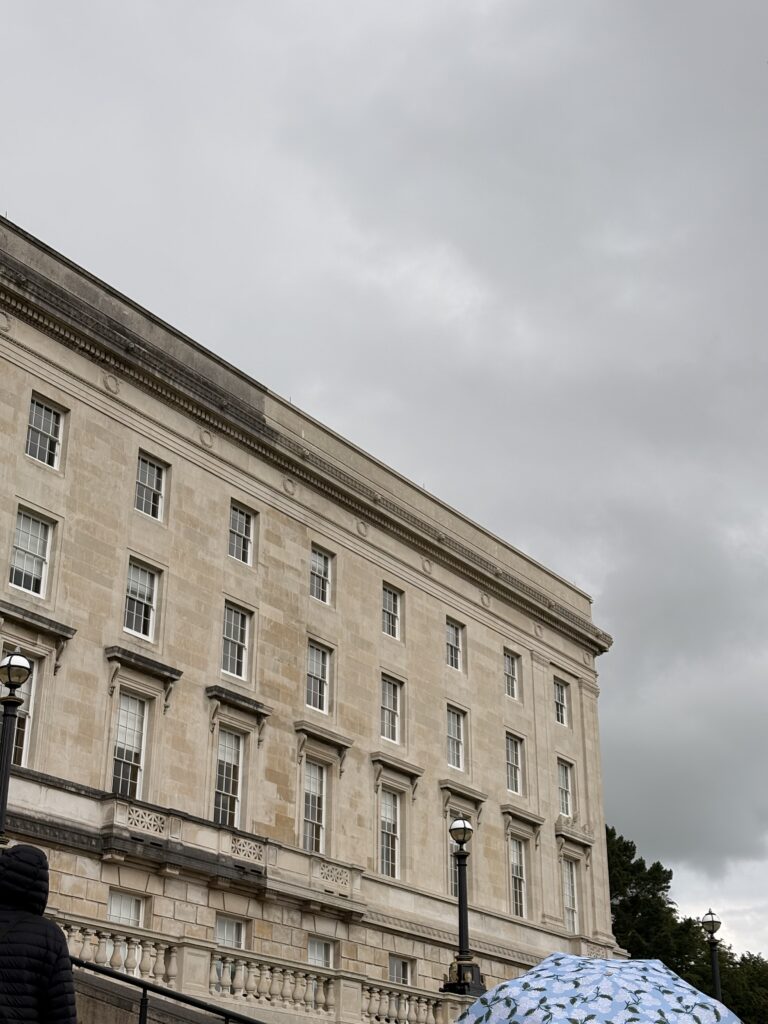
An interesting little fact about Stormont we were told by our tour guide, Katie, was that during WW2 the Royal Air Force inhabited the senate chamber. Due to their presence in Stormont it made the building a prime target during the war. They decided that they needed to camouflage the bright white building on the top of a hill and did so by adding foliage to the roof and smearing cow manure and tar to the sides of the  building as a sort of black “paint”. To this day they are still trying to remove the tar and manure from the sides of the building as it stained the white building. In the image you can see the line on the building where they have removed the stain and where it still remains.

This is a photo of the outside of Stormont where the power washing is still occurring in the efforts to remove the staining from the tar on the building in WW2. You can see the line where they stopped for the day in this photo. Photo taken by Sam Rokoszewski.

We then talked about the Assembly chamber and were able to go into the chamber as it was not being used for meetings at the time. There are designated times for the assembly meetings and the public are able to come and listen in to the conversations. On Mondays the MLA’s, Members of Legislative Assembly, meet and talk at 12 and on Tuesdays they meet at 10 AM. These meetings can last as long as they want, there have been meetings in which they talked for over 10 hours. 

When the room was first built it was in an adversarial layout, just like the senate chamber. However, in 1995 during Christmas break there was a fire that broke out in the Assembly chamber. It burned everything as the entire room was wooden. They had to rebuild and it cost 24 million pounds to do so. 

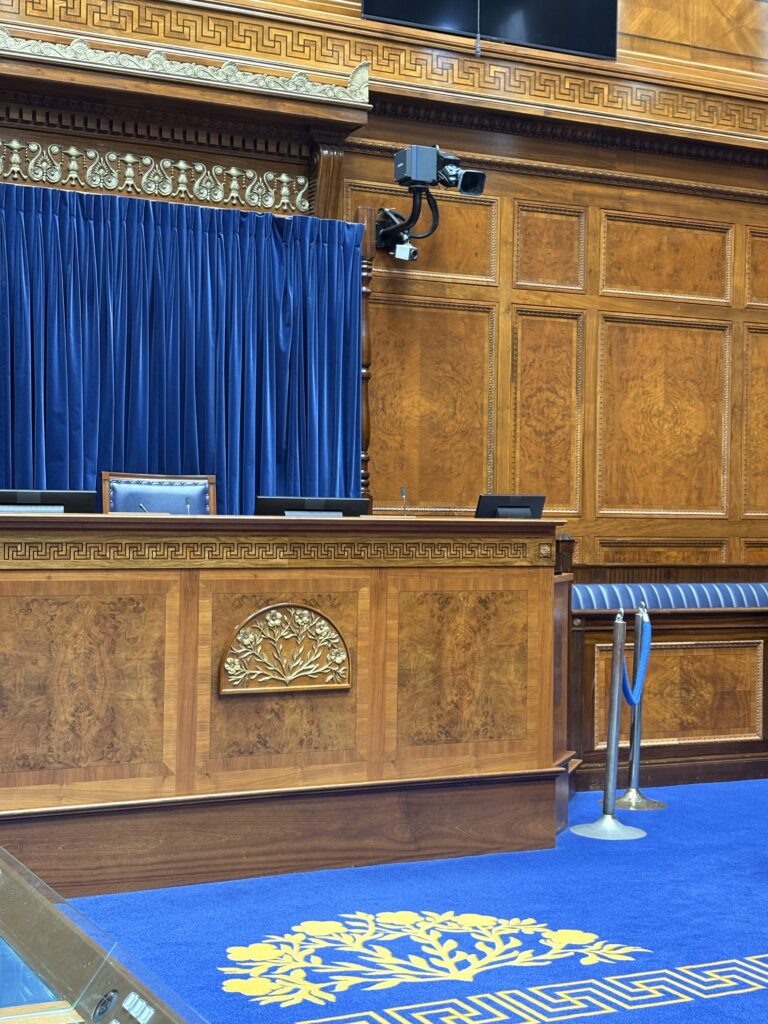
That said, they were able to redesign the entire room. They changed the layout to a European U style allowing all individuals to sit at one continuous table. This was done to show that they were all sitting at the same table working towards a common goal together. They added cameras into the room as well so that civilians could watch the live stream of the meetings if they wished to do so. Currently, Sinn Fein sits on the left side of the table and the DUP sits on the right. Sinn Fein is currently the largest party as the first minister is from this party and the DUP is the second largest as the deputy minister is from that party. The alliance party sits in the middle of the U as they are a party that does not identify with nationalist or unionist beliefs. There are also smaller parties that sit next to Sinn Fein and the DUP. Some seats are known as “naughty seats”, where those who are part of a one person party reside.

This is the Assembly room from the doorway you walk into the room through. Photo by Sam Rokoszewski.

Throughout the entire Stormont building there is everything in sixes, “representing the number of counties in Northern Ireland, Parliament Buildings has six floors and there are six pillars at the entrance to the building.” (Parliament Buildings Facts) Another one being an emblem, a bouquet of 6 flowers. The 6 flowers represent the 6 counties that are within Northern Ireland. I thought it was beautifully put as it shows a connection within a country that is so divided and currently working towards unity and peace. They used flowers to pay tribute to their history with the linen mills. It is also a way of showing that it is a process when governing a nation. The idea that when a flower blooms it also grows. It is a process and it is a way of wishing for a brighter future for the nation. 

This shows the flower emblem on the carpet as well as the podium. There is also a camera mounted to the wall that is used for live streaming the Assembly meetings. Photo by Sam Rokoszewski.

Something unique about Northern Ireland is that if one party does not want to sit in Assembly then no one can sit. This seems to reinforce the black and white mindset that was ingrained in individuals minds during the conflict. The Us versus Them mindset. The Northern Ireland Government is the longest one to not sit, and when they are not sat then the English parliament has direct rule and say as to what happens in Northern Ireland. The Irish President does not come to Stormont and neither does the King of the United Kingdom as it shows a favoring of one party over another and the entire goal of Stormont is to have cross community working and a balanced and equal environment to do so. 

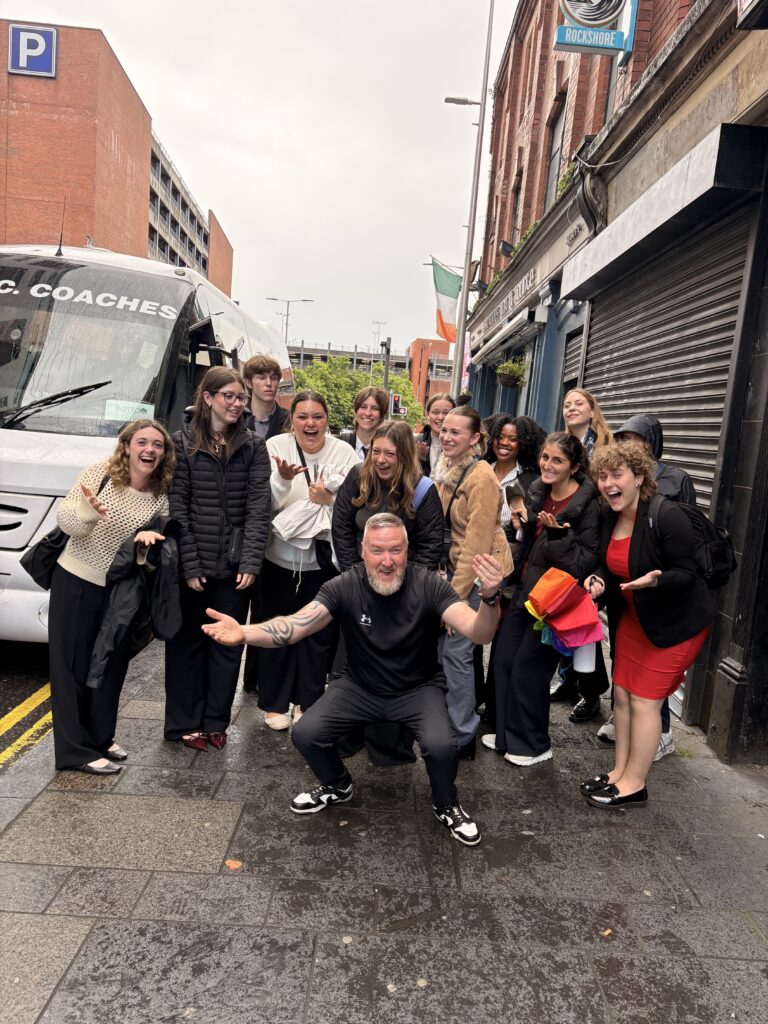
I think is important to note the way in which citizens feel about the power that Stormont holds. Many civilians do not think anything productive occurs in the building. When we were approaching the building our bus driver welcomed us to the place on the hill where absolutely nothing goes on. He told us that he “never has voted, never wants to, and never will vote” (Buz the bus driver). 

This is a photo of our class and Buz the bus driver. Photo taken by Dr. Sara LaBelle.

A communication concept that I feel connects to Stormont is how nonverbal communication through the design of the space is impacted, this is also known as proxemics. The arrangement of the environment can communicate ideas and values as well as shape the interactions individuals have with one another. Proxemics is defined as “the study of how people perceive and organize the spaces and distances they maintain between each other in culturally specific situations” (Danesi). Edward Hall researched proxemics in 1959 and created 8 factors that play important roles into what proxemics is. They are postural sex identifiers, sociofugal/sociopetal orientation factors, kinesthetic factors, touching factors, visual factors, thermal factors, olfaction factors and vocal factors. The factors that are present within Stormont are the sociofugal/sociopetal orientation (the layout of the rooms), visual factors (eye contact), and even vocal factors (showing dominance by raising their voice). (Danesi). This was very evident in the Assembly chamber as the room was originally designed with an Adversarial layout with the different parties sitting across from one another around a table. This created a physical and mental division as well as cultivating the us versus them mindset and is greatly reflected in the conflict of Northern Ireland. After the fire in 1995 the room was redesigned and had all parties sitting at one continuous table. This environmental change also changed the mentality of Assembly members and communicated the commitment they made to collaboration and shared problem solving. The emblem of Stormont shown throughout the building also is a form of symbolic communication. The representation of the 6 counties within Northern Ireland as well as showing the desire for unity and growth within the nation. These both demonstrate how important it is to have an environment in which symbols communicate powerful messages surrounding identity and continuing to strive for peace. 

Here is our entire class at the front of Stormont. Photo taken by Daniel Wehrenfennig.

June 11th – Final Discussion

I also covered the final conversation of our trip with Bebhinn McKinley and Daniel Wehrenfennig. Bebhinn was once a good relations officer in Ireland and was born in Dundalk which is the city directly south of the border. She shared how the conflict within Northern Ireland directly affected her family. She grew up in a small community where violence was normalized and personal. She knew many individuals who passed due to the violence including her own uncle. Her uncle was a member of the IRA and was shot in bed with his wife right beside him. Both of Bebhinn’s parents are from Northern Ireland, her dad was an ex-prisoner and committed another violent act and was quickly on the run. He became internally displaced due to the conflict and became wanted by the RUC. Stories like this one reminds us that the conflict was not just a political event but it was experiences that shaped and changed everyday lives of ordinary people. 

One theme that continued to be present throughout the entire trip was how impactful trauma is. Even with the Good Friday agreement being signed around thirty years ago, individuals are still carrying emotional damage from the conflict. Bebhinn talked about how communities are still struggling with how to handle memory, grief and the questions of justice. There are debates surrounding legacy issues, including proposals of a blanket amnesty. These show how there is still disagreement about how we should be addressing and remembering the past. 

At the same time we learned about all of the ways the country is trying to move forward. There are community dialogue programs, women’s leadership initiatives, and cross community projects all creating opportunities for healing and forward thinking. She emphasized how important it is to have conversations, active listening and relationship building between the different communities that were beyond divided at one point in time. Breaking down the miscommunication and misconceptions is essential to rebuilding the trust. 

My biggest takeaway from our final conversion was that peace is not a final destination but it is a constant and ongoing process. Northern Ireland has made lots of progress since the Troubles however history is still influencing politics, identity and everyday life. The resilience of the Northern Ireland people is amazing, they are all committed to continuing to have conversations that are difficult and uncomfortable. All showing that reconciliation requires patience, empathy and a willingness to talk out the difficult and traumatic experiences together. When leaving Northern Ireland I have gained a better understanding that peace is not just the absence of violence. It is a continuous strive to work through trauma, create safe spaces for dialogue between communities and build relationships with one another. All of the stories we have heard throughout the trip remind me that communication has the power to create new possibilities for understanding as well as creating peace.

This is the Peace wall on the Shankhill Road side, I wrote Chapman 2026. Photo taken by Sam Rokoszewski.

More information:

Live stream of Assembly meetings

What is Stormont?

Fun Facts about Stormont

Citations:

Loth, Calder. “The Complex Greek Meander – Institute of Classical Architecture & Art.” The Complex Greek Meander , 4 Dec. 2016, www.classicist.org/articles/classical-comments-the-complex-greek-meander/. 

M. Danesi, Proxemics, Encyclopedia of Language & Linguistics (Second Edition), Elsevier, 2006, Pages 241-243, ISBN 9780080448541, https://doi.org/10.1016/B0-08-044854-2/01441-3.(https://www.sciencedirect.com/science/article/pii/B0080448542014413)

Parliament Buildings Facts, www.niassembly.gov.uk/assembly-business/office-of-the-speaker/80th-anniversary-open-day/parliament-buildings-facts/. Accessed 22 June 2026. 

June 2-3, Community Panel & Lagan College: The Importance of Intergroup Contact in Reconciliation

June 2nd – Community Panel

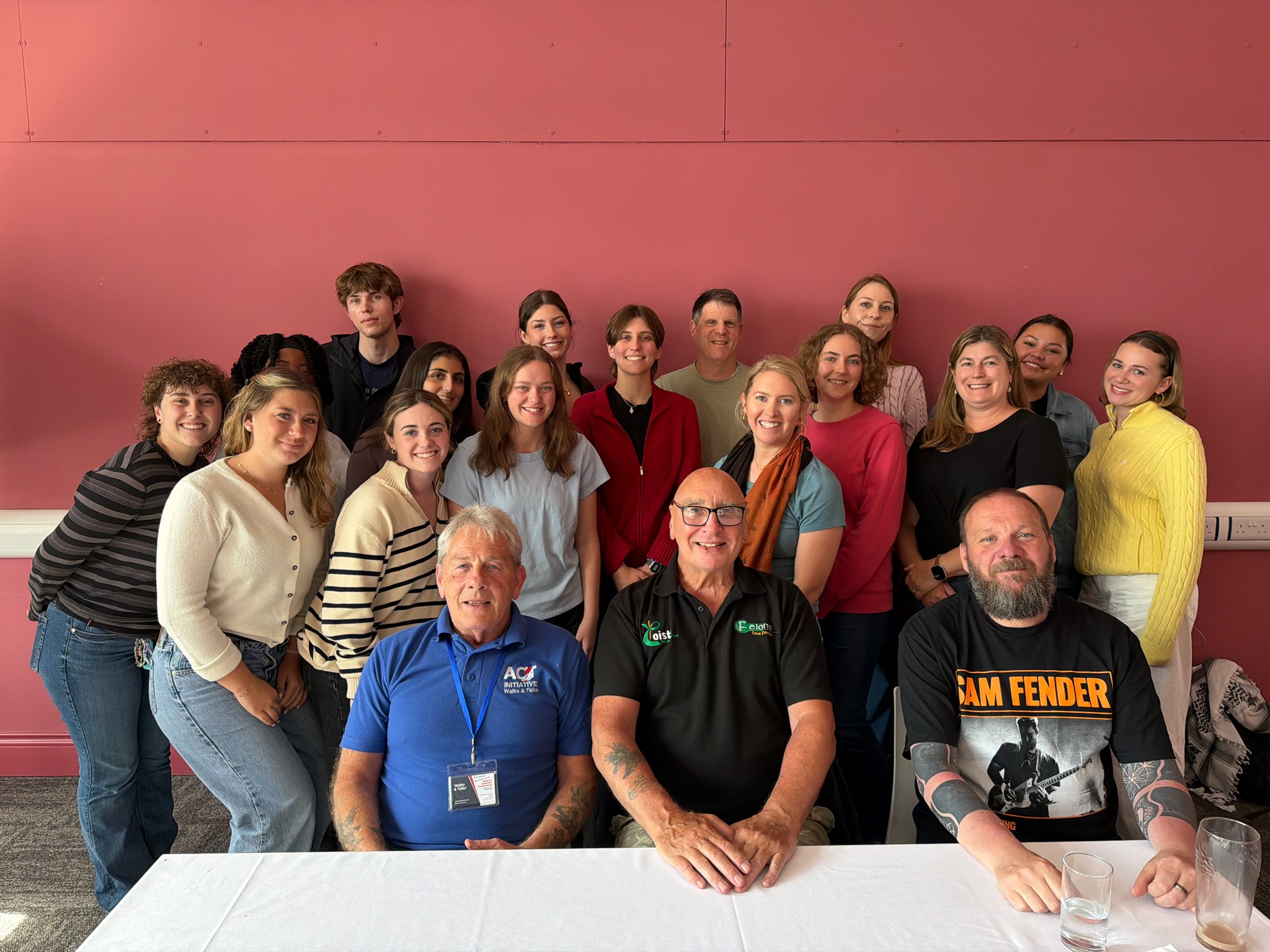
On June 2nd, after a day of walking tours and conversations with ex-combatants, the Peace Communications class came back from lunch for a community panel with people from all sides of The Troubles. The panel was led by Garod, a former Republican prisoner; Richard, a former loyalist paramilitary member; and Lee, a former British Army soldier. Each member of the panel gave their story of their experience during the conflict, and they each gave their answers to the questions from the class. Their combined perspectives provided an interesting, nuanced picture of the conflict, including how people become involved and how they are affected in the aftermath of violent conflict.

Garod began the panel by telling his story, framing the conflict not as a sectarian (or religiously motivated) one, but as a constitutional fight to unite Ireland. As an Irish Republican, he faced internment multiple times and ended up spending over 23 years in prison in total throughout the conflict. Internment affected many people on both sides of the conflict, when British Army soldiers arrested and imprisoned people, including Republican activists, without due process or evidence of paramilitary involvement. Garod was involved in the blanket protests in the Long Kesh prison, started by Kieran Nugent, which began once paramilitary prisoners were no longer given political status, so they refused to wear their prison jumpsuits and wore only blankets instead. Garod faced violence in prison from the guards, and successfully escaped from Long Kesh in 1983, before getting caught and facing a life sentence. He was released on the terms of the Good Friday Agreement in 1998 and began giving similar talks to the one we attended. He is a part of Coiste, an organization through which ex-political prisoners give walking tours of Belfast and educate people about the history of the city and the conflict.

Richard told his story as an ex-loyalist paramilitary prisoner, explaining his past with the conflict as growing up in a community where he did not learn about Irish history, but was surrounded by loyalist groups such as the Orange Order, an international fraternal group of Protestant men based in Northern Ireland. His father and brothers were in the military, and he eventually became involved in the Ulster Defense Association (UDA). He was injured by a bomb in 1972, and was eventually arrested. He spoke about how he and his fellow prisoners tried to address the conditions they were living under in the prisons, and how they were concerned about the food being laced, so they refused to eat it. When he was released from prison, he worked, and then after retirement became involved with the ACT initiative, an organization which supports former loyalist political prisoners and gives walking tours of Belfast.

Lee’s story was highly reflective, and he spoke about the ways he was changed by the conflict as a former British Army soldier. Coming from a working class family, he joined the military as a teenager out of high school, and decided to join the infantry, influenced by the narratives of glory and heroism perpetuated by the military, and a “romantic notion of conflict.” Lee spoke very critically about the tactics that the British Army used in order to desensitize and radicalize teenagers and young people into being okay with using violence against other people, create obedience, and forge an “us vs. them” mentality in their minds. In 1994 after the Irish Republican Army (IRA) declared a ceasefire, he began to reflect and question what he had been taught about the Catholic/Nationalist/Republican (CNR) community, and after being invited to a football match in 1995 in a CNR community, he began to unlearn the stereotypes he’d been taught and humanize the people he had learned to view without nuance or humanity. He left the Army in 1996, and faced struggles with drug addiction in the aftermath of the conflict. He eventually went back to school and received a PhD in history, and now tells his story in many talks like the one we attended.

All three of these perspectives were very enlightening to hear about and led to very interesting questions from the class which invited us into their differing perspectives on the conflict’s impact on relationships, trans-generational trauma, and current tensions within the communities in Northern Ireland that remain in the post-conflict era. The panel was especially impactful because of its cross-community nature. The importance of the panel was hearing all of these perspectives together rather than separately. Seeing the way these men, who previously considered each other to be enemies, interacted and shared friendship with one another helped to physically exemplify the importance of intergroup contact and communication in conflict resolution and reconciliation. As Northern Ireland remains a highly divided and segregated society, it is important to encourage dialogue and contact between members of these divided groups in order to move from negative peace, defined as “the absence of personal violence,” to positive peace, defined as “the absence of structural violence” (Galtung, 1969, 183). Hewston and Hughes highlighted the importance of intergroup contact, both direct and indirect, and its positive impact on “attitudes, trust, and even forgiveness” in a paper about intergroup contact and its impact in Northern Ireland (2015, 65).

Garod, Richard, and Lee are living proof that intergroup contact is a key tool in conflict resolution, as people formerly both involved and impacted by violence. It can be incredibly impactful to hear directly from those who were involved in the violence about their dedication to demilitarization and nonviolence. In a paper exploring the role of former combatants in the Northern Ireland peace process and reconciliation, Ferguson and Flack emphasize that organizations like Coiste and the ACT initiative are highly important for transforming their attitudes and activism, particularly in their willingness to engage with the “other” and working toward improving their communities (2024, 161). To see those once so motivated to use violence as a means to achieve political ends engaging with the “other” could be a very useful example to the rest of their communities of how to move forward after the Troubles and encourage cross-community reconciliation. As an outsider in Northern Ireland, the panel was very impactful for me for these reasons, inspiring me to believe that the future does not have to remain violent and divided, and people can come together in transformative ways to encourage peace building.

PCST/SCC 393 Class with Richard, Garod, and Lee. Photo by Daniel Wehrenfennig.

After this panel, we were able to explore the Falls museum, which details the story of the start of the violence during the Troubles from August 1969 to July 1970. The exhibit provided a lot of background on the colonization and discrimination Irish Catholics faced in Northern Ireland in the hundreds of years leading up to the Troubles, and insight into the violence and destruction that the people of the Falls road faced. There were many personal testimonies from those impacted that we were able to listen to, which made the experience more impactful than if the exhibit only included written and narrated third-person histories. The day ended after this tour with a debrief and discussion on everything we’d learned and talked about that day, which was quite a lot, and we prepared to go to Lagan College the next day!

June 3rd – Lagan College

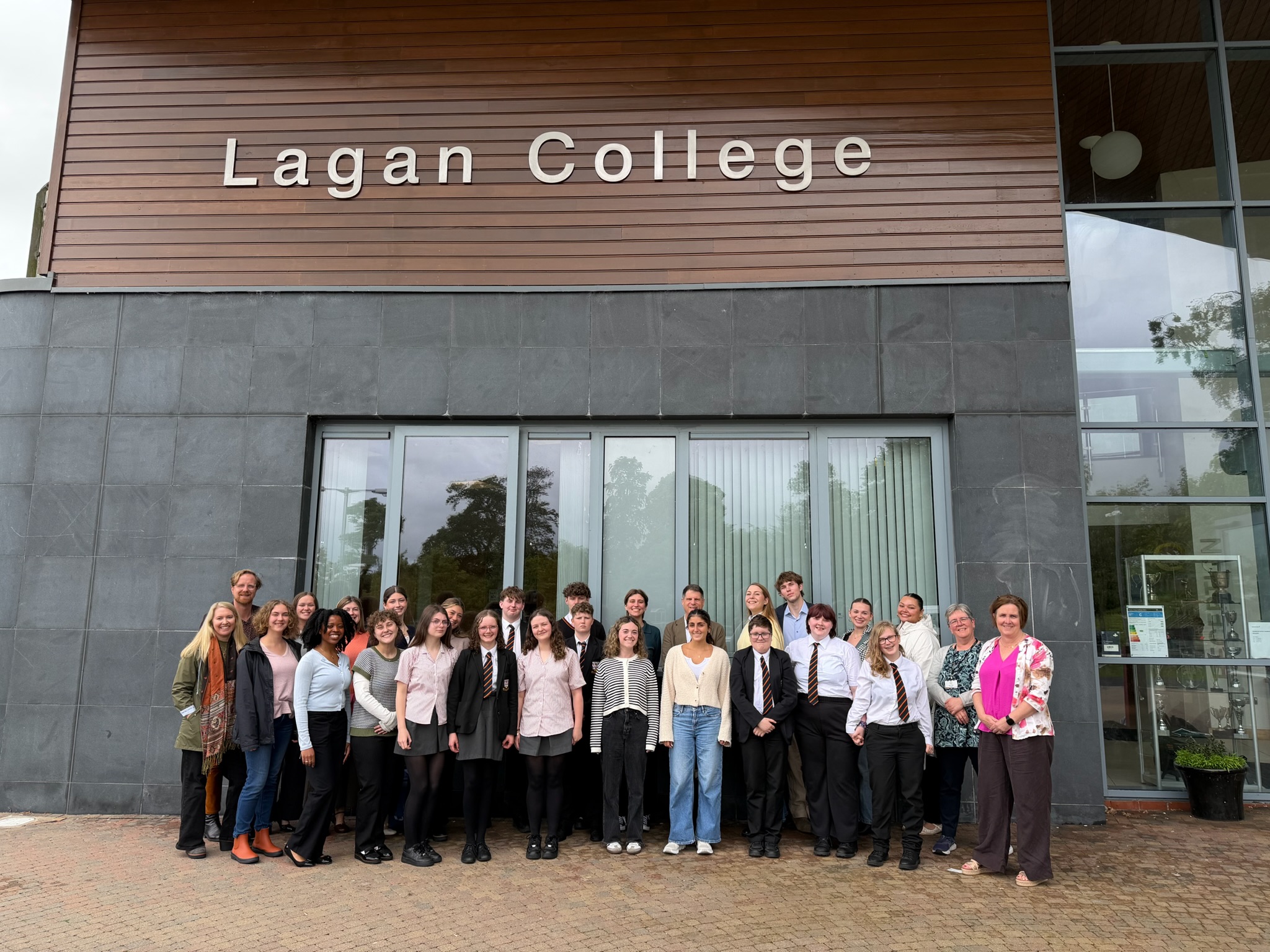
On June 3rd, we started the day with a bus ride out of Belfast’s city center to Lagan College, the first integrated school in Northern Ireland. It opened 1981 and was established by a community of parents who came together to create a cross-community learning environment for their children. Northern Ireland currently has 70 integrated schools, meaning only about 8% of all schools in the region are integrated across religious lines. Not only do most schools in Northern Ireland segregate by religion, but they also segregate based on ability, with most children taking placement tests to be put into either a secondary school or a grammar school after primary school. Lagan, however, is not a secondary or primary school, and doesn’t segregate on ability in this way. The school is highly focused on inclusion, community, dialogue, equality, justice, and reconciliation. Lagan has a certain proportion of demographics that they must maintain legally: 40% Catholic, 40% Protestant, and 20% other. Amanda, Lagan’s Principal, told us that the school tends to be comprised of about 1/3 of each of these groups. It has a quiet meeting space called the Croi, which means heart in the Irish language, where students can pray, or simply enjoy the peace and quiet. In this room, we met with students and faculty from the school and learned about its history and values.

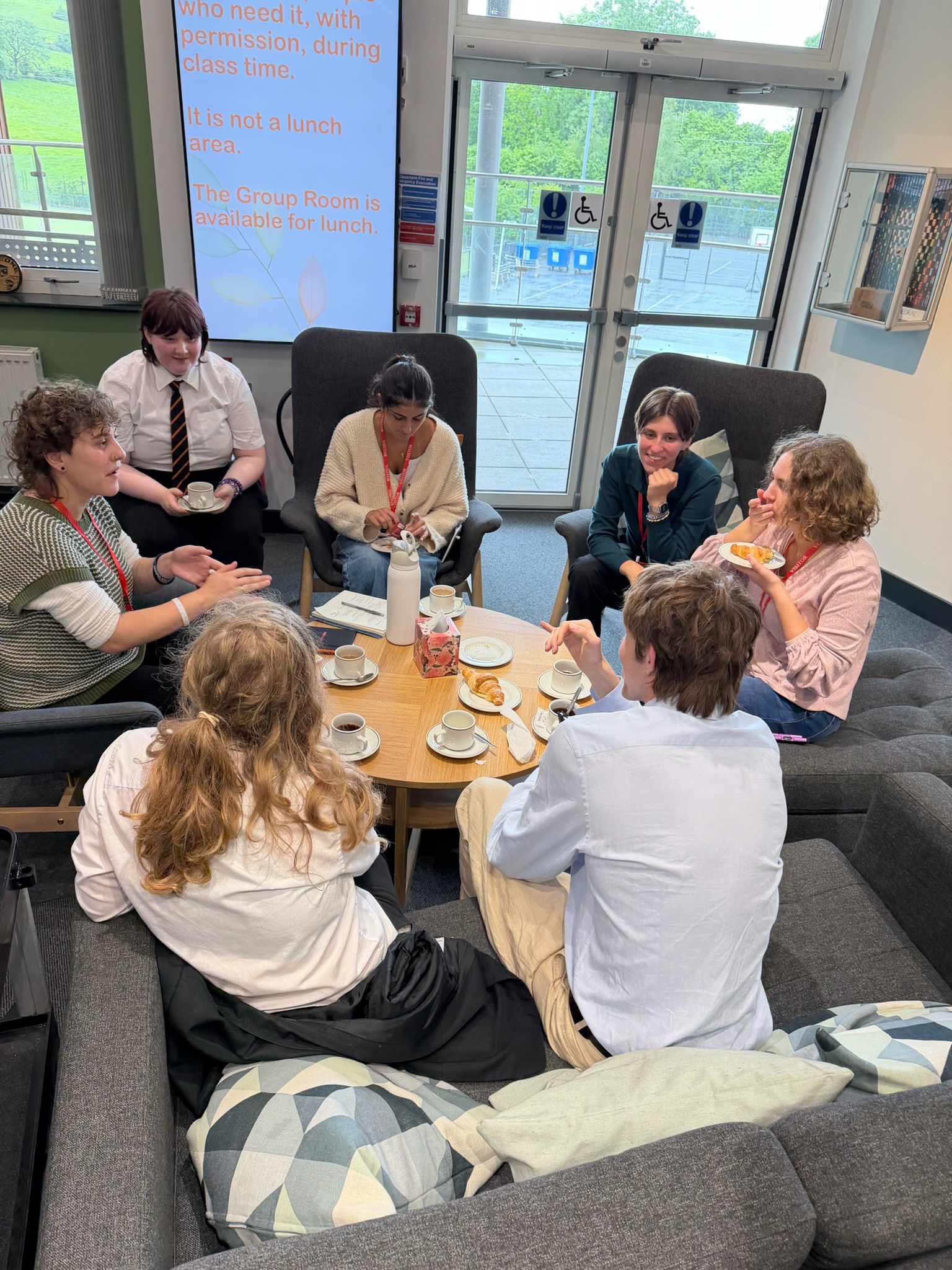
After this briefing in the Croi, Lagan students led the students of our class on tours, and we were able to get their perspectives on the school and ask them questions about what they learn and what the environment is like. The students I spoke to mentioned that they chose Lagan because siblings went there, but also because of its friendliness and acceptance of neurodivergent and LGBTQ+ students. I was very impressed by how advanced their curriculum seemed to be- I spoke with a 15 year old drama student who is writing a Brechtian play for an assignment, a concept I did not learn about until my first year of university as a theatre major! Another aspect of the school that impressed me was the way student’s issues seem to be very well listened to and supported at Lagan. Some students I spoke to in the Queer Student Alliance (QSA) told me about how they receive a lot of support from the school, and how the staff are well educated and involved in social justice initiatives that matter to the students.

Some PCST/SCC 393 students chatting with Lagan College students. Photo by Daniel Wehrenfennig.

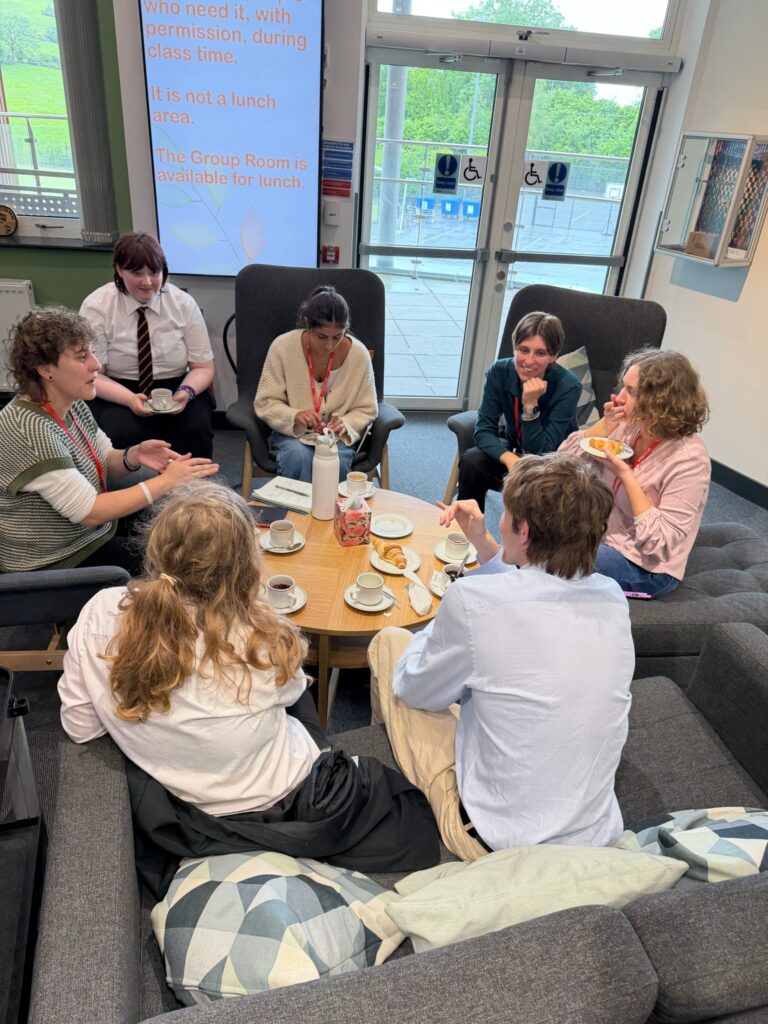
After the tours (and some tea and croissants) we had a panel with all of the students who led the tours, as well as the Principal and one of the school’s Chaplains, Helen, where we were able to ask them all of our questions. They gave wonderful insight into how being in an integrated school has impacted their learning and every day experiences, especially for students who are not religious, and those who grew up in segregated schools. Hewstone and Hughes have found in a study that students in integrated schools have more interactions with and more positive attitudes toward the “outgroup” than those in Catholic or Protestant schools (2015, 66). I observed this first hand from the students at Lagan, who spoke openly about the cross-community friendships they have, within and outside Lagan. I can see how this school’s open environment can directly contrast the culture in Northern Ireland of keeping quiet and not talking about controversial issues that many people we spoke to on the trip talked about. The leaders of the school encourage tough conversations and choose words wisely rather than avoiding what needs to be talked about for fear of offending somebody. Teaching young people to engage in hard conversations is a powerful way to begin to change a culture of silence and move toward conflict transformation.

PCST/SCC 393 Students with students and faculty of Lagan College. Photo by Daniel Wehrenfennig.

The community panel and visit to Lagan College were two of the most impactful events on the Northern Ireland trip, illustrating not only the importance of learning histories and perspectives from different sides of the Troubles, but how the synthesis of these histories and perspectives is highly important to helping Northern Ireland continue to heal.

Learn More

Coiste: https://www.coiste.ie/

ACT initiative: https://www.act-ni.co.uk/

The Falls Exhibit: https://wherethetroublesbegan.com/

Lagan College: https://lagancollege.com/about-us/

Works Cited

Ferguson, N., & Flack, P. (2024, December 15). The Role of Former Northern Irish Combatants in Building Peace and Preventing Violence: Community and Combatant Perspectives. Former Extremists: Preventing and Countering Violence, 157-176.

Galtung, J. (1969). Violence, Peace, and Peace Research. Journal of Peace Research, 6(3), 167-191.

Hewstone, M., & Hughes, J. (2015, August). Reconciliation in Northern Ireland: the value of inter-group contac. BJPsych International, 12(3), 65-67.

June 1st: Intro to Belfast and June 2nd: Prof. Ralston Talk and Peace Walls Tour

Day 1

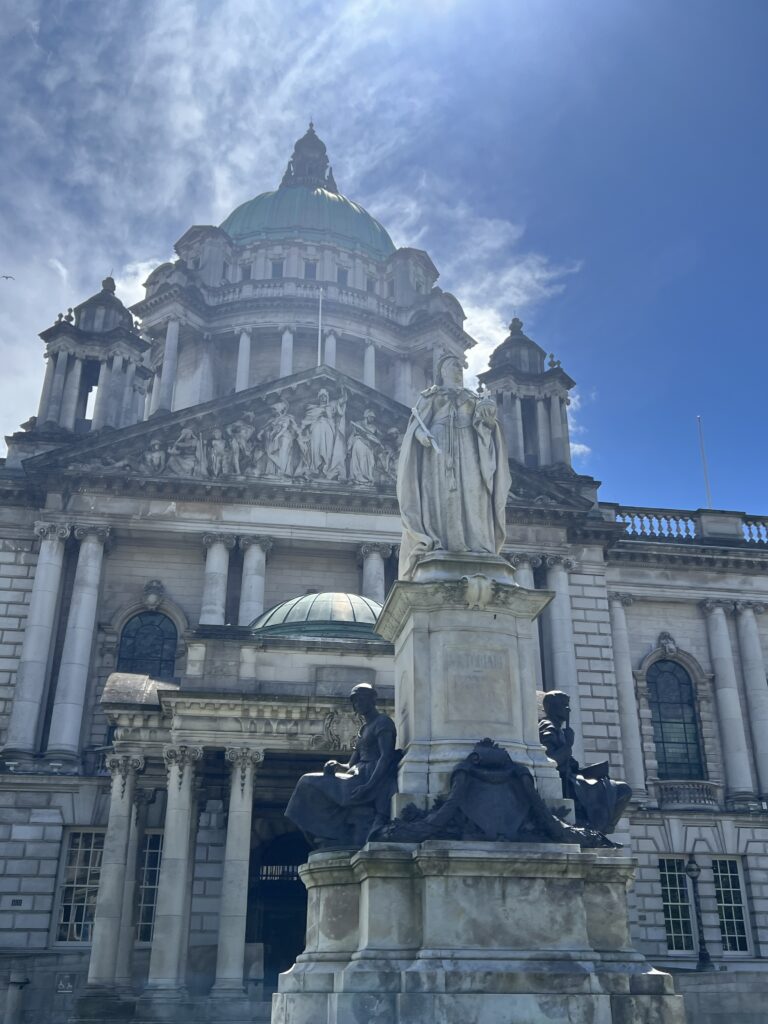
When I first arrived in Belfast with my study abroad group, I was struck by the city’s cultural ambiguity. The first thing I saw as I left the train station was a mural of William of Orange staring imposingly. I kept asking myself, “What is the identity of Belfast?” Little idiosyncrasies stood out to me, like the pink double-decker buses—it looks like a London double-decker tour bus, but it is noticeably pink instead of red. The ambiguity of the city is most obvious when you visit Belfast City Hall, where a statue of Queen Victoria stands at the center, but no single flag stands to represent the city or the constituent country. I wondered if Belfast identified as British, Irish, or both. Aspects of cultural ambiguity and social identity theory followed me throughout my first two days in Belfast.

Image 1: Belfast City Hall

On day two, we met with Bill Rolston, a former professor of sociology and Director of the Transitional Justice Institute at the University of Ulster. Notably, Dr. Rolston is a nationalist who photographs a broad range of murals in Northern Ireland. For example, murals honoring William of Orange, memorials of Bloody Sunday victims, and depictions of paramilitary groups and activists. Dr. Rolston gave Chapman students a very informative history lesson about Ireland from the 1066 Norman Invasion of England to the 1921 Partition of Ireland, “The Troubles,” and the Good Friday Agreement. Significantly, message framing is employed to minimize the conflict in Northern Ireland by reducing it to “The Troubles.” (Smith & Petty, 1996) From 1968 to 1998, Northern Ireland became embroiled in a fight for civil rights and urban warfare between paramilitaries, state police, and the British Army.

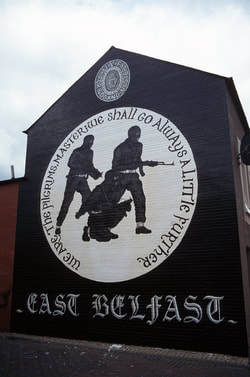
Image 2: 1996 Armed loyalists, UVF emblem. ‘We are the pilgrims, master; we shall go always a little further. East Belfast.’

Following our history lesson, we went on a mural tour with a former UVF combatant, and I immediately noticed a contest for meaning, memory, and culture between Catholic/Nationalist/Republican (CNR) and Protestant/Unionist/Loyalist (PUL). (Gallagher, 1989) While the Catholic, Nationalist community remembers over 800 years of British oppression, the Protestant, Loyalist community remembers the Ulster Plantation as the birthplace of their culture. While walking to each mural in Shankill, the former UVF soldier emphasizes that the Loyalist community is distinctly British and that his heritage and culture are important.

Notably, the community separates itself from Irish culture, including the Gaelic language and musical traditions. On the Loyalist side of the sectarian community, only English is spoken and written, and the music is distinctly Ulster-Scottish in origin, specifically the flute and drums. In murals, the IRA is often demonized as “terrorists” while the Ulster Volunteer Force is portrayed as knights in a Holy War, fighting mythical dragons. These murals often feature the Ulster Banner, represented by the English flag with the Red Hand of Ulster superimposed at the center. The Ulster-Scots remember an idealized version of historical events based on their ingroup. (Harwood, 2020)

Image 3: UVF Mural

The descendants of the Ulster plantation are aware that their ancestors took the land and feel the tension within the sectarian city. But instead of reconciling with the past and their positionality, they dig their heels in the land and identify with the British. In terms of social identity theory, “People may adopt a social mobility strategy, essentially ‘leaving’ one ingroup for a different, more socially valued group.” (Harwood, 2020) Claiming a British identity offers a connection to a more powerful social group that can protect the Ulster-Scots in the region. Ulster-Scots defend the walls to protect the identity they have constructed for themselves, as well as the memories and history passed down that inform their identity.

Image 4: Peace Walls

At the end of the tour, we parted ways at the “peace walls” which divide the neighborhoods into sectarian spaces between the CNR and PUL. This is where Jake traded off the tour to former IRA combatant, Padr, who literally shared his side of the story within the CNR community.

Immediately, Padr elucidates the community’s struggles through cultural landmarks and his own life experience. As an oppressed community, the Gaelic language and culture were forbidden in public spaces, including schools. Kids could not engage in Gaelic sports, and the community as a whole could not openly play Irish music and song. English dominated public life, so many did not grow up learning Gaelic in schools, and Gaelic survived only in private spaces within family homes. Furthermore, the Catholic community faced significant job discrimination that limited job opportunities for social mobility.

Image 5: Clonard Monastery, Belfast


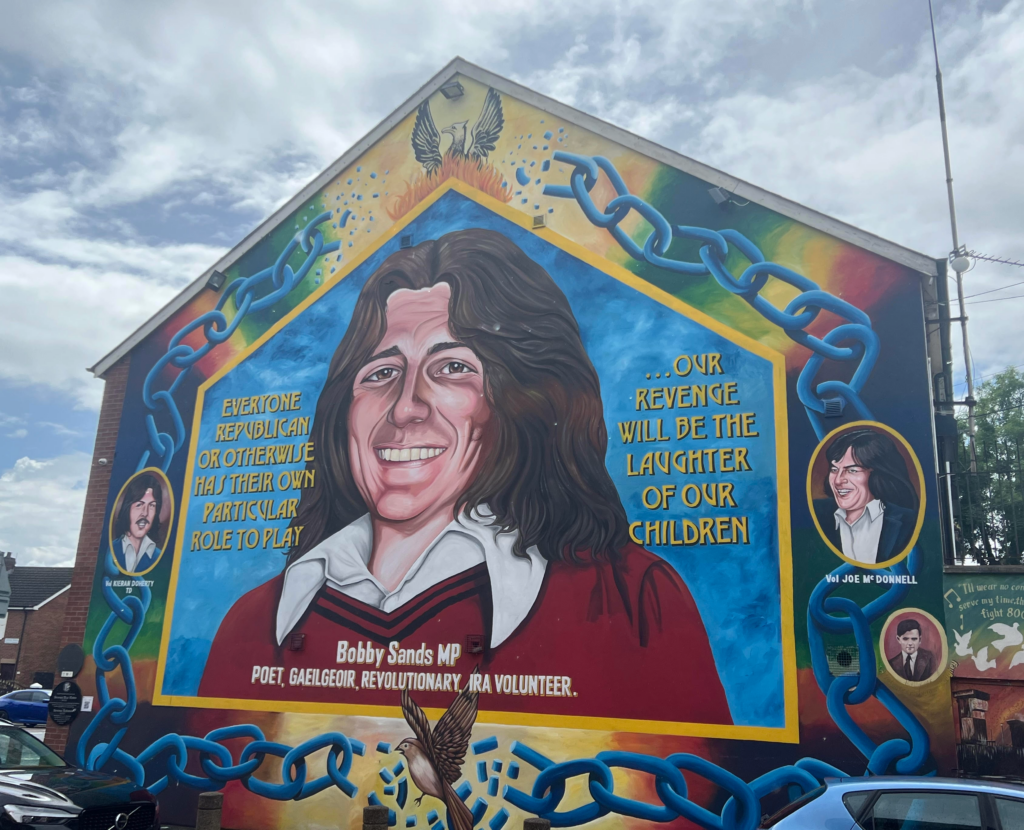
Notably, Padr grew up working class and struggled in school. So when Padr was recruited to join the IRA, it was not just a matter of desperation, but an initiative to right the wrongs of national suppression in the community. Significantly, Padr possessed a social change belief system, where instead of “abandoning their group for a more desirable outgroup, they instead attempt to make their ingroup’s position more desirable.” (Harwood, 2020) For instance, the fight for civic and human rights became a major point of national struggle from 1968 to 1998, and political prisoners like Padr staged several protests while being imprisoned by the British Army. Padr describes the various strikes in great detail, even recalling his compatriot, Bobby Sands, who died during a hunger strike to achieve human rights for political prisoners. For example, freedom of association among fellow prisoners and a decriminalized status for IRA prisoners.

Image 6: Memorial of Bobby Sands, a political prisoner and hunger striker.


The ambiguity of Belfast stems from two communities sharing a city mired in historical tension, and fighting to tell its story through message framing and persuasion. (Smith & Petty, 1996) The contrast between national suppression and civil rights versus UVF depictions of gallant holy warriors and English heritage demarcates the division of historical remembrance. The division between historical narratives depicted in murals illustrates biases and shared experiences of violence. A step towards reconciliation can begin with sharing and accommodating one another’s personal histories in narratives. Creating a history that tells both sides of the story will elucidate Belfast’s ambiguity and initiate a shared construction of national identity.

References

Gallagher, A. M. (1989). Social identity and the Northern Ireland conflict. Human Relations, 42(10), 917-935. https://research-ebsco-com.chapman.idm.oclc.org/c/wnnu3f/search/details/2s3k27ivqz?db=buh

Harwood, J. (2020). Social Identity Theory. In The International Encyclopedia of Media Psychology, J. Bulck (Ed.).https://onlinelibrary.wiley.com/doi/10.1002/9781119011071.iemp0153

Smith, S. M., & Petty, R. E. (1996). Message framing and persuasion: A message processing analysis. Personality and Social Psychology Bulletin, 22(3), 257-268. ttps://doi.org/10.1177/014616729622300

June 10th- Ulster Museums & Exhibit of Everyday Objects

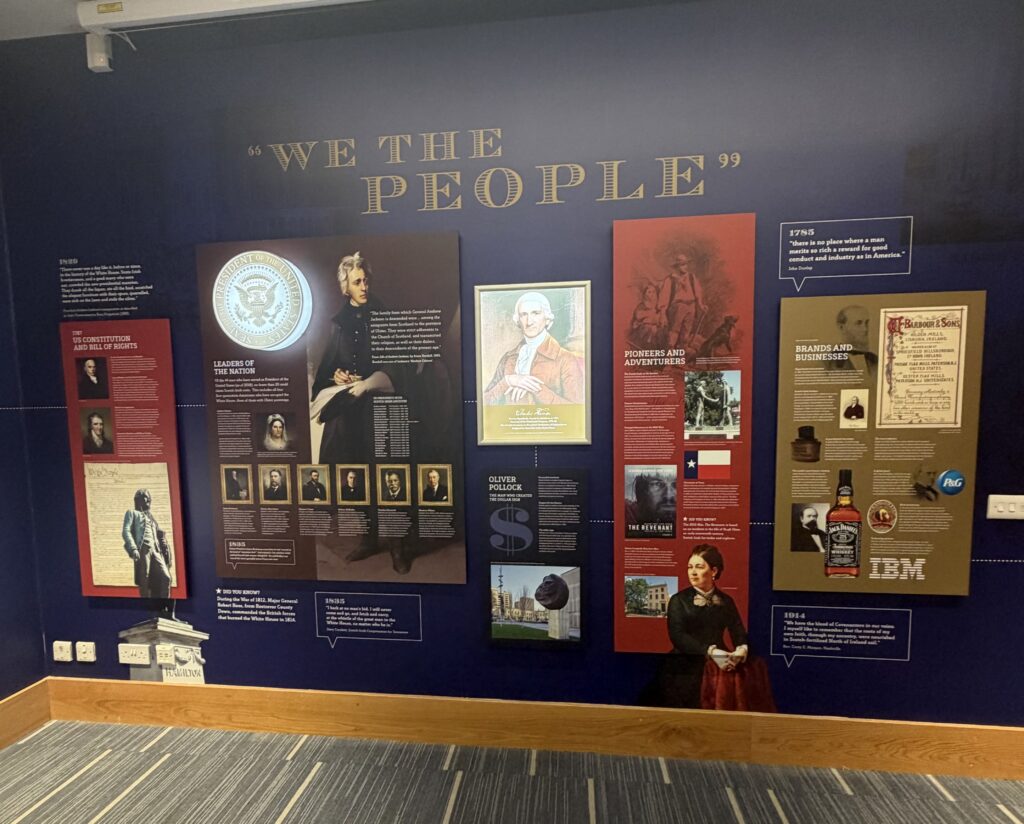
On Day 10 of our course, we began our day at the Ulster-Scots Centre in Belfast. This museum was rather different from the museums we had explored on previous days of our trip. Instead of being centered around the period of the troubles, the exhibit instead told the story of the cultural group of the Ulster-Scots, and their influence in Northern Ireland and the United States.

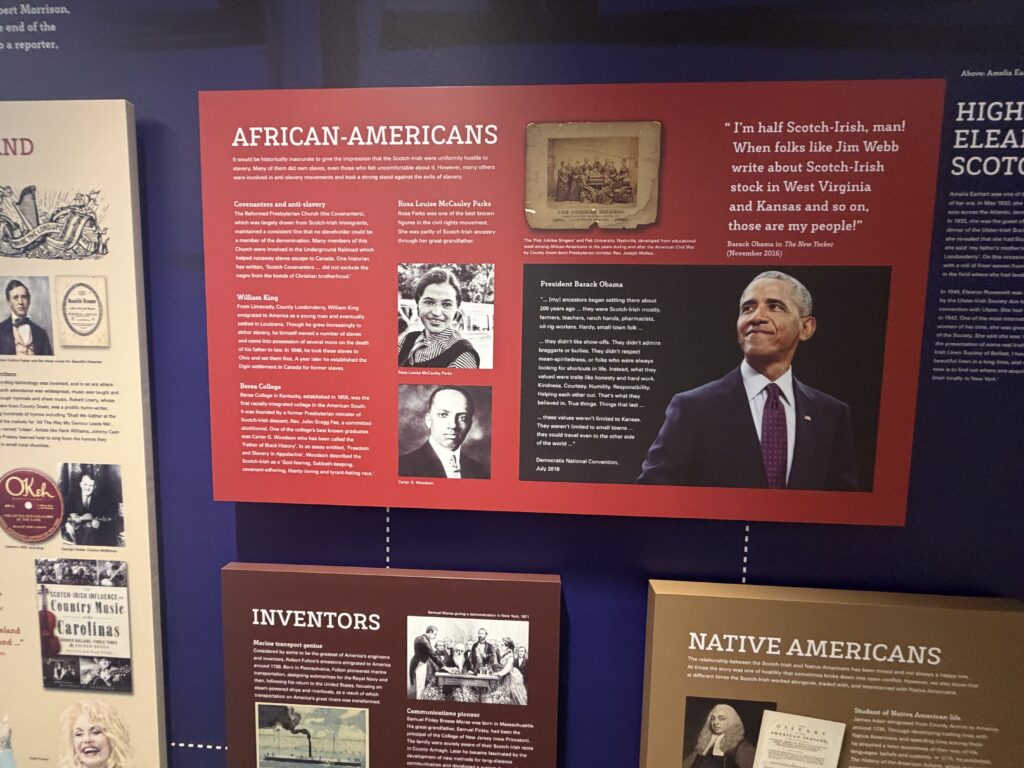
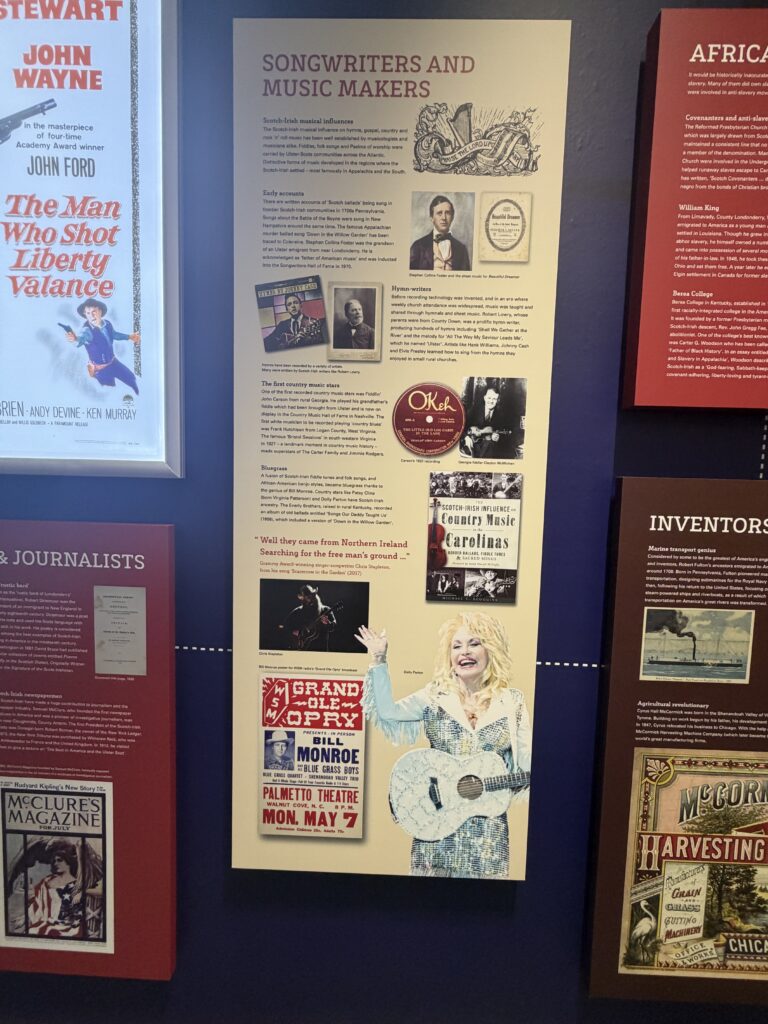
Our guide, William Welford, an Ulster-Scot himself, provided us with an extensive history of the Ulster-Scots arrival from Scotland and their subsequent settlement in the Irish region of Ulster (hence the name Ulster-Scots). William explained how over the years, the group took on its own unique culture and its own language with more Germanic roots than Irish’s Celtic ties. Despite their longstanding influence in the Ulster region, they remain an underrepresented minority. William also allowed us to tour the museum where we explored the deep ties Ulster-Scots have to the United States through notable unionist and confederate generals, U.S Presidents like Barack Obama, and notable celebrities like Dolly Parton. 

Photo taken by Uche Nwadiashi (6/10)

This museum utilized distinct framing in its depiction of the Ulster-Scots. Framing can be defined as “schemata that enable individuals “to locate, perceive, identify, and label” occurrences within their life space and the world at large,” (Goffman, 1974). Unique methods of framing could be seen in the museum’s description of Ulster-Scots involvement in the confederate side of the American Civil war. Instead of questioning the somewhat obvious moral failure of Ulster-Scots who fought to maintain slavery in the American south, the museum simply discusses to the novelty of having Ulster-Scots who rose to such high positions of power in the US army and how exceptional it is for such a small minority population to have accomplished such a feat. This museum greatly utilized strategic framing to focus the viewers attention to specific parts of the Ulster-Scots history and narrative. 

Photo taken by Uche Nwadiashi (6/10)

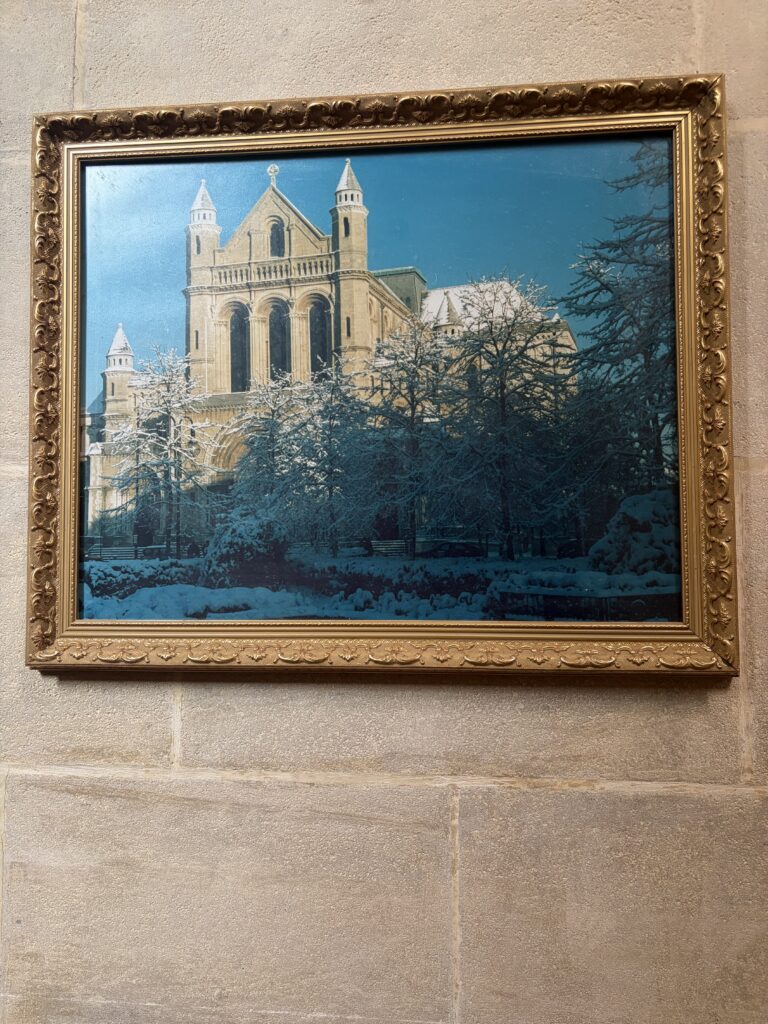
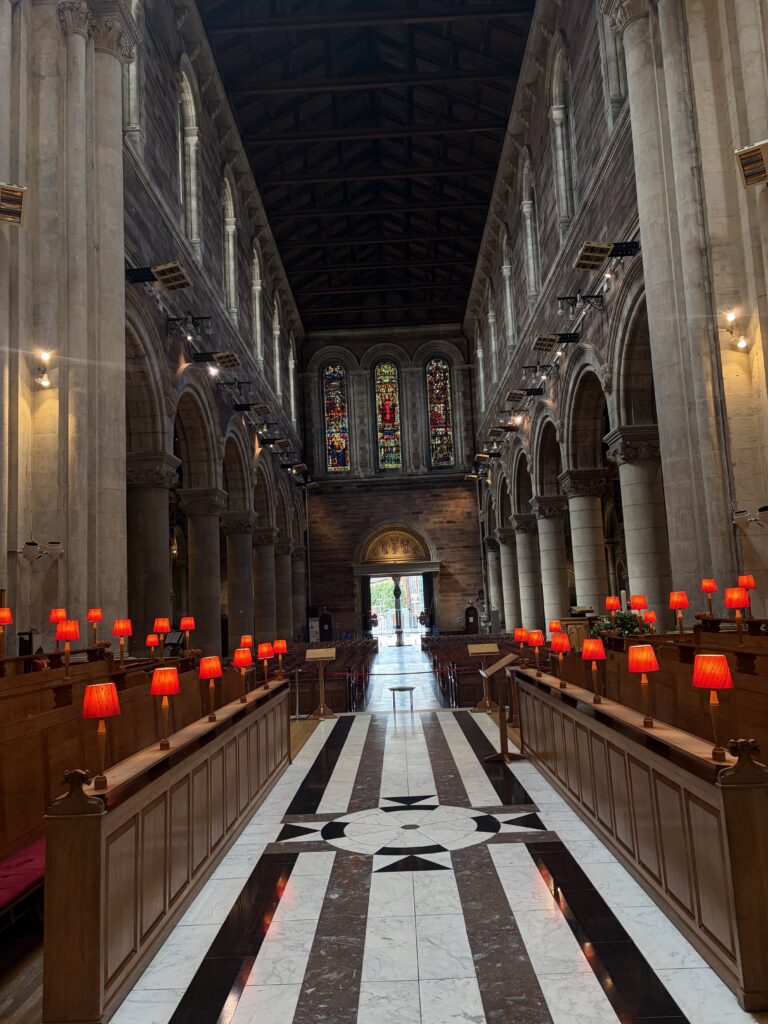
Following the visit to the Ulster-Scots Museum, we walked to the museum of “Everyday Objects Transformed by the Conflict,” currently on display at Saint Anne’s Cathedral in Belfast. 

Photo taken by Uche Nwadiashi (6/10)

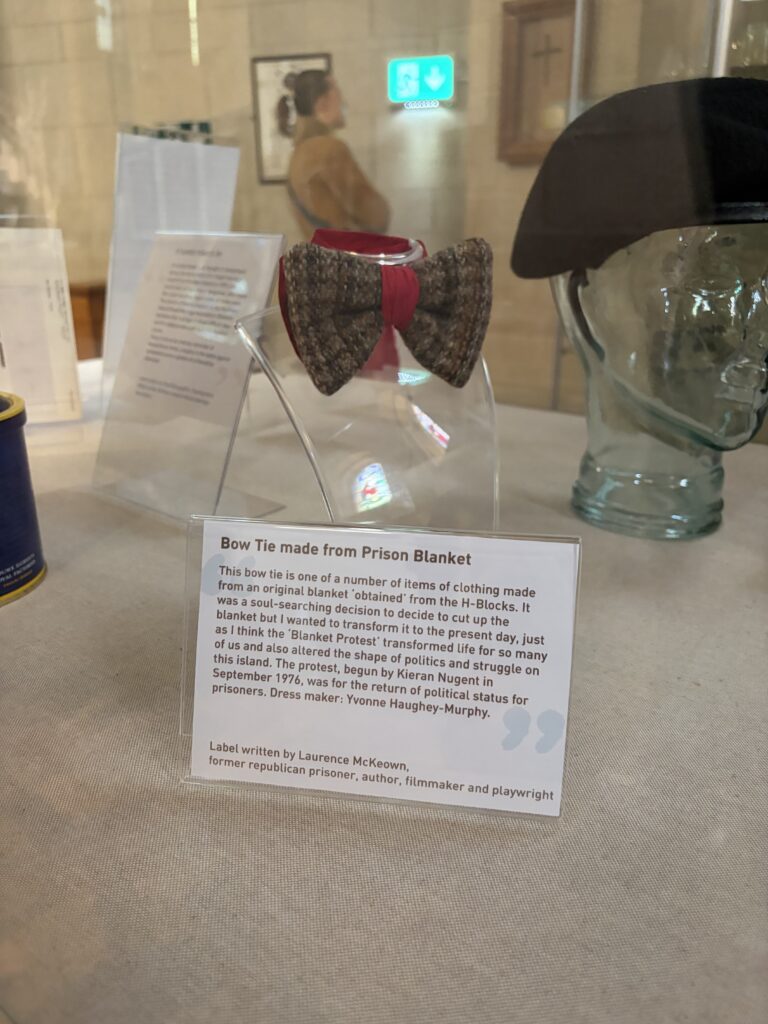
This museum was particularly interesting for how deeply it explored the principles of intergroup communication. The museum displayed a plethora of ordinary and seemingly insignificant objects that told incredibly unique and vulnerable stories of the troubles from the perspectives of individuals on both sides of the conflict. The museum as a whole allows for the exchange of both thoughts and memories between individuals from both sides of the conflict through symbolic interaction, one of the cornerstone principles of intergroup communication (Giles et al, 2012).  In this museum, we were able to see objects like a bowtie made from the hunger strike blanket of Laurence McKeown, a former republican prisoner. 

Photo taken by Uche Nwadiashi (6/10)

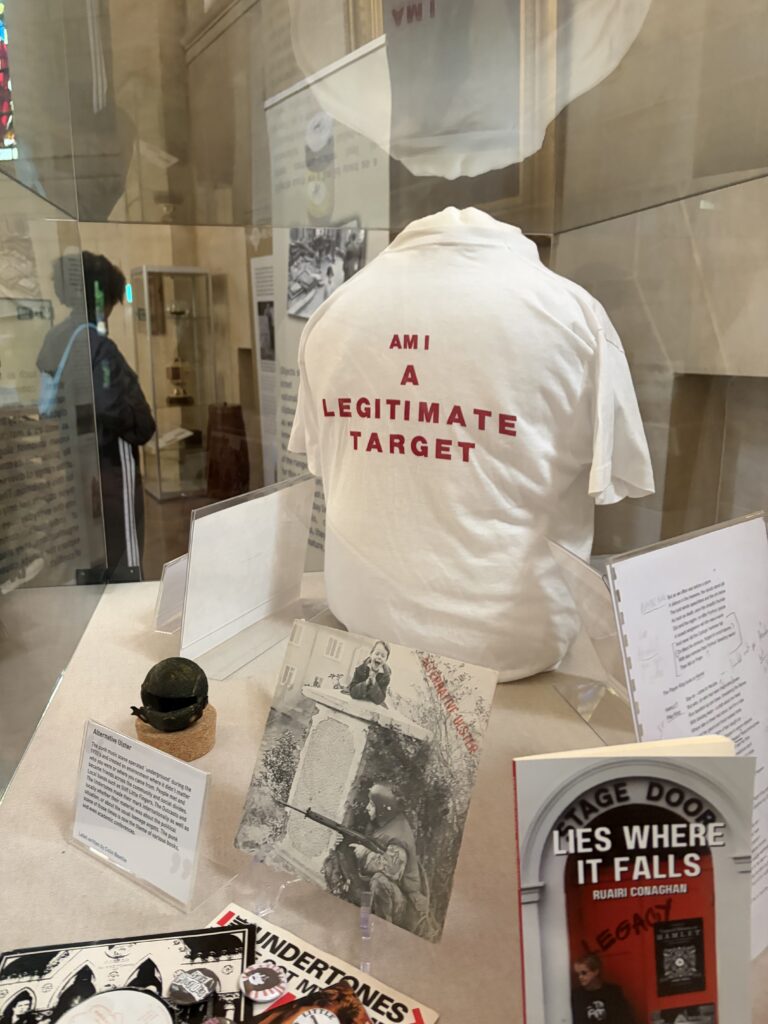
We also saw other objects like a tennis ball that was used by UVF prisoners to communicate in Long Kesh prison and a shirt from the “Am I a Legitimate Target” protest that questioned the term used by paramilitaries to justify their widespread violence.

Photo taken by Uche Nwadiashi (6/10)

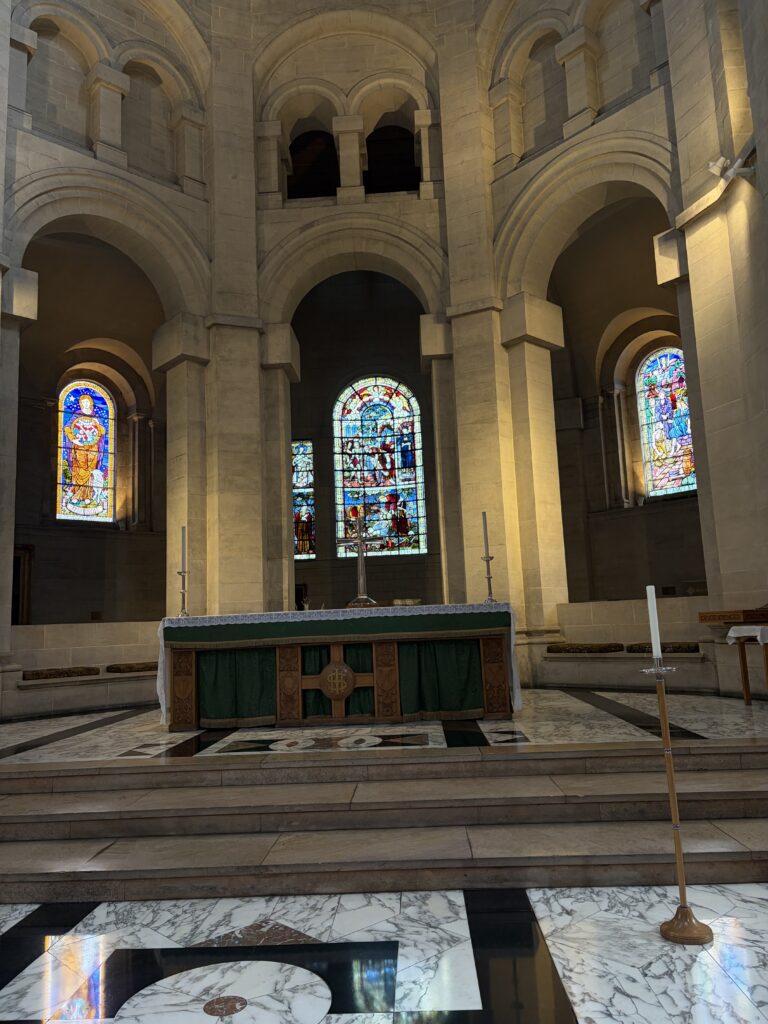
Additionally, the exhibit currently (as it moves around) being held in Saint Anne’s Cathedral, the official Anglican church of the state only further adds to the intertextuality of the entire exhibit. In an institution of both faith and the state, individuals from both sides of a conflict, divided purposefully by the state and partially by religion are able to come together to share their stories of hardship, strife, and also just everyday life during the troubles.  

Photo taken by Uche Nwadiashi (6/10)

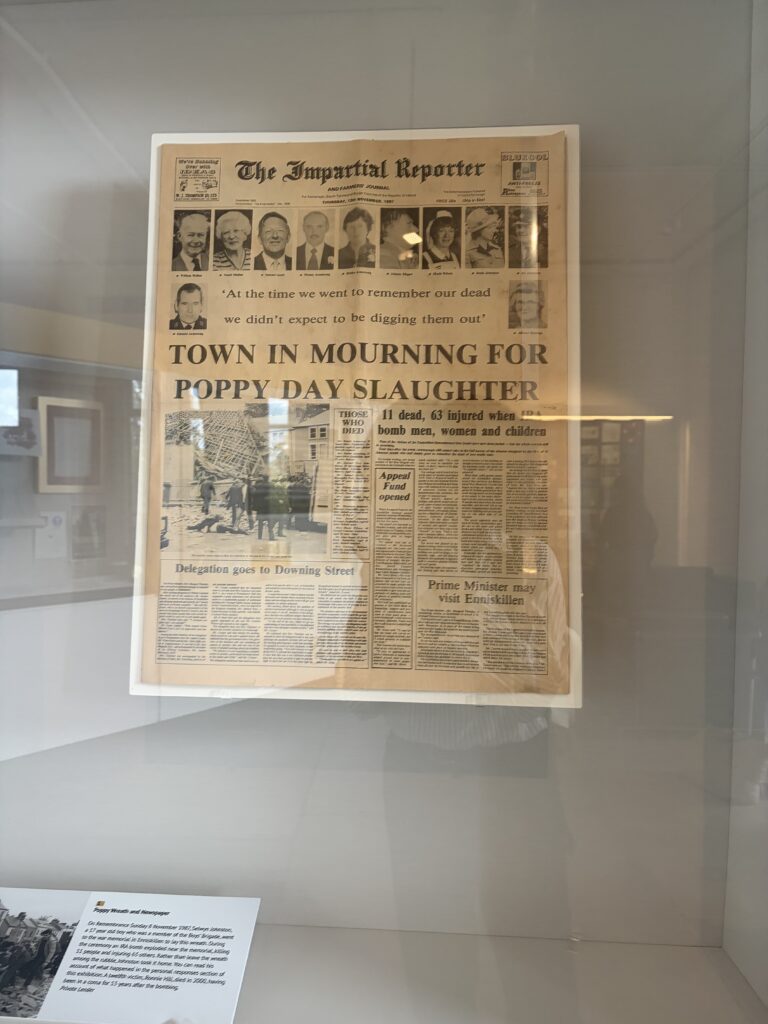
Following the everyday objects exhibit, we ended our morning at the official Ulster Museum. Although this museum included many exhibits relating to fashion, paleontology, and more, we focused our time on the portion of the museum dedicated to the troubles. This portion of the museum explored the principals of truth and reconciliation. Because it is not affiliated with either side of the conflict, the museum instead aims to create a shared and collective truth of the conflict. In this work it is able to illuminate certain truths of the past, a necessary step in peace building (Borer, 2006). The museum does so through telling of the losses experienced by both sides, but also by sharing the stories of the amazing things ordinary citizens accomplished during the times of the troubles. In the museum, the massacre of Bloody Sunday (a republican casualty) and  the Poppy Day Slaughter (a unionist casualty) are told side by side, which only emphasizes the shared loss felt by both sides during the conflict.

Photo taken by Uche Nwadiashi (6/10)

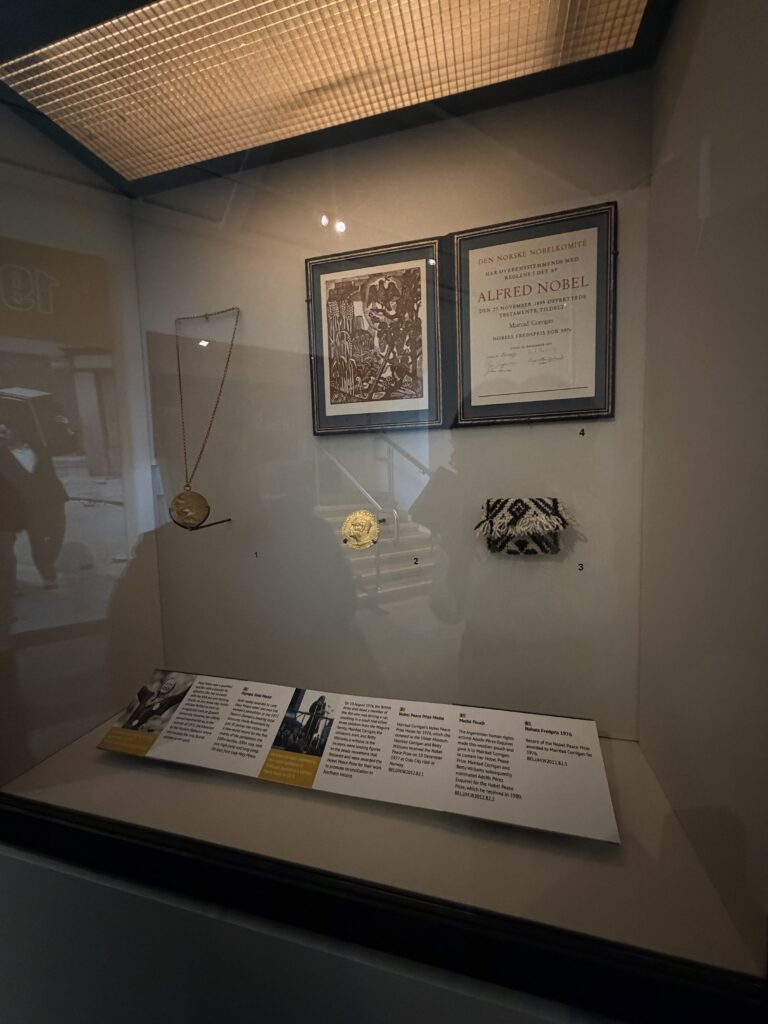
 The museum also tells the story of Mary Peters, a Northern Irish athlete who won the Olympic gold medal in women’s pentathlon in 1972, in the midst of the troubles. These stories of ordinary citizens pursuing greatness can also be seen through the stories of Betty Williams and Mairead Corrigan, two women who won the Nobel Peace Prize in 1976. After Corrigan’s nieces and nephews were killed during the conflict, she alongside Wilimas turned to peace activism.

Photo taken by Uche Nwadiashi (6/10)

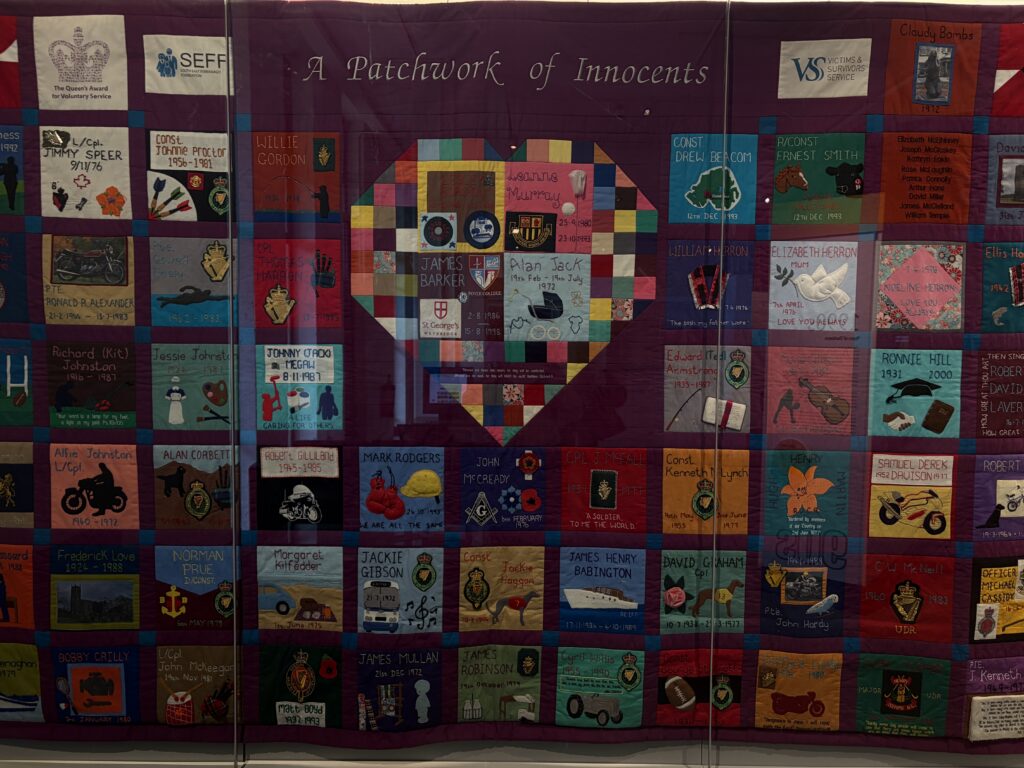
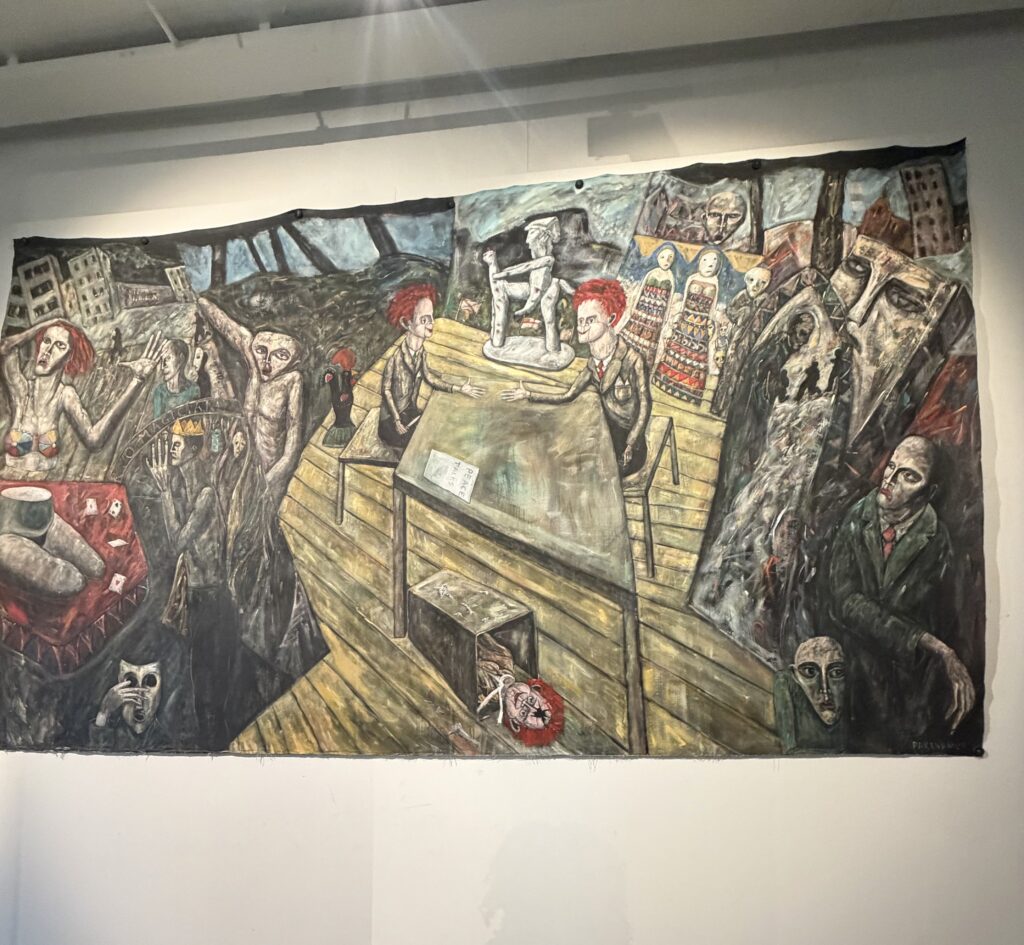
Choosing to highlight stories like that of Peters, Williams, and Corrigan while also featuring losses from both sides help to further expand the notion of truth held by all. Walking through the exhibit pushes one to confront the great losses suffered by both sides while also remembering that despite the overarching nature of the conflict, ordinary people, particularly women, still accomplished extraordinary things in spite of the conflict. Interestingly, the museum also included remembrance of the innocent through a patchwork quilt that remembers the children and 600 innocents lost as a result of the conflict. In addition, the museum included various pieces of art like a piece by Jack Pakenham that depicted the distorted and grotesque nature of the conflict. 

Photo taken by Uche Nwadiashi (6/10)

The tours of the various museums showed us the views of the forgotten, the overlooked, and the ordinary people and aspects of the life so often omitted during study of both Northern Ireland and the troubles. These museums, unlike those we visited on previous days, were about so much more than just the armed conflict. It was about the innocents, the peacebuilders, the artists, and the athletes. It explored the people both behind and within the terrible atrocity. It is a reminder that so much life still existed outside paramilitary organizations. Individuals still had hopes and dreams, drew pictures, and ran races. And it is all these individuals together that truly represent the troubles of Northern Ireland.

Photo taken by Daniel Wehrenfennig (6/10)

Learn More

References

Benford, R. D., & Snow, D. A. (2000). Framing Processes and Social Movements: An Overview and Assessment. Annual Review of Sociology, 26, 611–639. https://www.jstor.org/stable/223459?seq=4

Borer, T. A. (2006). Telling the Truths: Truth Telling and Peace Building in PostConflict Societies. University of Notre Dame Press; JSTOR. https://doi.org/10.2307/jj.39514171

Discover Together | Ulster Museum. (n.d.). Www.ulstermuseum.org. https://www.ulstermuseum.org/

Discover Ulster-Scots Centre. (2026). Ulsterscotsagency.com. https://www.ulsterscotsagency.com/about-us/discover-ulster-scots-centre/

Everyday Objects Transformed By The Conflict – Healing Through Remembering. (2026). Healingthroughremembering.org. https://healingthroughremembering.org/everyday-objects-transformed-by-the-conflict/

Giles, H. (Ed.). (2012). The Handbook of Intergroup Communication (1st ed.). Routledge. https://doi.org/10.4324/9780203148624

June 7 and June 11

Before traveling to Northern Ireland, I tended to think of peacebuilding as primarily a matter of political negotiations and formal agreements. However, our experiences throughout the course demonstrated that peace is also sustained through everyday interactions, shared spaces, and intentional dialogue.

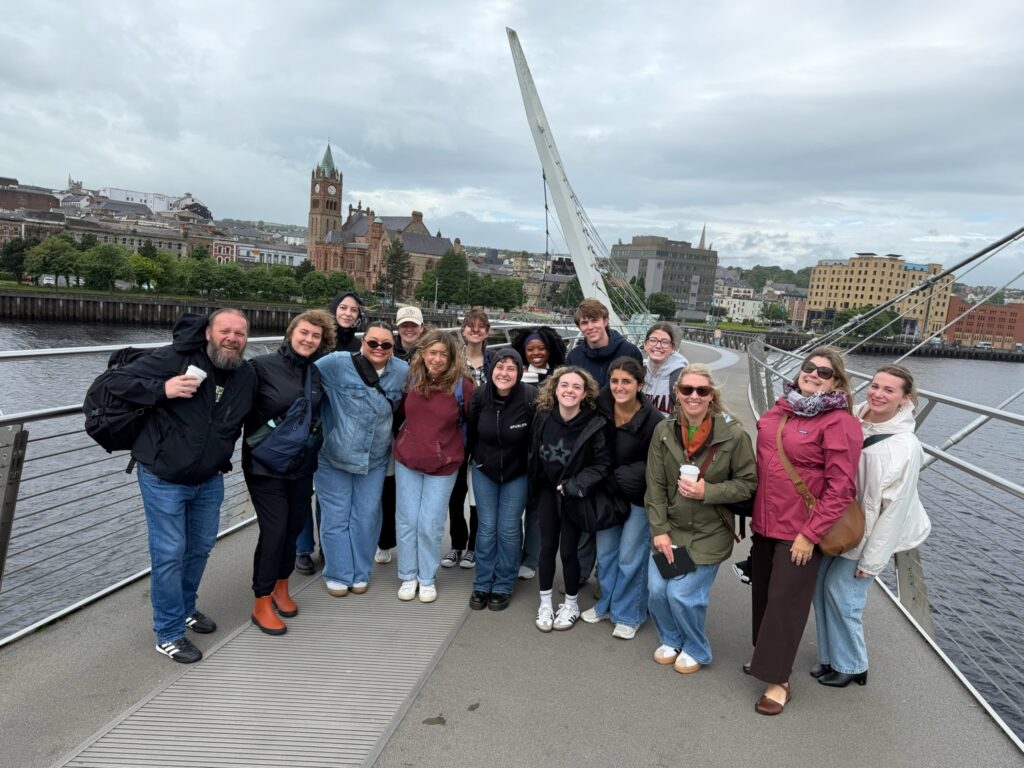
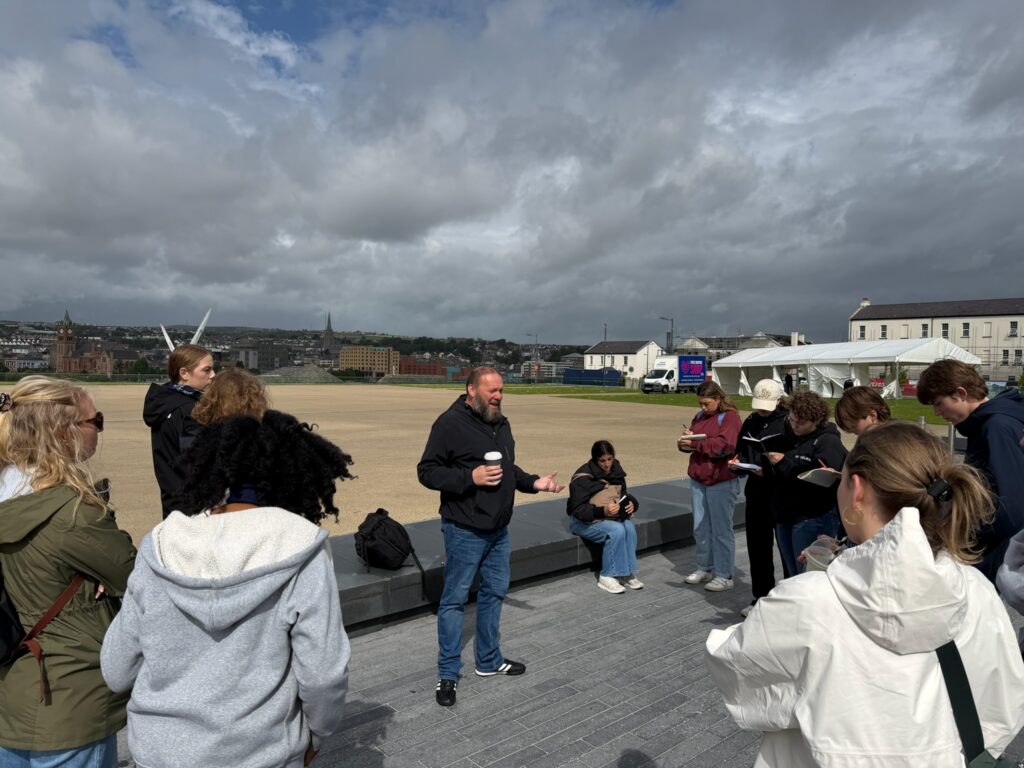
On June 7, our group spent the day in Derry/Londonderry. We walked across the Peace Bridge, which physically connects the predominantly nationalist Cityside with the predominantly unionist Waterside. While the bridge serves a practical purpose, it also symbolizes efforts to encourage connection between communities historically divided by the Troubles. Later that day, we visited the Barracks, a former British military site that has since been repurposed for community use. We listened to Lee share stories and memories from his time on the base. For example, he pointed out where helicopters would land and described how the layout of the base reflected the hierarchy of the British military. The buildings used by higher-ranking officials were noticeably more ornate than the barracks where ordinary soldiers lived. Experiencing these spaces firsthand challenged my assumptions about what peacebuilding looks like in practice. Rather than simply removing reminders of conflict, communities can transform them into places that encourage reflection, interaction, and shared experiences.

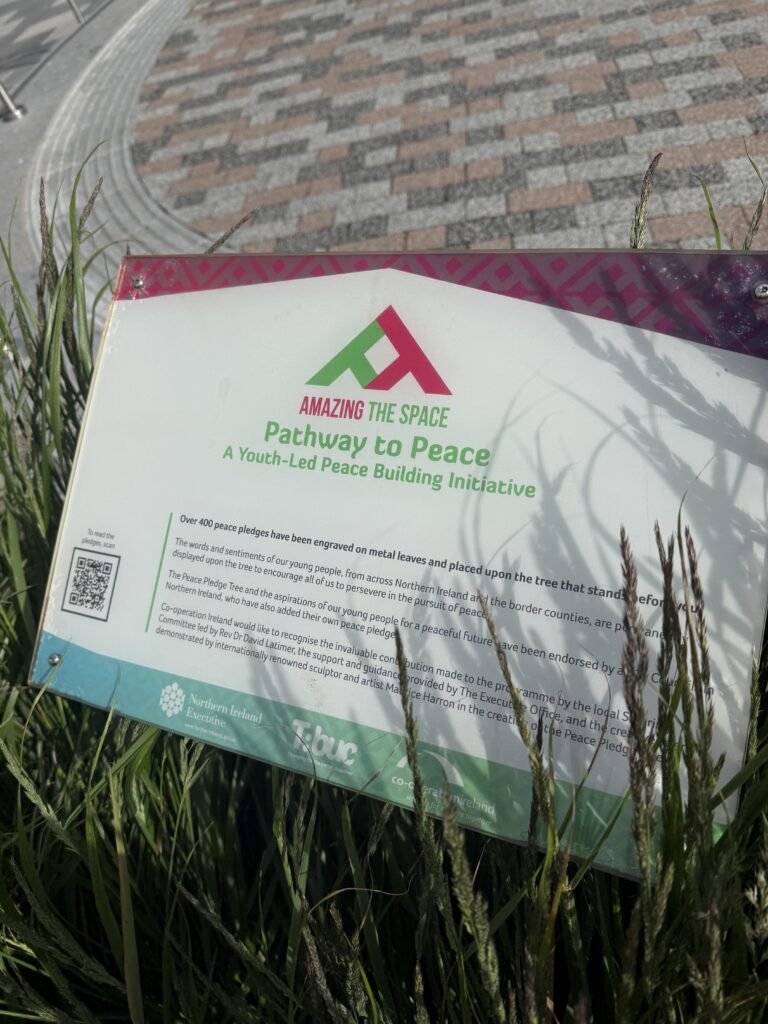
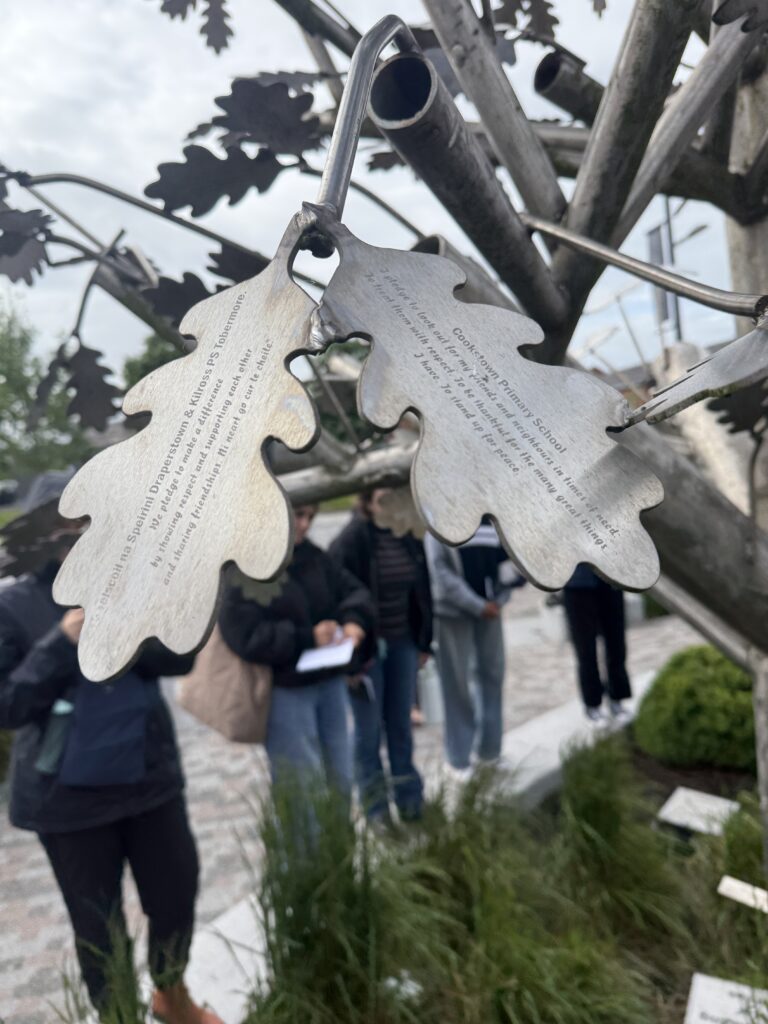
We also got to see the memorials implemented to help promote peace on both sides. The main one being the Pathway to Peace, a student-led initiative with metal leaves inscribed with quotes from various Youths pledging peace. The inscriptions are integrated with regular English and Gaelic to emphasize the bridging of the communities.

Photo of the description of the Initiative taken by Avery Gourvitz

Photo of two leaves of pledges from students taken by Avery Gourvitz

Reflecting on our experiences in Derry/Londonderry, I was reminded of Voci et al.’s (2015) discussion of intergroup contact in Northern Ireland. The authors argue that meaningful contact between members of different groups can contribute to forgiveness and improve intergroup relations (Voci et al., 2015). The Peace Bridge and the Barracks represent more than physical structures; they create opportunities for individuals from different backgrounds to occupy the same spaces and engage with one another in everyday life.

Photo on Peace Bridge taken by Daniel Wehrenfennig

Photo of Lee Lavis telling our group about his experiences with the former Barracks taken by Daniel Wehrenfennig

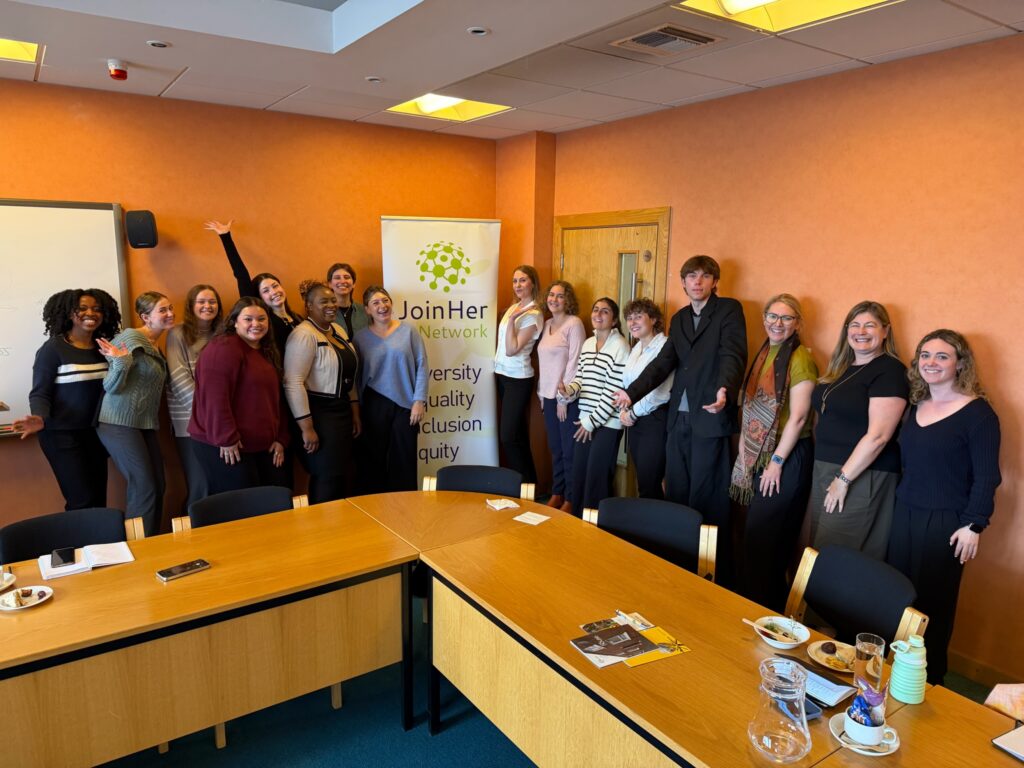
On June 11, our group met with Lori from the JoinHer Network, whose work further expanded my understanding of peacebuilding. Hearing Lori discuss the importance of creating supportive communities and fostering dialogue reinforced the idea that peace requires ongoing effort from people at all levels of society. One point that particularly stood out to me was her emphasis on intersectionality and the importance of recognizing the many identities that shape people’s experiences. Caputo (2016) argues that dialogue is a critical component of peacebuilding because it allows individuals to understand experiences different from their own and build relationships across lines of difference. The work of JoinHer demonstrated how these principles continue to shape Northern Ireland today.

Photo of our group with Lori from the JoinHer Network taken by Daniel Wehrenfennig

One of my biggest takeaways from this course was recognizing that peace is not a static outcome achieved once an agreement is signed. Instead, it is an active process that requires communication, trust, and opportunities for people to connect with one another. Whether through crossing a bridge, repurposing a historically significant space, or participating in conversations that foster understanding, the people and organizations we encountered illustrated that peace is something communities must continually create together.

Learn More

References

Caputo, J. S. (2016). Peacebuilding through dialogue in Northern Ireland. In Communicating differences: Culture, media, peace and conflict negotiation (pp. 54–67). Palgrave Macmillan. https://doi.org/10.1057/9781137499264_4

Voci, A., Hewstone, M., Swart, H., & Veneziani, C. A. (2015). Refining the association between intergroup contact and intergroup forgiveness in Northern Ireland: Type of contact, prior conflict experience, and group identification. Group Processes & Intergroup Relations, 18(5), 589–608. https://doi.org/10.1177/136843021557700

June 8th and 9th – Johnston McMaster, Maureen Hetherington, and Kate Turner

On the 8th of June we got the privilege of talking to Johnston McMaster and Maureen Hetherington. Maureen, former CEO of The Junction, has worked with Jonston towards uniting people and allowing space for those affected by the conflict to share their stories. She believes that peace was not created by politicians, but was created by the people. She talked to us about how so many she worked with didn’t know their own history, let alone other sides. She shared how her husband was a member of the police force and on his first day of work he was shot. Luckily, he survived but was left badly injured. This made her question, “why would somebody lift a gun and shoot someone?” (Hetherington, 2026). As she got into peace work and began talking to survivors of the conflict, she learned that so many she spoke to didn’t see their enemy as people. This led her to begin the Toward Understanding & Healing project and then later, the Ethical and Shared Remembering project. The idea of both projects was for people to change how they think of one another and to bring together all sides of the conflict including the IRA, UVR, police force, military, etc. They brought people to a safe and secure location with carefully organized breakout rooms to get a wide range of sides and experiences so participants could hear from all kinds of people opposite themselves. Many of the people she worked with said this was the first time they felt they could fully talk through their emotions and experiences. Participants were able to share without interruption, challenge, or judgment. She started these programs not to be the only one, but to inspire other organizations to take on the same initiative and help programs like this one grow and spread across Northern Ireland. Maureen described her work with Johnston as, he comes up with the ideas/methods for fostering a safe and open space for those who need support and she deals with how to get those programs facilitated to the people. 

 Johnston went over his way of thinking and how he approached post-conflict repair. One thing he mentioned was the question, “Could we remember ethically, and could we remember together?” (McMaster, 2026). He wanted people to not just cherry pick what they wanted to talk about or recognize from the conflict but to remember everything. Even if it was uncomfortable it was important to hear and respect all sides. Johnston also talked to us about the 3-strand framework when it comes to reconciliation. This framework focuses on narrative hospitality, narrative generosity, and narrative flexibility. Narrative hospitality allows participants to look and listen to different views of history and to be prepared for opinions different from their own. Narrative generosity looks at histories in the plural and how the past is not always black and white. Narrative flexibility says history isn’t static and one must have flexibility to take in new information about the past that isn’t necessarily the same as theirs. The 3-strand framework was the basis that Ethical and Shared Remembering was built on. In 2021, two more strands were added, narrative enlargement and narrative repair.  Narrative enlargement looked at the importance of recognizing the imperialistic context of history. Narrative repair looked at recovering the voices of those who went unheard, especially women. The conversations and community that has been built around this project has given so many voices a chance to be heard but also to listen. However, when it comes to the conversation surrounding a united Ireland, Johnston says, “we haven’t done the homework” and that though many want a poll to be held in 2030, people need to spend more time seriously looking at the future and what a united Ireland means (McMaster, 2026). 

Photo taken by Daniel Wehrenfenning

The next day on the 9th of June we spoke to Kate Turner. Kate is the director of Healing Through Remembering which began after the Belfast Agreement in 1998. So much of her work has been about relationships and connecting people. She says, “We see Healing Through Remembering as a question, not a statement” (Turner, 2026). It’s a place where you do bring politics into the conversation and discomfort and disagreements can happen but in a controlled and safe space. To Kate, she believes there needs to be a space where both peace and acceptance as well as politics and disagreements can be present. She spoke about how Northern Ireland hasn’t fixed their issues but rather placed a band aid over them. Healing Through Remembering pushes to face the issues that Northern Ireland still faces and make real and effective change through conversations with the people. Alongside her work with Healing Through Remembering, Kate has also worked on the exhibition, Everyday Objects Transformed by The Conflict. This exhibition takes a wide range of everyday objects given on loan that represent different meanings to different people throughout the troubles. Some of the items in the exhibit include, a bullet proof clip-board used by police forces, a matchbox with the unionist slogan, and even a trash bin lid that was used by republican/nationalists areas for street communication. This exhibition showed how simple objects like a single brick can be transformed into a weapon when thrown in a riot. The exhibition was set up in 2012 and is still around today. Though the exhibition does not have a permanent home, it travels to different places around Northern Ireland and features changing items loaned by survivors of the conflict. 

Photo taken by Daniel Wehrenfenning

Both Maureen and Johnston’s project of Ethical and Shared Remembering and Kate’s Healing Through Remembering can be related back to the idea of Intergroup Communication. Intergroup Communication is the exchange of emotions, thoughts, and experiences between individuals from different social groups through symbolic interaction (Gorgulu, 2020). Through sharing stories and life experiences in face-to-face and safe settings, people from different backgrounds and perspectives can connect with one another and help reduce prejudice and the ‘us versus them’ mentality. We saw this so much throughout the trip and the conversations with Maureen, Johnston, and Kate were no different. They proved that through the process of open communication and listening, people can better understand those around them and begin the process of healing themselves and their community.

References

About The Junction. The Junction. (n.d.). https://thejunctionni.wordpress.com/

Everyday Objects Transformed by The Conflict. Healing Through Remembering. (n.d.). 

https://healingthroughremembering.org/everyday-objects-transformed-by-the-conflict/

Gorgulu, V. (2020). Intergroup communication. In The SAGE international encyclopedia of mass media and society 

               (Vol. 5, pp.    816-819). SAGE Publications, Inc., https://doi.org/10.4135/9781483375519.n320  

Healing Through Remembering. (n.d.). https://healingthroughremembering.org/

Hetherington, M. (n.d.). Ethical and Shared Remembering. Creative Centenaries. 

https://www.creativecentenaries.org/toolkit/case-studies/ethical-and-shared-remembering 

Towards Understanding and Healing. The Junction. (n.d.-b). https://thejunctionni.wordpress.com/