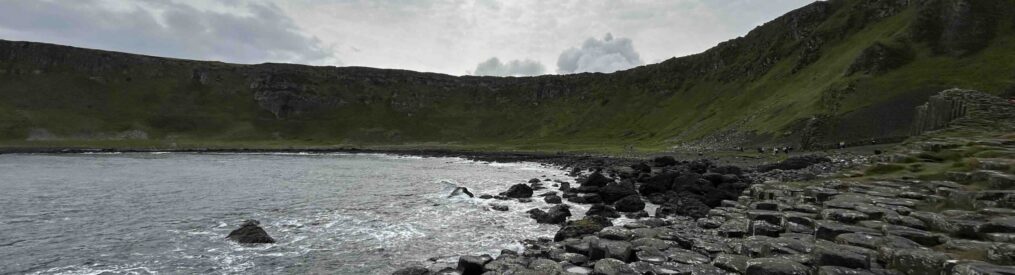
June 10th – Stormont Visit
Hi! My name is Sam Rokoszewski and I am a 4th year Health communications major. I am covering Day 10 of our trip, this was the day we travelled to Stormont, as well as our final meeting on Day 11 with Bebhinn McKinley. Unfortunately, all of the politicians were in assembly meetings this day as there were anti-immigration protests the night prior and they had to find a way to combat them the following day.
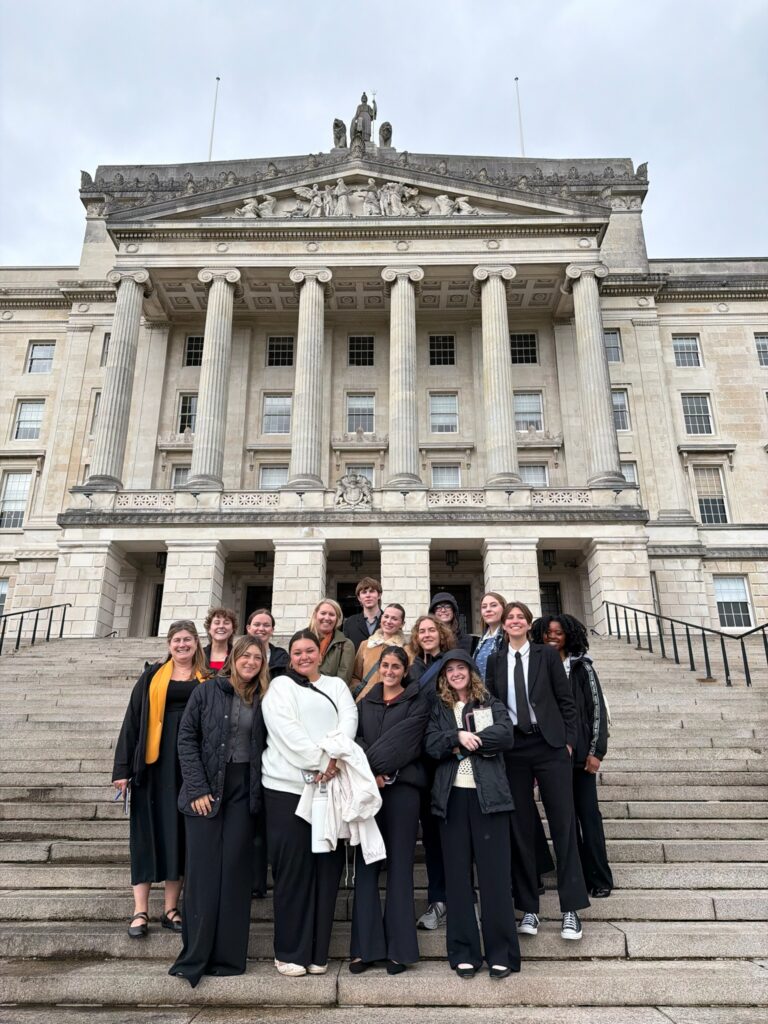
Stormont is an old estate that was taken over by Parliament in 1932 located in Belfast the capital of Northern Ireland. The Parliament of Northern Ireland inhabited many other spaces in Belfast before deciding to take this estate. They paid 20,000 pounds for the grounds at the time. The Prince of Wales was the individual who came to properly open Stormont as a Parliament building which is why the road leading to the estate is named Prince of Wales Avenue.
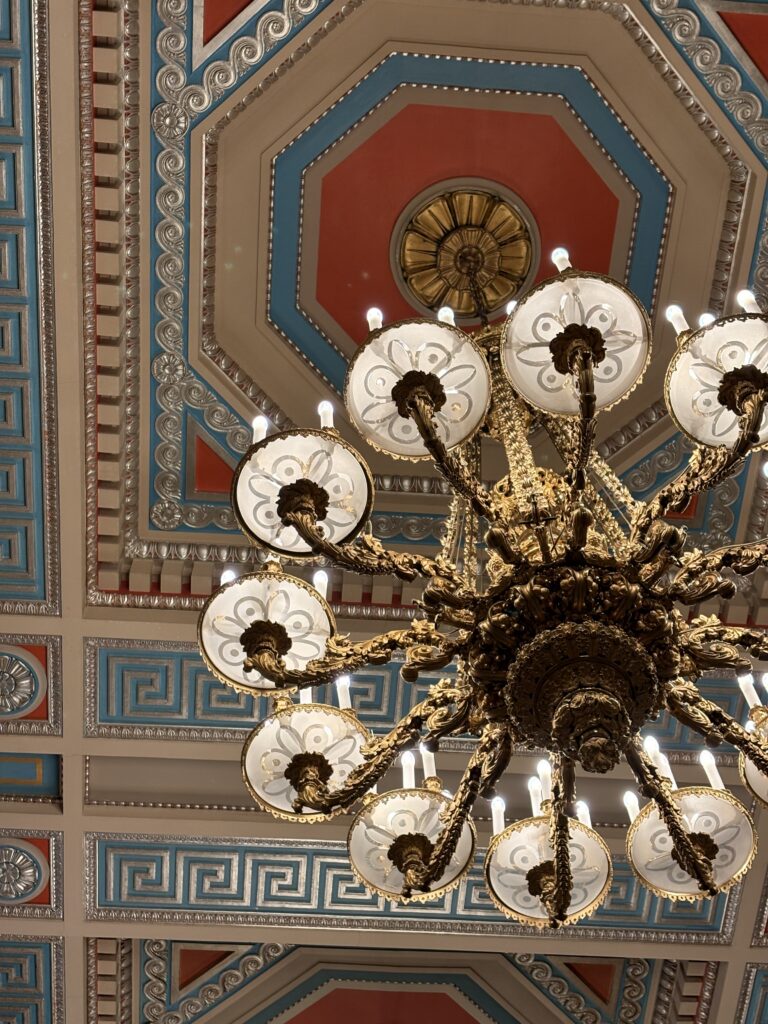
The building has fire proof and dust proof paint as you see in the picture below. There are 4 chandeliers made of 24 karat gold hanging from the ceiling as well in the grand hall. There is also a greek key design to the paint on the ceiling and it is an “unbroken, interlocking pattern made it a symbol of both unity and infinity.” (Calder). This is perfect for the Parliament building as it continues to emphasize the need for unity within the building. Within the Grand Hall there are paintings of former first ministers, deputy ministers and speakers all of which are accompanied by a plaque letting you know who they are and what they have done.
There are six stories to the building, the second floor is dedicated to the senate chamber and the first floor is for the assembly and house of commons.
Within the senate chamber there is a table in the center of the room with governing oppositions on opposite sides of the table. There are 27 senators that sit within this chamber of parliament. From 1932 to 1972 the senate was shut down due to the conflict that was occurring within Northern Ireland. After the conflict there were committees created to address specific issues that need to be addressed within their parliament. Some being education and healthcare.
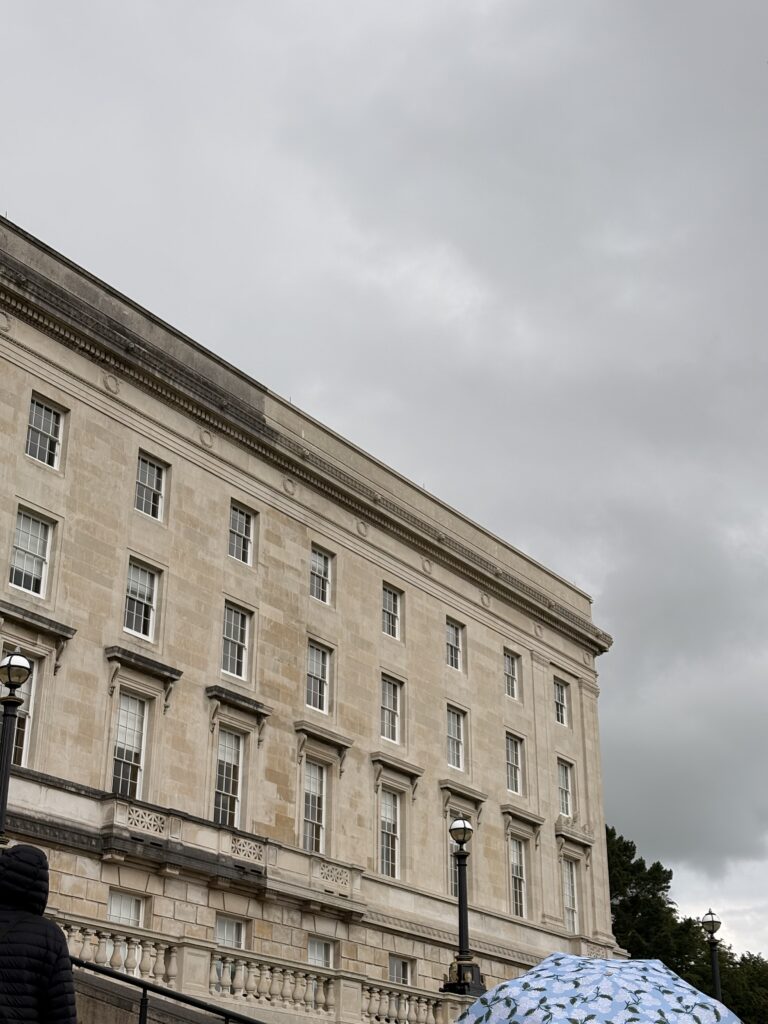
An interesting little fact about Stormont we were told by our tour guide, Katie, was that during WW2 the Royal Air Force inhabited the senate chamber. Due to their presence in Stormont it made the building a prime target during the war. They decided that they needed to camouflage the bright white building on the top of a hill and did so by adding foliage to the roof and smearing cow manure and tar to the sides of the building as a sort of black “paint”. To this day they are still trying to remove the tar and manure from the sides of the building as it stained the white building. In the image you can see the line on the building where they have removed the stain and where it still remains.
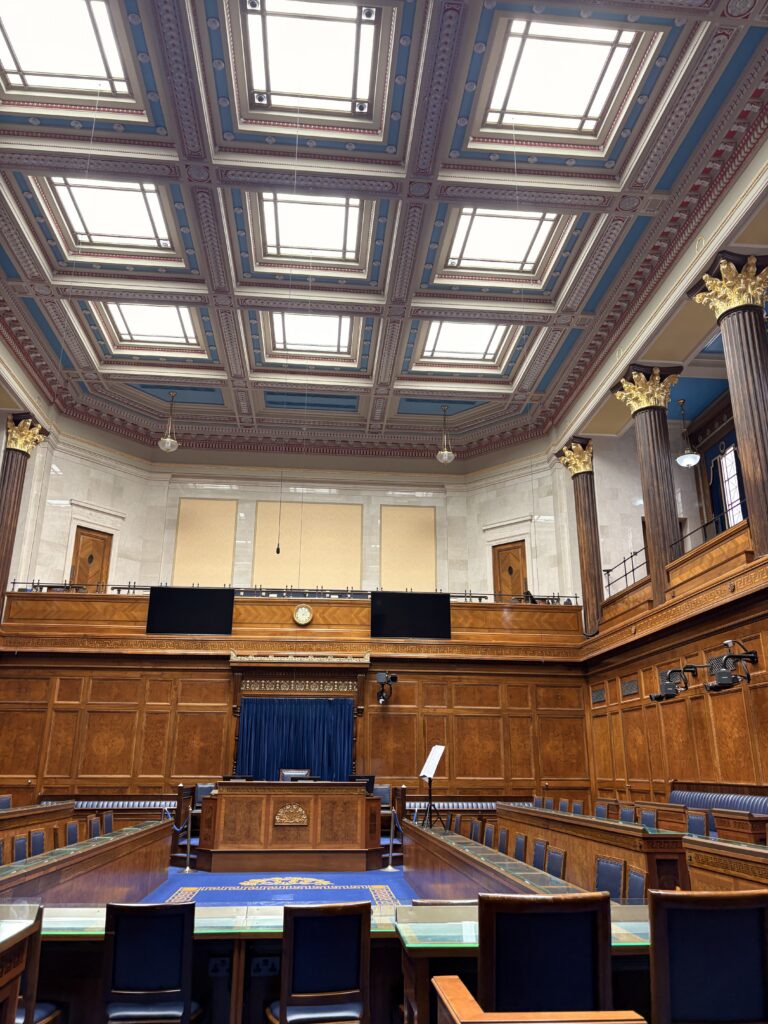
We then talked about the Assembly chamber and were able to go into the chamber as it was not being used for meetings at the time. There are designated times for the assembly meetings and the public are able to come and listen in to the conversations. On Mondays the MLA’s, Members of Legislative Assembly, meet and talk at 12 and on Tuesdays they meet at 10 AM. These meetings can last as long as they want, there have been meetings in which they talked for over 10 hours.
When the room was first built it was in an adversarial layout, just like the senate chamber. However, in 1995 during Christmas break there was a fire that broke out in the Assembly chamber. It burned everything as the entire room was wooden. They had to rebuild and it cost 24 million pounds to do so.
That said, they were able to redesign the entire room. They changed the layout to a European U style allowing all individuals to sit at one continuous table. This was done to show that they were all sitting at the same table working towards a common goal together. They added cameras into the room as well so that civilians could watch the live stream of the meetings if they wished to do so. Currently, Sinn Fein sits on the left side of the table and the DUP sits on the right. Sinn Fein is currently the largest party as the first minister is from this party and the DUP is the second largest as the deputy minister is from that party. The alliance party sits in the middle of the U as they are a party that does not identify with nationalist or unionist beliefs. There are also smaller parties that sit next to Sinn Fein and the DUP. Some seats are known as “naughty seats”, where those who are part of a one person party reside.
Throughout the entire Stormont building there is everything in sixes, “representing the number of counties in Northern Ireland, Parliament Buildings has six floors and there are six pillars at the entrance to the building.” (Parliament Buildings Facts) Another one being an emblem, a bouquet of 6 flowers. The 6 flowers represent the 6 counties that are within Northern Ireland. I thought it was beautifully put as it shows a connection within a country that is so divided and currently working towards unity and peace. They used flowers to pay tribute to their history with the linen mills. It is also a way of showing that it is a process when governing a nation. The idea that when a flower blooms it also grows. It is a process and it is a way of wishing for a brighter future for the nation.
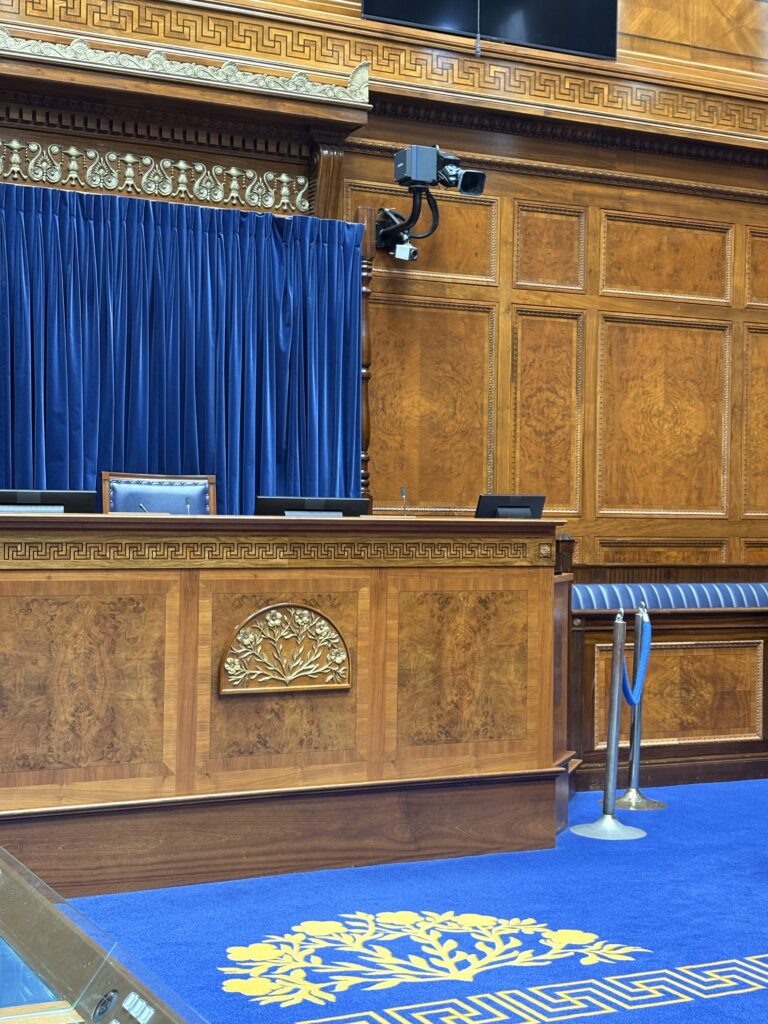
Something unique about Northern Ireland is that if one party does not want to sit in Assembly then no one can sit. This seems to reinforce the black and white mindset that was ingrained in individuals minds during the conflict. The Us versus Them mindset. The Northern Ireland Government is the longest one to not sit, and when they are not sat then the English parliament has direct rule and say as to what happens in Northern Ireland. The Irish President does not come to Stormont and neither does the King of the United Kingdom as it shows a favoring of one party over another and the entire goal of Stormont is to have cross community working and a balanced and equal environment to do so.
I think is important to note the way in which citizens feel about the power that Stormont holds. Many civilians do not think anything productive occurs in the building. When we were approaching the building our bus driver welcomed us to the place on the hill where absolutely nothing goes on. He told us that he “never has voted, never wants to, and never will vote” (Buz the bus driver).
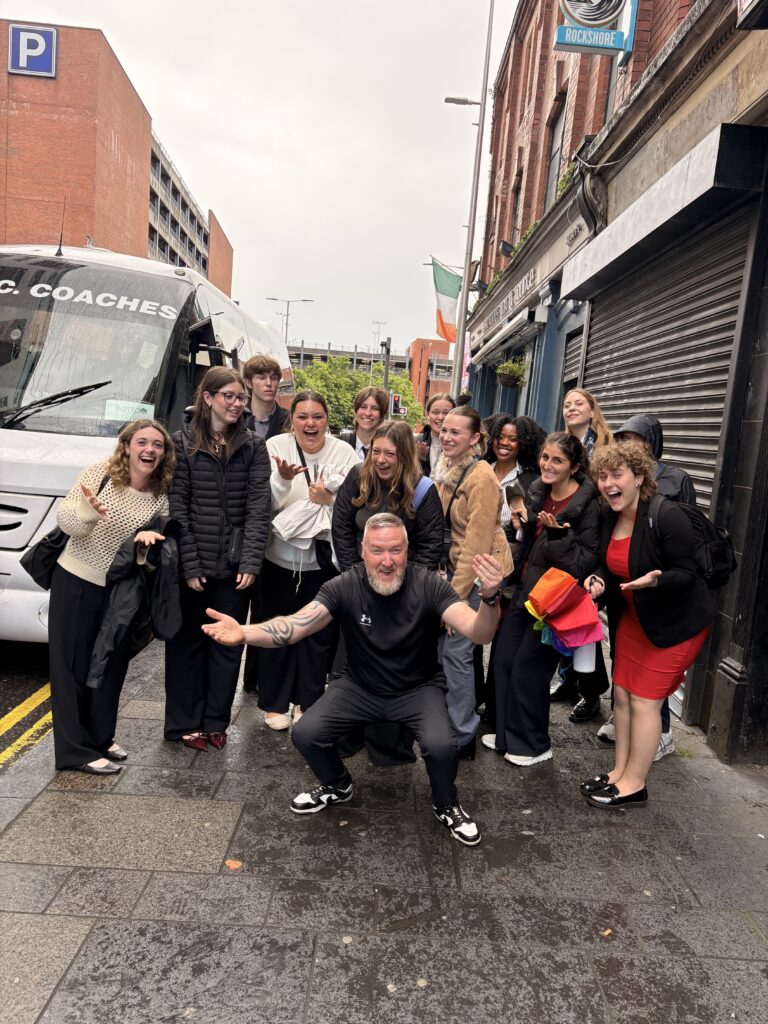
A communication concept that I feel connects to Stormont is how nonverbal communication through the design of the space is impacted, this is also known as proxemics. The arrangement of the environment can communicate ideas and values as well as shape the interactions individuals have with one another. Proxemics is defined as “the study of how people perceive and organize the spaces and distances they maintain between each other in culturally specific situations” (Danesi). Edward Hall researched proxemics in 1959 and created 8 factors that play important roles into what proxemics is. They are postural sex identifiers, sociofugal/sociopetal orientation factors, kinesthetic factors, touching factors, visual factors, thermal factors, olfaction factors and vocal factors. The factors that are present within Stormont are the sociofugal/sociopetal orientation (the layout of the rooms), visual factors (eye contact), and even vocal factors (showing dominance by raising their voice). (Danesi). This was very evident in the Assembly chamber as the room was originally designed with an Adversarial layout with the different parties sitting across from one another around a table. This created a physical and mental division as well as cultivating the us versus them mindset and is greatly reflected in the conflict of Northern Ireland. After the fire in 1995 the room was redesigned and had all parties sitting at one continuous table. This environmental change also changed the mentality of Assembly members and communicated the commitment they made to collaboration and shared problem solving. The emblem of Stormont shown throughout the building also is a form of symbolic communication. The representation of the 6 counties within Northern Ireland as well as showing the desire for unity and growth within the nation. These both demonstrate how important it is to have an environment in which symbols communicate powerful messages surrounding identity and continuing to strive for peace.
June 11th – Final Discussion
I also covered the final conversation of our trip with Bebhinn McKinley and Daniel Wehrenfennig. Bebhinn was once a good relations officer in Ireland and was born in Dundalk which is the city directly south of the border. She shared how the conflict within Northern Ireland directly affected her family. She grew up in a small community where violence was normalized and personal. She knew many individuals who passed due to the violence including her own uncle. Her uncle was a member of the IRA and was shot in bed with his wife right beside him. Both of Bebhinn’s parents are from Northern Ireland, her dad was an ex-prisoner and committed another violent act and was quickly on the run. He became internally displaced due to the conflict and became wanted by the RUC. Stories like this one reminds us that the conflict was not just a political event but it was experiences that shaped and changed everyday lives of ordinary people.
One theme that continued to be present throughout the entire trip was how impactful trauma is. Even with the Good Friday agreement being signed around thirty years ago, individuals are still carrying emotional damage from the conflict. Bebhinn talked about how communities are still struggling with how to handle memory, grief and the questions of justice. There are debates surrounding legacy issues, including proposals of a blanket amnesty. These show how there is still disagreement about how we should be addressing and remembering the past.
At the same time we learned about all of the ways the country is trying to move forward. There are community dialogue programs, women’s leadership initiatives, and cross community projects all creating opportunities for healing and forward thinking. She emphasized how important it is to have conversations, active listening and relationship building between the different communities that were beyond divided at one point in time. Breaking down the miscommunication and misconceptions is essential to rebuilding the trust.
My biggest takeaway from our final conversion was that peace is not a final destination but it is a constant and ongoing process. Northern Ireland has made lots of progress since the Troubles however history is still influencing politics, identity and everyday life. The resilience of the Northern Ireland people is amazing, they are all committed to continuing to have conversations that are difficult and uncomfortable. All showing that reconciliation requires patience, empathy and a willingness to talk out the difficult and traumatic experiences together. When leaving Northern Ireland I have gained a better understanding that peace is not just the absence of violence. It is a continuous strive to work through trauma, create safe spaces for dialogue between communities and build relationships with one another. All of the stories we have heard throughout the trip remind me that communication has the power to create new possibilities for understanding as well as creating peace.
More information:
Live stream of Assembly meetings
Citations:
Loth, Calder. “The Complex Greek Meander – Institute of Classical Architecture & Art.” The Complex Greek Meander , 4 Dec. 2016, www.classicist.org/articles/classical-comments-the-complex-greek-meander/.
M. Danesi, Proxemics, Encyclopedia of Language & Linguistics (Second Edition), Elsevier, 2006, Pages 241-243, ISBN 9780080448541, https://doi.org/10.1016/B0-08-044854-2/01441-3.(https://www.sciencedirect.com/science/article/pii/B0080448542014413)
Parliament Buildings Facts, www.niassembly.gov.uk/assembly-business/office-of-the-speaker/80th-anniversary-open-day/parliament-buildings-facts/. Accessed 22 June 2026.