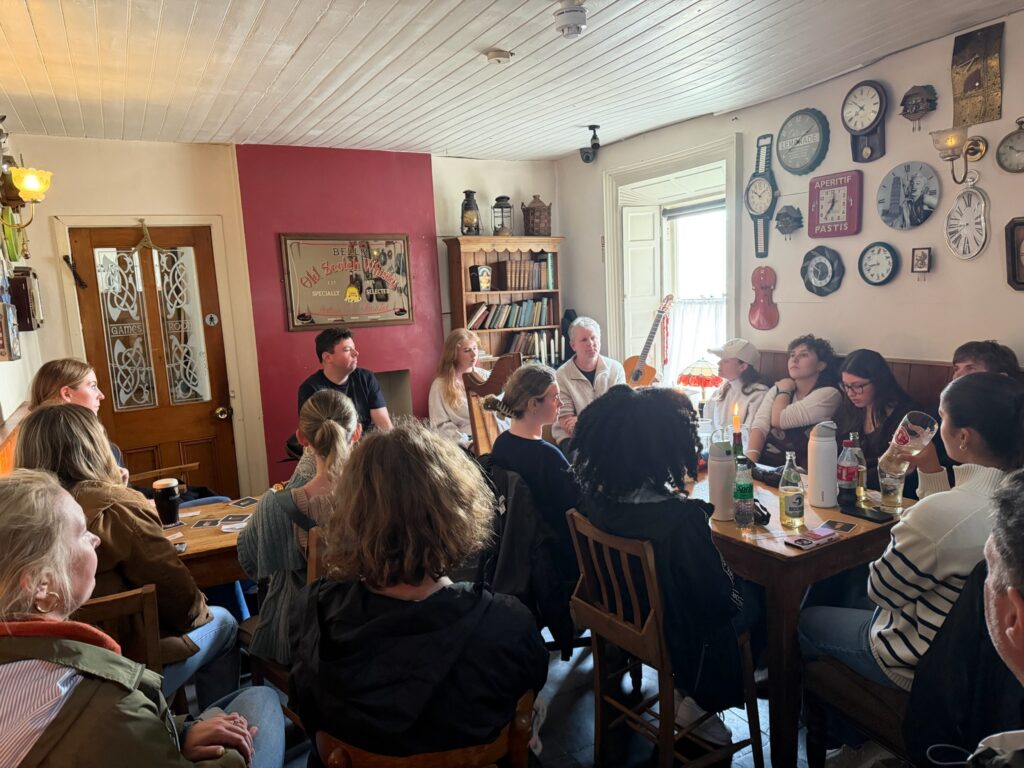
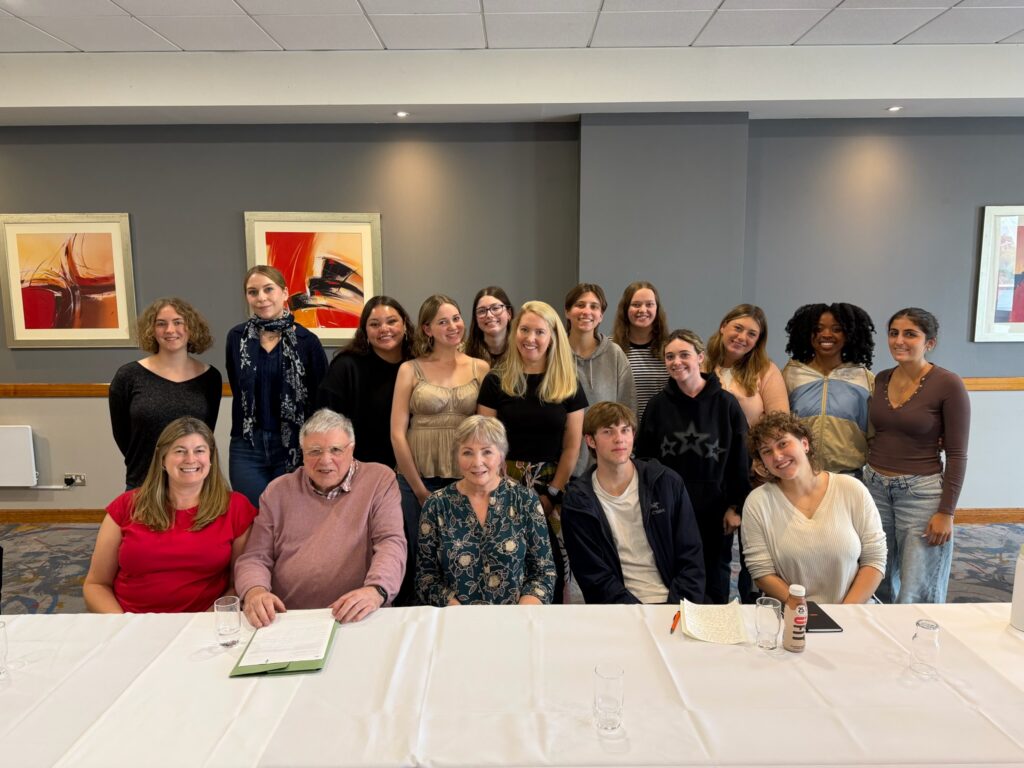
Over the course of the 12 days we spent together in Northern Ireland, there were multiple highlights and days that stuck out to me the most. The day we spent learning about traditional Irish music and walking to the pubs was probably my favorite part. I really enjoyed when they had us close our eyes and listen to the uilleann pipes. It was so amazing how when you closed your eyes and just listened to the music that you were transposted to a whole different world. So many of us said that when we closed our eyes it almost felt like we were transported to hundreds of years ago and could feel the land. I absolutely loved getting to also hear them share about the Irish language and how even in all the efforts to kill it, Gaelic has survived and so many people are making efforts to learn it and know more about their history.
Photo from traditional Irish music tour
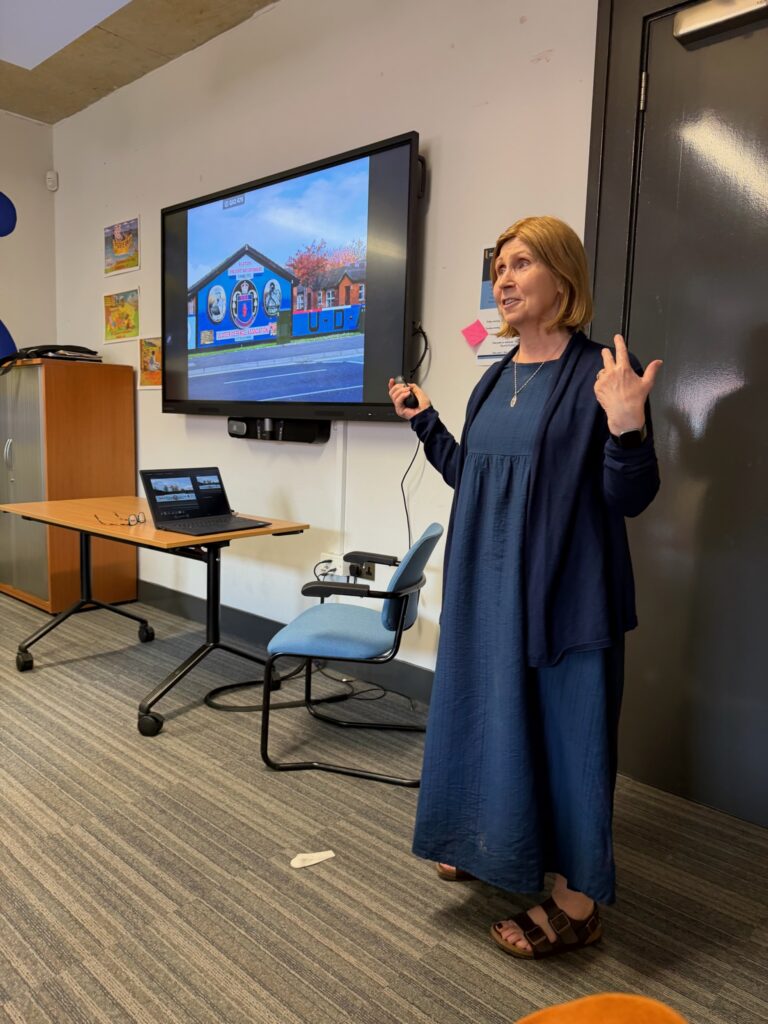
That takes me into the next part of the trip I enjoyed the most and that was speaking to Linda Ervine. Linda is both a teacher and someone who has advocated for the teaching of the Irish language. She started her own group where she taught both Catholics and Protestants the language, and through this also helped create community among members as well. In 2021 she started her own primary school to teach integrated children Irish. However, she was faced with a lot of backlash and hate from people online. Threats were made to her which halted the process of opening the school. However, she did not want to let the ignorance and hate of others stop her from teaching and bringing communities together. One quote I took down from her said, “some people will never be able to change, but that shouldn’t hold the rest of us back.” Linda had a passion for teaching and wanted the people of Northern Ireland to learn their native language. I loved hearing her speak as she had the most positive and optimistic outlook on life. You could just tell by her presence that she was genuine and cared a lot about what she did.
Photo of Linda Ervine
The biggest challenges I faced during this trip were adjusting to the culture and experiencing homesickness. Spending time in any new place can be challenging and as someone who is really close with their family, I struggled a lot with being away from them in a whole new environment and a different country. However, meeting everyone on the trip helped me feel so much more comfortable. I loved getting to know everyone and creating connections that will last way beyond just our travel course. Another thing I struggled with on our trip was the adjustment to the culture and environment in Ireland. This was my first time being in a different country and it was definitely a challenge to adjust to the food, weather, transportation, accents and environment as a whole. That being said, having the experience of traveling to a new country, learning about their history and culture, and getting the opportunity to create new relationships with other Chapman students is something I will always cherish.
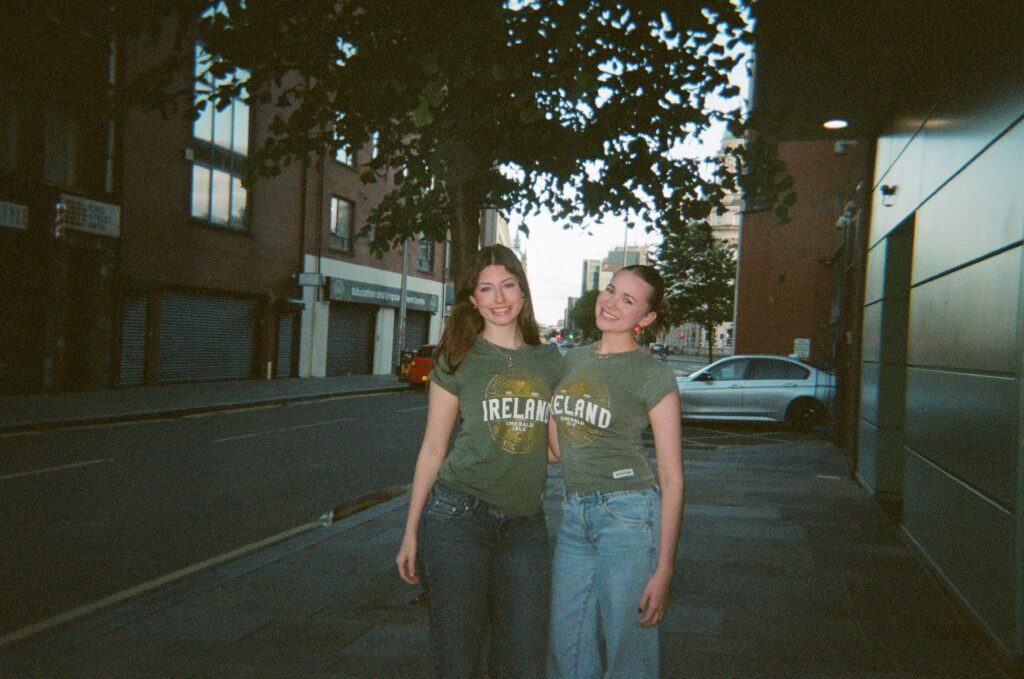
Photo of Claire Santo and Faith Dunscombe
Photo taken by Claire Santo of Kaite Clark, Faith Dunscombe, Sam Rokoszewski, and Ruth Belinsky
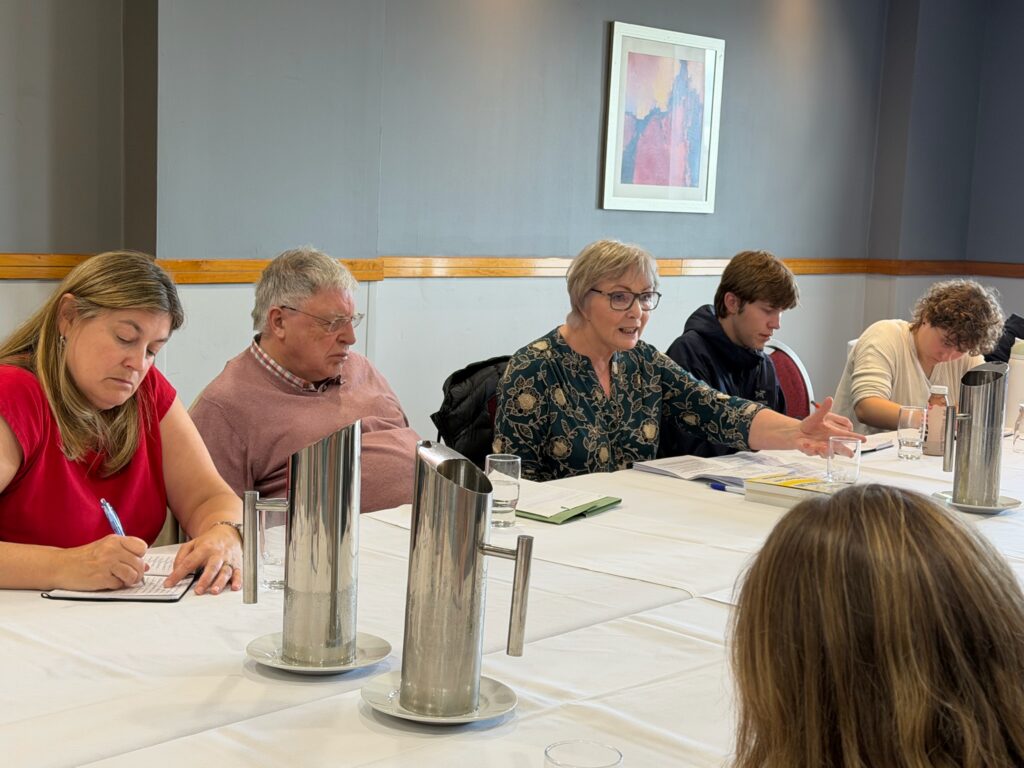
On the 8th of June we got the privilege of talking to Johnston McMaster and Maureen Hetherington. Maureen, former CEO of The Junction, has worked with Jonston towards uniting people and allowing space for those affected by the conflict to share their stories. She believes that peace was not created by politicians, but was created by the people. She talked to us about how so many she worked with didn’t know their own history, let alone other sides. She shared how her husband was a member of the police force and on his first day of work he was shot. Luckily, he survived but was left badly injured. This made her question, “why would somebody lift a gun and shoot someone?” (Hetherington, 2026). As she got into peace work and began talking to survivors of the conflict, she learned that so many she spoke to didn’t see their enemy as people. This led her to begin the Toward Understanding & Healing project and then later, the Ethical and Shared Remembering project. The idea of both projects was for people to change how they think of one another and to bring together all sides of the conflict including the IRA, UVR, police force, military, etc. They brought people to a safe and secure location with carefully organized breakout rooms to get a wide range of sides and experiences so participants could hear from all kinds of people opposite themselves. Many of the people she worked with said this was the first time they felt they could fully talk through their emotions and experiences. Participants were able to share without interruption, challenge, or judgment. She started these programs not to be the only one, but to inspire other organizations to take on the same initiative and help programs like this one grow and spread across Northern Ireland. Maureen described her work with Johnston as, he comes up with the ideas/methods for fostering a safe and open space for those who need support and she deals with how to get those programs facilitated to the people.
Johnston went over his way of thinking and how he approached post-conflict repair. One thing he mentioned was the question, “Could we remember ethically, and could we remember together?” (McMaster, 2026). He wanted people to not just cherry pick what they wanted to talk about or recognize from the conflict but to remember everything. Even if it was uncomfortable it was important to hear and respect all sides. Johnston also talked to us about the 3-strand framework when it comes to reconciliation. This framework focuses on narrative hospitality, narrative generosity, and narrative flexibility. Narrative hospitality allows participants to look and listen to different views of history and to be prepared for opinions different from their own. Narrative generosity looks at histories in the plural and how the past is not always black and white. Narrative flexibility says history isn’t static and one must have flexibility to take in new information about the past that isn’t necessarily the same as theirs. The 3-strand framework was the basis that Ethical and Shared Remembering was built on. In 2021, two more strands were added, narrative enlargement and narrative repair. Narrative enlargement looked at the importance of recognizing the imperialistic context of history. Narrative repair looked at recovering the voices of those who went unheard, especially women. The conversations and community that has been built around this project has given so many voices a chance to be heard but also to listen. However, when it comes to the conversation surrounding a united Ireland, Johnston says, “we haven’t done the homework” and that though many want a poll to be held in 2030, people need to spend more time seriously looking at the future and what a united Ireland means (McMaster, 2026).
Photo taken by Daniel WehrenfenningPhoto taken by Daniel Wehrenfenning
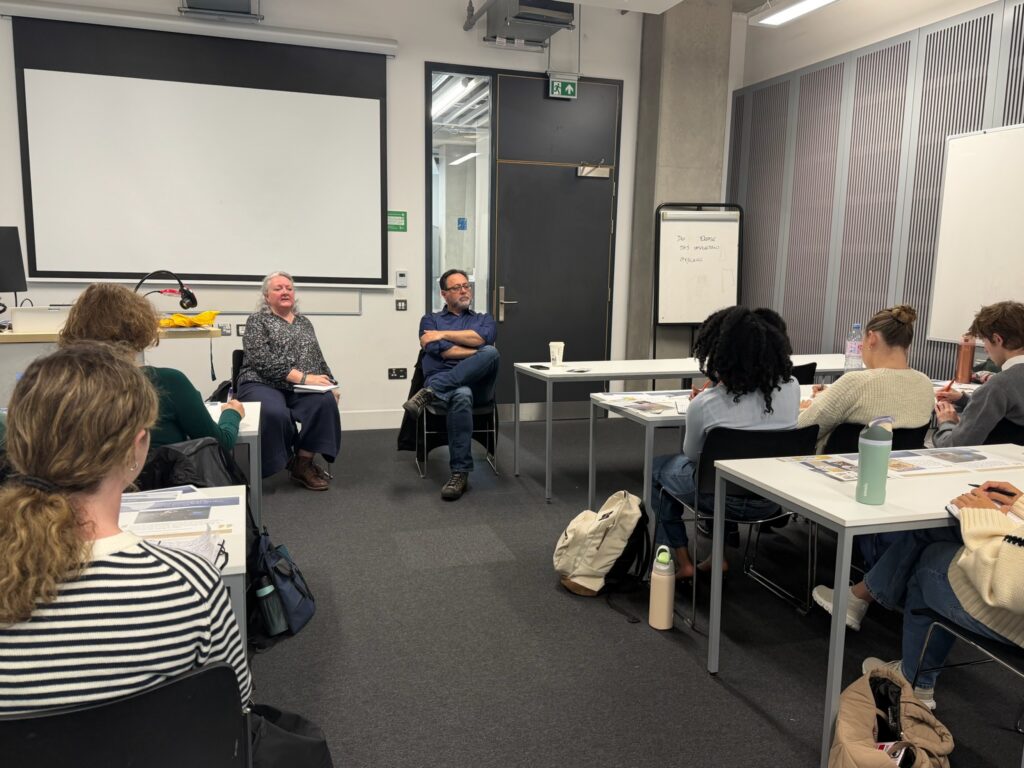
The next day on the 9th of June we spoke to Kate Turner. Kate is the director of Healing Through Remembering which began after the Belfast Agreement in 1998. So much of her work has been about relationships and connecting people. She says, “We see Healing Through Remembering as a question, not a statement” (Turner, 2026). It’s a place where you do bring politics into the conversation and discomfort and disagreements can happen but in a controlled and safe space. To Kate, she believes there needs to be a space where both peace and acceptance as well as politics and disagreements can be present. She spoke about how Northern Ireland hasn’t fixed their issues but rather placed a band aid over them. Healing Through Remembering pushes to face the issues that Northern Ireland still faces and make real and effective change through conversations with the people. Alongside her work with Healing Through Remembering, Kate has also worked on the exhibition, Everyday Objects Transformed by The Conflict. This exhibition takes a wide range of everyday objects given on loan that represent different meanings to different people throughout the troubles. Some of the items in the exhibit include, a bullet proof clip-board used by police forces, a matchbox with the unionist slogan, and even a trash bin lid that was used by republican/nationalists areas for street communication. This exhibition showed how simple objects like a single brick can be transformed into a weapon when thrown in a riot. The exhibition was set up in 2012 and is still around today. Though the exhibition does not have a permanent home, it travels to different places around Northern Ireland and features changing items loaned by survivors of the conflict.
Photo taken by Daniel Wehrenfenning
Both Maureen and Johnston’s project of Ethical and Shared Remembering and Kate’s Healing Through Remembering can be related back to the idea of Intergroup Communication. Intergroup Communication is the exchange of emotions, thoughts, and experiences between individuals from different social groups through symbolic interaction (Gorgulu, 2020). Through sharing stories and life experiences in face-to-face and safe settings, people from different backgrounds and perspectives can connect with one another and help reduce prejudice and the ‘us versus them’ mentality. We saw this so much throughout the trip and the conversations with Maureen, Johnston, and Kate were no different. They proved that through the process of open communication and listening, people can better understand those around them and begin the process of healing themselves and their community.