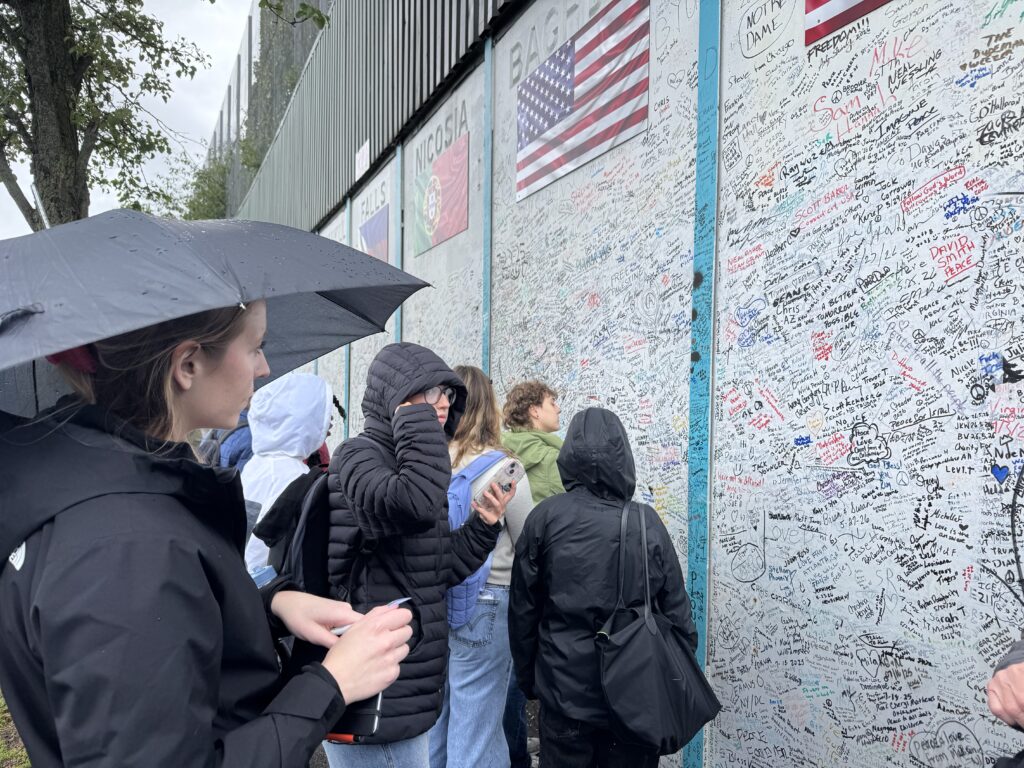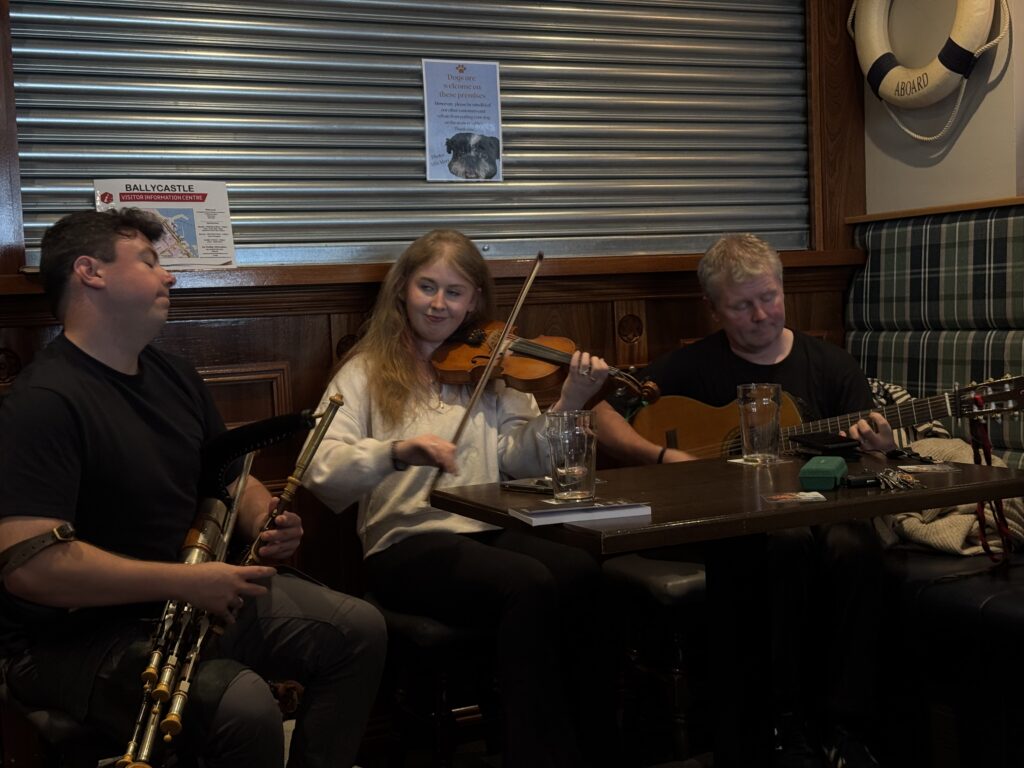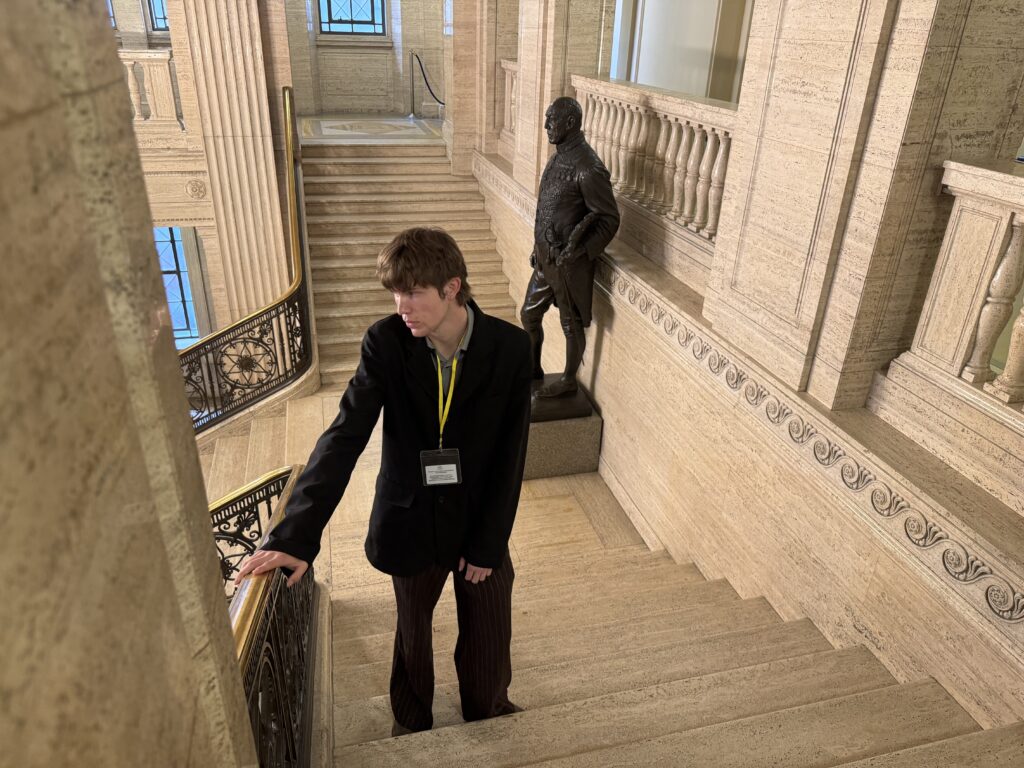
Entering this unforgettable travel and immersion opportunity as a Peace and Justice Studies major, I had predicted that I would learn more about core concepts integral to my studies which did occur, however I was completely floored by how in-depth and exemplified many of the peacebuilding tools were here. What has always been extremely compelling for me and a lens I have hoped to explore is the intersection between the arts and social change. As someone eager to research this further, there were a multitude of moments where I got to see the creative side to peacebuilding. Whether it was learning about the protest songs highlighted in exhibits at the Free Derry Museum like “We Shall Overcome”, learning about the preservation of traditional Irish music even against threats by police over its usage in bars, or hearing about the punk subculture as a way of dismantling divided identities, I found this area of my field of study to be eye-opening on how creative peacebuilding methods can get as a means of mobilizing change. One example in specific that stuck out the most to me was ‘The House’, a project that Dr. Katy Radford worked closely on, symbolizing the experiences of victims of ‘The Troubles’ uniquely through different scenes spread throughout a home. Eggshells on the floor symbolizing tensions, women juggling in the kitchen to represent the stress women were under, personal anecdotes from the conflict inscribed on furniture, and other theatrical elements all composed this project allowing viewers to see the chaos of ‘The Troubles’ through a different lens.
To me, my greatest takeaway was understanding how the different creative strategies to peacebuilding across the span of the trip illuminated the infinitely diverse approaches organizations take to tackle issues in post-conflict societies. Spending an evening at Corrymeela, seeing the power of games like “Red, Blue, Green” and their name game as mechanisms of bringing people together to foster a sense of understanding of differing perspectives and identities, it helped reinforce to me that peacebuilding doesn’t need to follow a structured archetype. Even organizations like Healing Through Remembering cleverly using everyday objects to uncover deeper experiences and histories in an exhibit to spark a sense of understanding of perspectives reminded me of how important creativity can be in fueling empathy.
Another element of this experience that was fascinating to see was the power of stepping up, people taking charge to make an impact in their communities. The commitment of so many leaders of organizations like Linda Ervine of Turas, the Irish language school, starting a program because nobody else did and working to foster community through shared learning of language was very inspiring to me. Hearing stories of initiatives like The Junction and JoinHer Network reminds me of the power of being the person to step up and make a change, demonstrating that we have the power to invent the future we want to see. Meeting individuals like Lee (an ex-British soldier) and learning about the experiences of those involved in the conflict, the diffusion of personal stories and the willingness for people to share them truly has the ability to move others and educate younger generations on the seriousness of violent escalation. These personal stories are some of the most valuable parts of the entire experience and being able to ask these individuals meaningful questions has instilled in me a greater sense of the human cost of conflict, and how perspectives can be so different.
My greatest challenges across the course in all honesty, came from a place of emotional sensitivity and the overload of information that accompanied my travels. While foundational to my newfound grasp of the conflict and its multidimensionality, hearing stories coming from the deepest emotional chambers of the speakers were admittedly difficult to listen to considering such violent and intense subject matter was often transparently intertwined into their honest accounts. Meeting with people directly tied to the conflict allowed me to comprehend the human cost of it all, seeing that both sides were victimized. As someone who considers himself to be sensitive to the core, I felt the weight of everything on a grand scale, with the stories of killings and sexual violence often carrying into my little pockets of analysis as I would lay in bed trying to defy jetlag. With such long days and a wide catalogue of knowledge to pick up on, there were definitely moments that felt somewhat daunting as I scrambled to interpret everything I had heard accurately. However, the acceleration of the course helped to push me out of my comfort zone, allowing a newfound sense of academic determination and stronger active listening skills. The magnum opus of challenges for me had to be the fact that my umbrella broke and would fly in various different directions at the mercy of the wind, leaving me rain-soaked at many times, however I think I managed to embrace the look.
There were lots of surprises on the trip that challenged what I had expected before going into it, many of which have reshaped how I view conflict but also my relationship to peer collaboration. Before the course I was terrified at the thought of knowing few people beforehand and entering a country halfway across the globe, especially one that I had yet to ever visit. However, my experience saw me making new lifelong friends and engaging in dialogue with my peers that brought creative new perspectives to light during our reflections. It was truly such an honor to travel with my peers and my companions, and my view of the conflict has been greatly reshaped due to them (so if you are reading this, thank you for everything). What stuck out to me the most is how there are still many structural barriers that perpetuate division among communities. Examples include the ongoing segregation of schools (According to the speakers at Lagan College, roughly 93% of schools are still segregated) and the roles of first minister and deputy first minister having to be fulfilled by either a unionist or nationalist at Stormont. Equally surprising to me, was the amount of grassroots organizations and initiatives taken to pursue a future where division is dismantled and shared identity is encouraged. Organizations like Turas, the Northern Ireland Women’s Coalition, Corrymeela, ACT Initiative, and The Junction all inspired me to want to start my own project to positively impact the communities around me.
There is endless gratitude for everything that I got to experience during this period of my life in Northern Ireland, and I encourage everyone to examine the grassroots organizations all around in our own communities. Taking my knowledge from this trip, I hope to implement some of the strategies we’ve encountered utilized by these groups into my own life and involvement in peacebuilding. Thank you to everyone who made this trip happen, it has changed me for good.