On June 4th, the group got to visit and stay at Corrymeela, a peace and reconciliation community in the outskirts of Northern Ireland. The experiences from Corrymeela were transformational for the group and my own perspective on conflict and the pathway to peace. Our time spent in Corrymeela was perfectly placed about halfway through our time in Northern Ireland and forced the group to more deeply consider what the peace process looks like and could feel like.
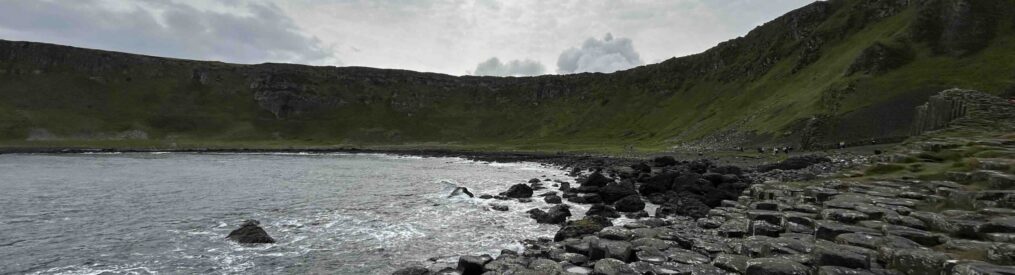
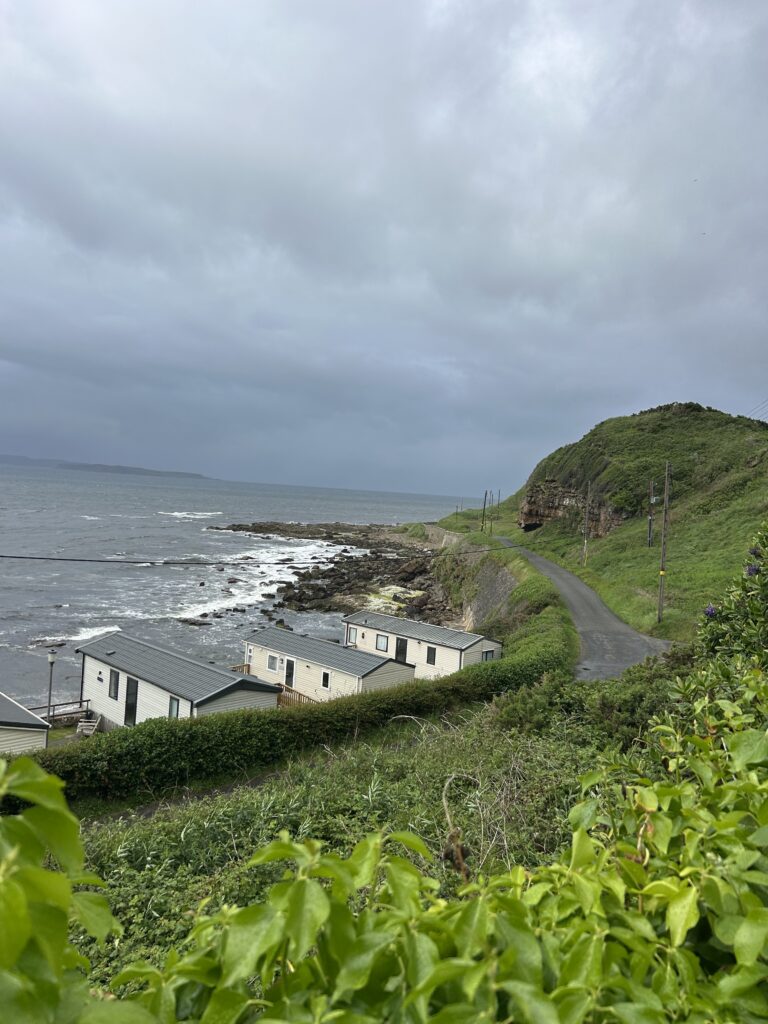
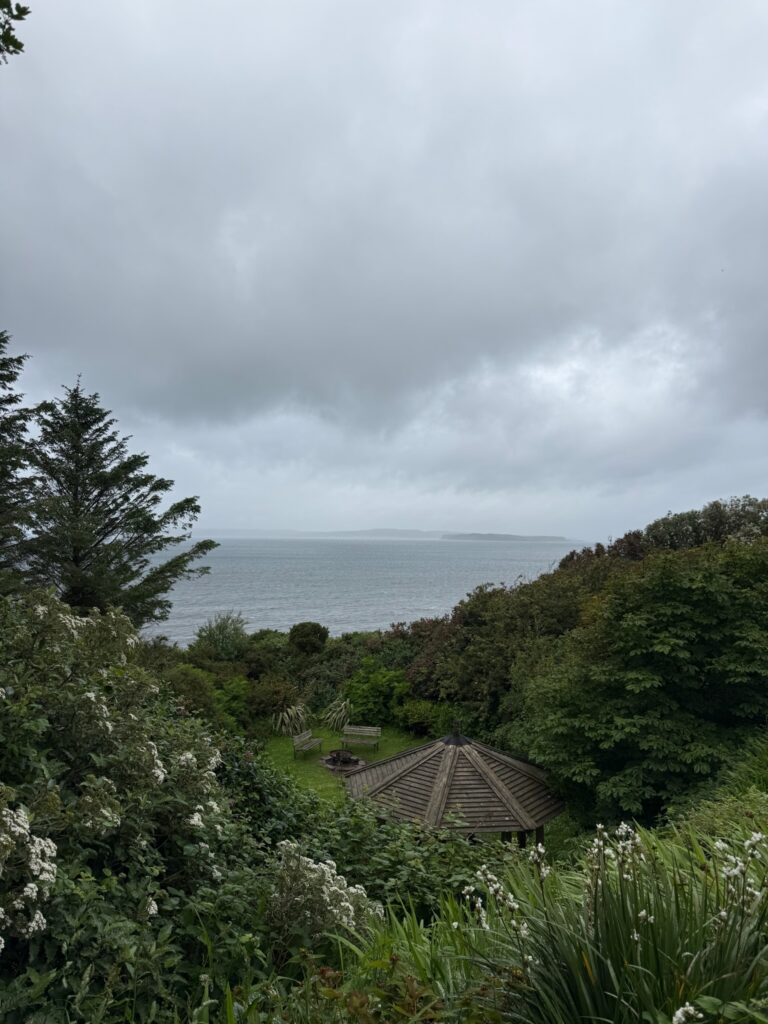
Quickly, the group noticed the unfathomable beauty of the area along the cliffs of Northern Ireland. Amazed by the beauty, we took some time to ourselves to explore the area and take in the landscapes. Little did we know, the placement of this space was completely intentional not only because of the beauty, but also because of the isolation it has from city life, and at the time, the conflict occurring across Northern Ireland. As the day went on, the group learned more and more about the intentionality of those staying at and working at Corrymeela. In introducing ourselves, we each stood and gave our names and the backstory and history of them, if we knew it. As Iulia, one of the leaders at Corrymeela, noted, this is a time for each person to tell others exactly as much or as little as they want to about themselves and are listened to wholeheartedly. Each person is valued for their story. This further promotes the community aspect at Corrymeela. Nearly everything is community centered and focused. This environment and communal feeling is something Corrymeela’s staff emphasize and what has made them such a successful space for open dialogue and trust building.
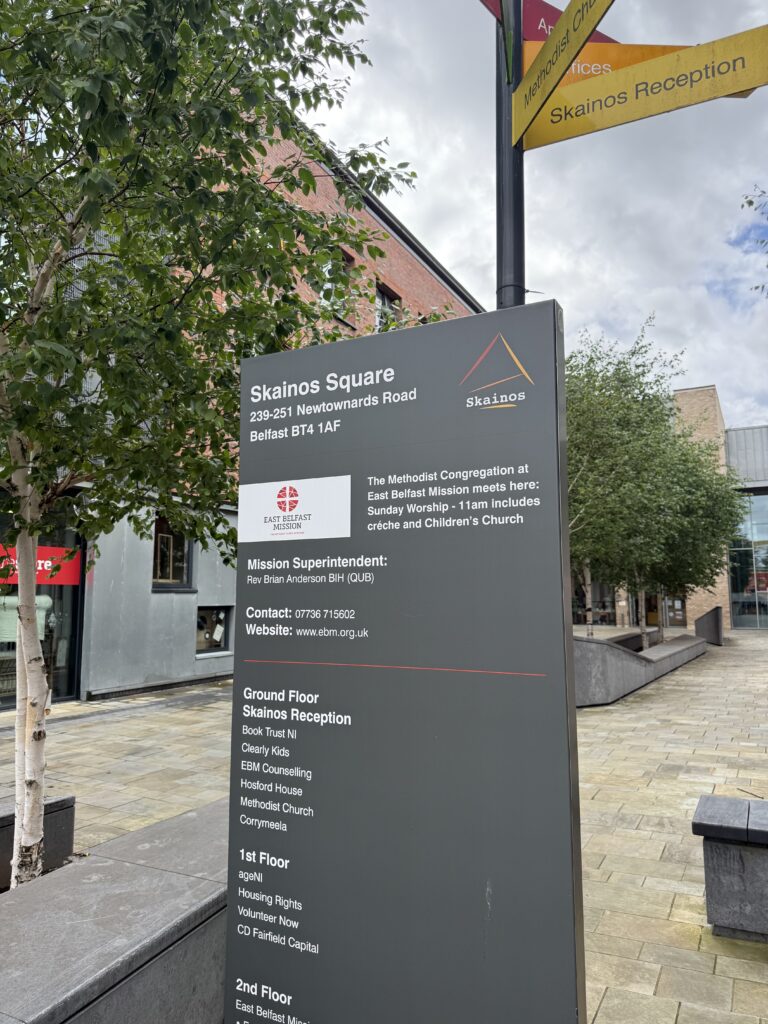
Photo taken by Vic Bullard (6/4)
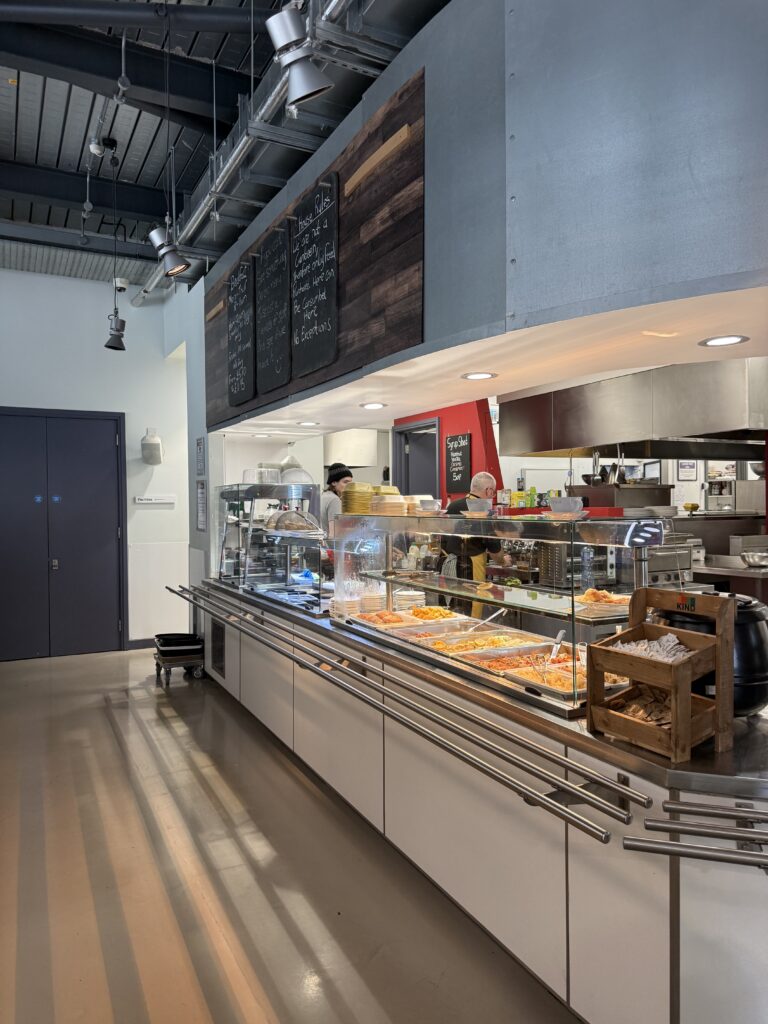
Photo taken by Leia Fidel (6/4)
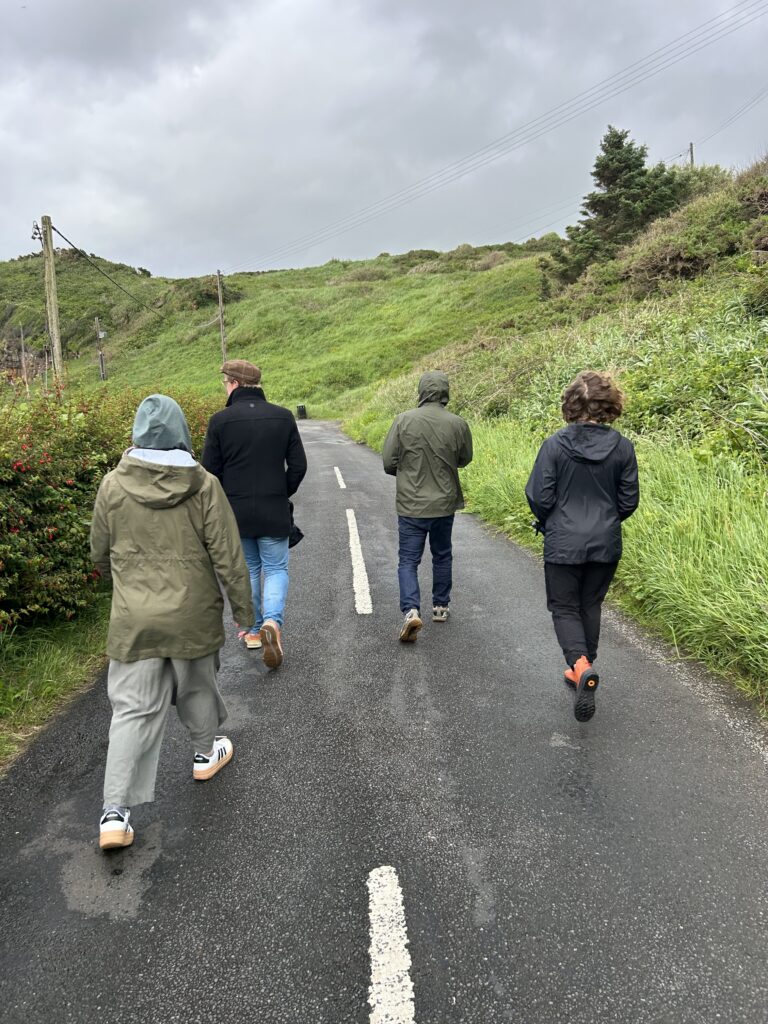
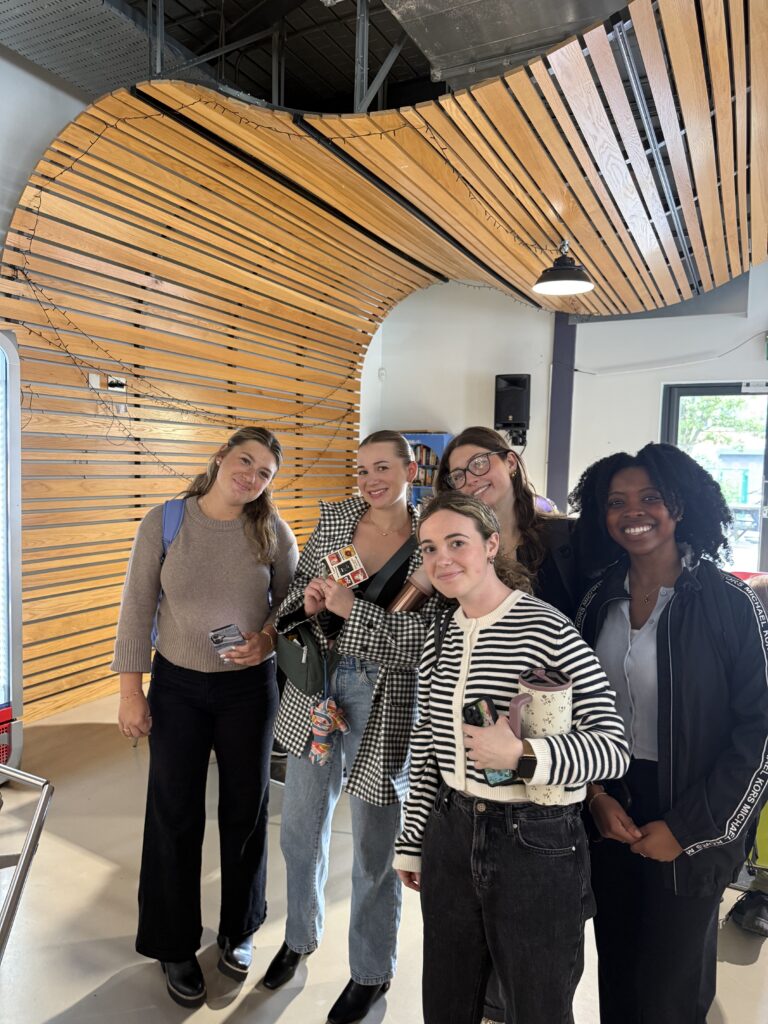
Photo taken by Uche Nwadiashi (6/4)
This idea of trust and conversation was emphasized and actualized later that day when we played a game called Red, Blue, Green. As we were split up into two groups, we each strategized ways to effectively play the game and win but not necessarily beat the other team. Despite each team having the same goal in mind, to win, the ways they went about it were different, and the conversations within the teams were complex. Some people took more charge than others, and at times there was intergroup conflict on what color to choose each round and assumptions about the other group. In the end, both groups tied, which means both sides won since the numbers were both positive. Although we didn’t realize it at the time, this game helped emphasize the struggles of the reconciliation process and trust and community building. Our class went into this game as a close-knit group who had inherent trust in each other anyways and still mistrusted each other and questioned the other groups behaviors. Yet, we were never in a 30-year conflict with each other, nor had villainized one another.
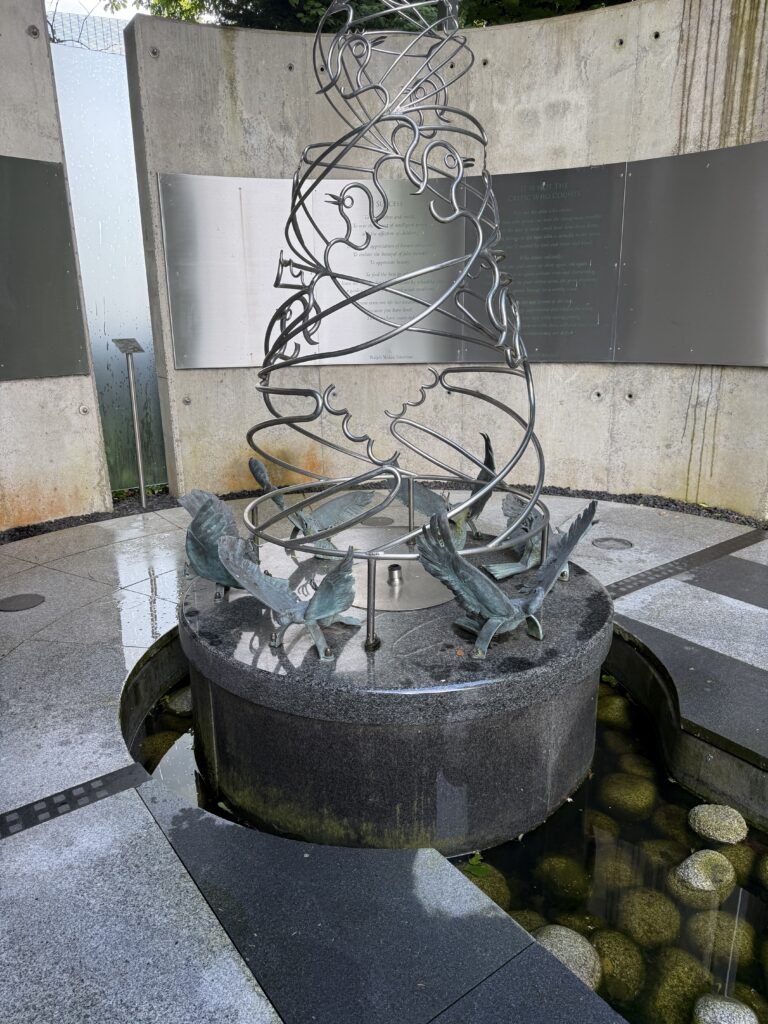
Photo taken by Leia Fidel (6/4)
As David Bloomfield mentions in his handbook, Reconciliation After Violent Conflict, reaching peace and reconciling is different for everyone, but open dialogue is vital (2003). Going through this trust demanding game as a unit, we relied on the opportunities to converse with the other group to determine our course of action. During times of conflict this trust and opportunities for open dialogue are not always as easily accessible or reliable. Yet, Corrymeela played an active and important role in the peace conversations had between paramilitary organizations and other actors in the conflict. With their physical isolation, these participants were able to disengage with the conflict plaguing their everyday life and lean further into having conversations with the ‘other side’. Hearing and understanding each other is the first step in effective dialogue and peace building (Bloomfield, 2003).
Photo taken by Grace Granger (6/4)
While having the space to have these conversations, upon leaving Corrymeela the real test began to see if either side was genuine in their promises. This is something the two teams struggled with while we played Red, Blue, Green. After making a promise to only play red for the remainder of the game, one team played green, which didn’t hurt either side, but helped that team. This required the other team to decide if they should continue trusting them or take their shift in action as a break in trust and hostile move. This demonstrates the fragility of trust and often conditionality of trust. As Iulia pointed out in our post-game discussion, the most commonly used word is “they” because each group is focused on what the other one is doing, thus questioning the strength of their trust in each other to begin with. If both sides are sitting there questioning the other side and their possible actions, the trust is already significantly lacking. Despite our game being a very small comparison to the peace conversations actually occurring and the process to peace and reconciliation, it helped all of us to recognize how difficult and nuanced the conversations would’ve been and how impressive it is that the peace present in Northern Ireland today was able to be agreed upon. Bloomfield also notes how some restructuring can be significant to community’s post conflict, which has been demonstrated through the Belfast Agreement and subsequent action by the government and people in Northern Ireland.
Photo taken by Claire Santo (6/4)
Overall, the peace process and reconciliation efforts in Northern Ireland are unbelievable, but also bring a sense of hope and reassurance to the conflict-ridden world we live in. Oftentimes, conversation is overlooked in times of conflict, but as Declan Murphy, an Armagh politician, noted, “wars are often not won on the battlefield” (2026). The experiences at Corrymeela, and their emphasis on community and listening, helped our small group bond and trust each other more, while also being as effective in larger spaces with more tension ridden groups. Places such as these make peace processes possible and the end of conflicts more desirable than the opposite.
References:
Bloodfield, David, Teresa Barnes, and Luc Huyse (2003). Reconciliation After Violent Conflict: A
Handbook. International Institute for Democracy and Electoral Assistance.
Gullion, Slieve (2026). Cllr. Declan Murphy. Sinn Féin.
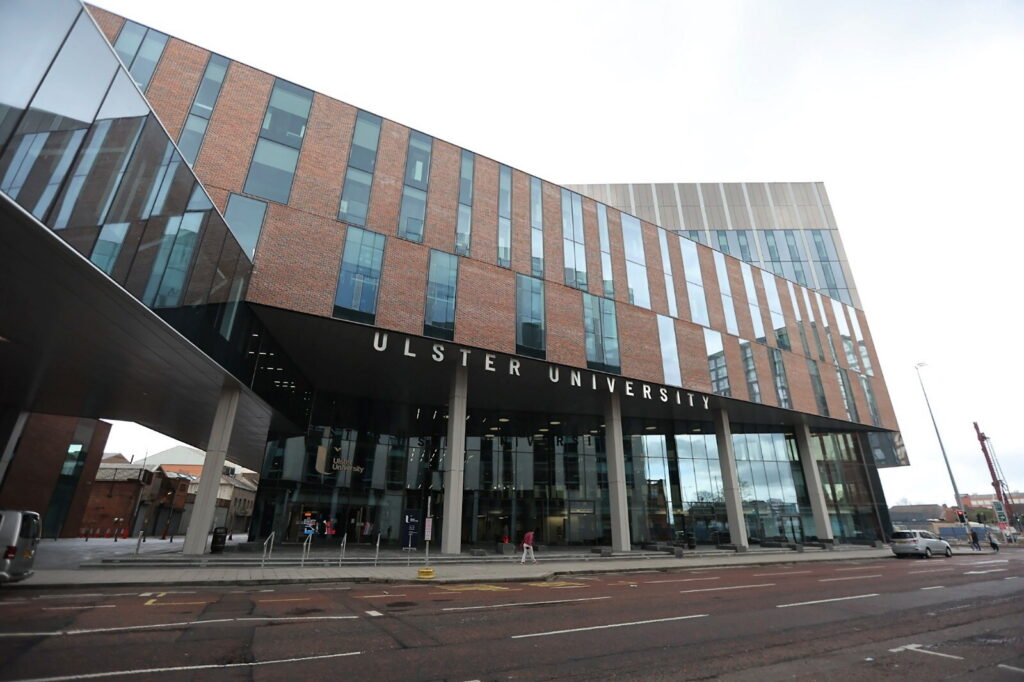
Tuesday, June 9th was our first day back in Belfast after spending about three days in Derry/Londonderry. In the morning, we walked to Ulster University to meet with Kate Turner and Brandon Hamber. Ulster University is the largest university in Northern Ireland, with three campuses across the country. It also stands as a testament to the progress made in Northern Ireland, as the building is made mostly of glass and stands in what was a historically violence-prone area of Belfast.
Front view of Ulster University in Belfast
After exploring a local shopping mall’s food court for lunch, our group met with Avila Kilmurray to discuss her role in community peacebuilding in Northern Ireland. The day ended with a group reflection and a free evening exploring Belfast. However, it would be remiss of me not to address that that evening was the start of what would be several days of violent anti-immigration rioting across the country, centered in Belfast, in response to a stabbing on June 8th. The week ended with hope, though, as thousands gathered at Belfast’s City Hall to participate in an anti-racism protest on June 13th. While not directly related to our studies, the events of our last week in Northern Ireland added to our conversations about the ongoing and evolving tensions still present in the country.
This blog will focus mainly on our group’s conversations with Brandon Hamber and Avila Kilmurray, as our discussion with Kate Turner will be covered by another blog post. Brandon Hamber is a professor and holds the John Hume and Thomas P. O’Neill Chair in Peace, which is based at the International Conflict Research Institute (INCORE) at Ulster University. INCORE has groups studying migration and heritage, gender, oral history, archives, and storytelling, and remembering the past. In regards to the conflict in Northern Ireland, one of Hamber’s areas of study is in the complex forms of masculinity present during and after the conflict. Avila Kilmurray is a prominent women’s activist still active in Northern Ireland today. She is the former director of the Community Foundation for Northern Ireland, and helped found both Derry Women’s Aid and the Women’s Coalition. Our meeting with Kilmurray was much needed as she brought to our studies the overlooked roles women played throughout the peace process.
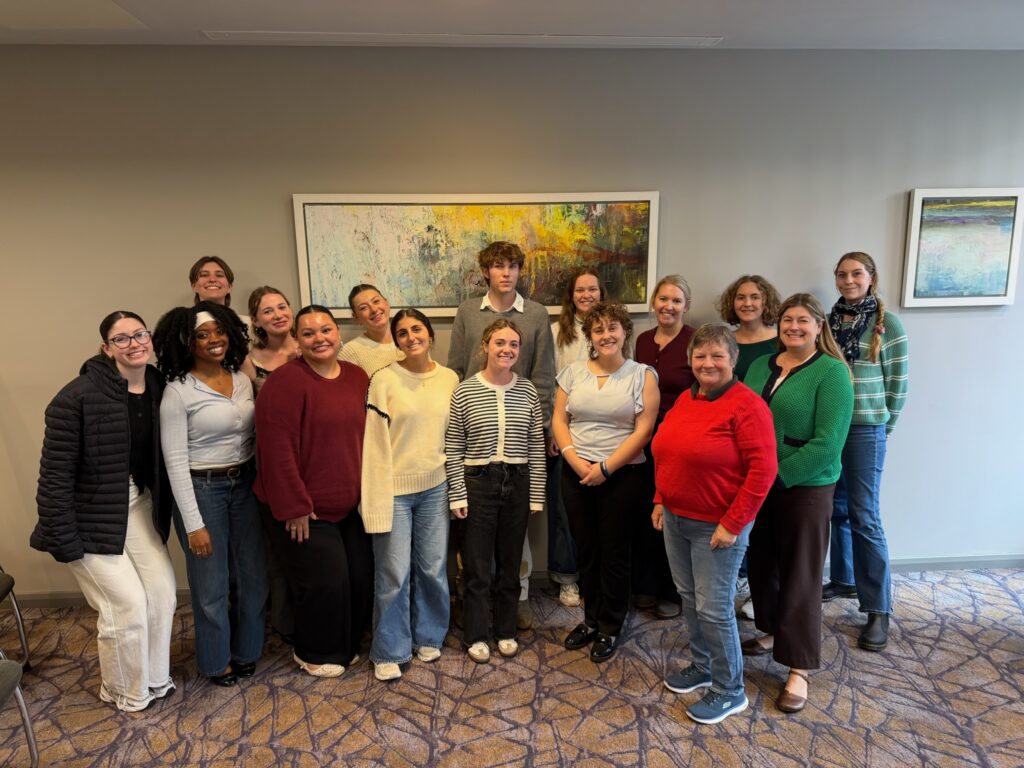
Kate Turner (front left) and Brandon Hamber (front right)Avila Kilmurray (front right in red)
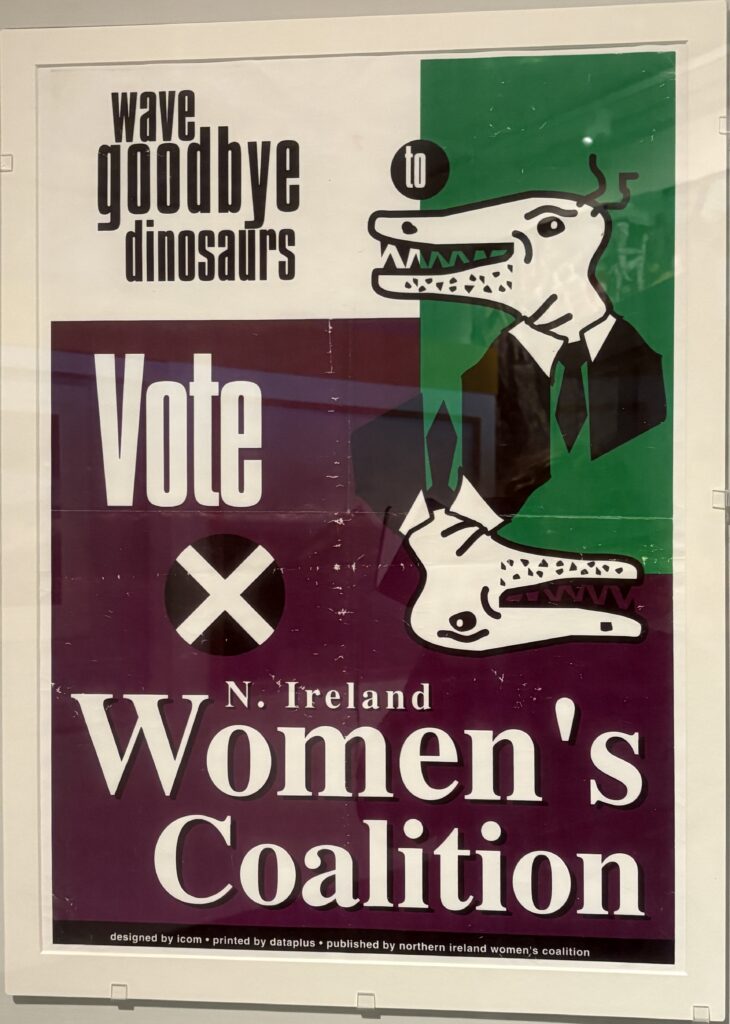
One of the most common concepts we encountered during our time in Northern Ireland was framing. Framing is the way that people perceive and interpret different ideas and experiences (Benford & Snow, 2000). Frames give different meanings to these ideas and experiences, which guides how people act and communicate (Benford & Snow, 2000). Throughout our conversations with Hamber and Kilmurray, the concept of framing kept coming up. Particularly in relation to the way that certain voices and stories have been left out because of the way the conflict has been framed, and how both of their work is focused on shifting the narrative to bring light to those hidden experiences. A common framing of the conflict is of paramilitaries as the defenders of their communities. This framing comes with a perception of paramilitaries as being of the macho-masculine inclination. Hamber explains that another form of masculinity was present during the conflict in the form of boxing clubs that provided a caring, protective form of masculinity as an alternative to the paramilitaries that were framed as the ideal form of masculinity. Part of Hamber’s work studying masculinity is to bring light to stories like those of the boxing clubs that have been overlooked because of the way the popular narrative has been framed. On the topic of gender, Kilmurray has long been engaged in the work of bringing attention to the experiences of women during the conflict and peace process that have mostly been ignored due to male-centered framing. The conflict and peace process in Northern Ireland have largely been framed as occurring between men, different armed groups and different political leaders, respectively; the involvement of women being mostly framed as normal domestic roles. As our group learned, women were much more involved in both the violent conflict and the peace process than is commonly acknowledged. The Women’s Coalition, and Kilmurray’s contributions to it, are proof of that. The Women’s Coalition was a political party founded in 1996 by women of both Catholic/Nationalist and Protestant/Loyalist backgrounds who felt that women’s voices had been left out for long enough. They were integral to the peace process and the Good Friday Agreement’s success, as they contributed not only policies about victim support, integrated education, and civic forums to the agreement, but also supported back channel peace negotiations when ceasefires fell through. The framing of the peace process as having been a product of male political and paramilitary leaders has resulted in a lack of acknowledgment and attention to the roles that women have played in ensuring a successful and inclusive peace process.
Women’s Coalition election campaign poster
Our conversations with Brandon Hamber and Avila Kilmurray introduced our group to the understanding that the way the conflict in Northern Ireland has been framed, historically and presently, has resulted in an ongoing process to uncover the hidden stories and experiences of people throughout Northern Ireland’s history. Understanding the way events have been framed allows us to develop a deeper understanding of the past, present, and future of Northern Ireland. Beyond Northern Ireland, understanding that different events and groups are framed in different ways encourages us all to go beyond the black and white, and look deeper for a more nuanced understanding of the world around us.
References
Benford, R. D., & Snow, D. A. (2000). Framing processes and social movements: An overview and assessment. Annual Review of Sociology, 26, 611-639. https://www.jstor.org/stable/223459
Hi! My name is Kaite Clark, and I am a 4th-year Psychology major, with a minor in Women’s and Gender Studies. I am so excited to share what our class was up to on Wednesday, June 3rd, in Belfast, Northern Ireland.
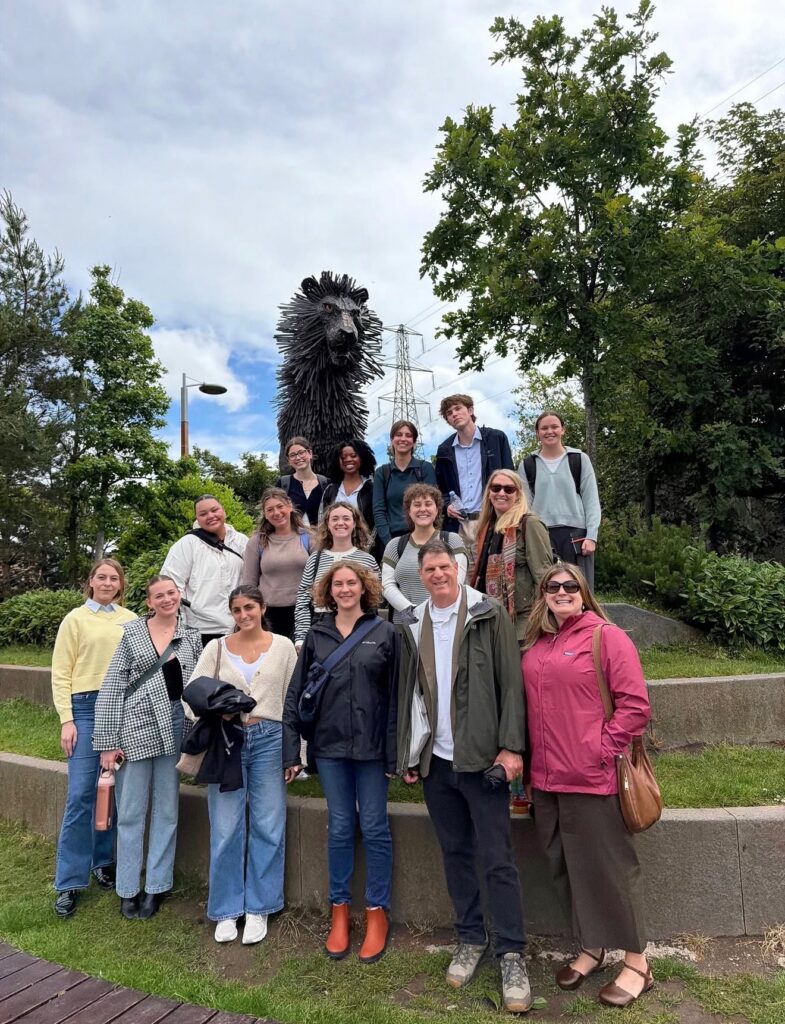
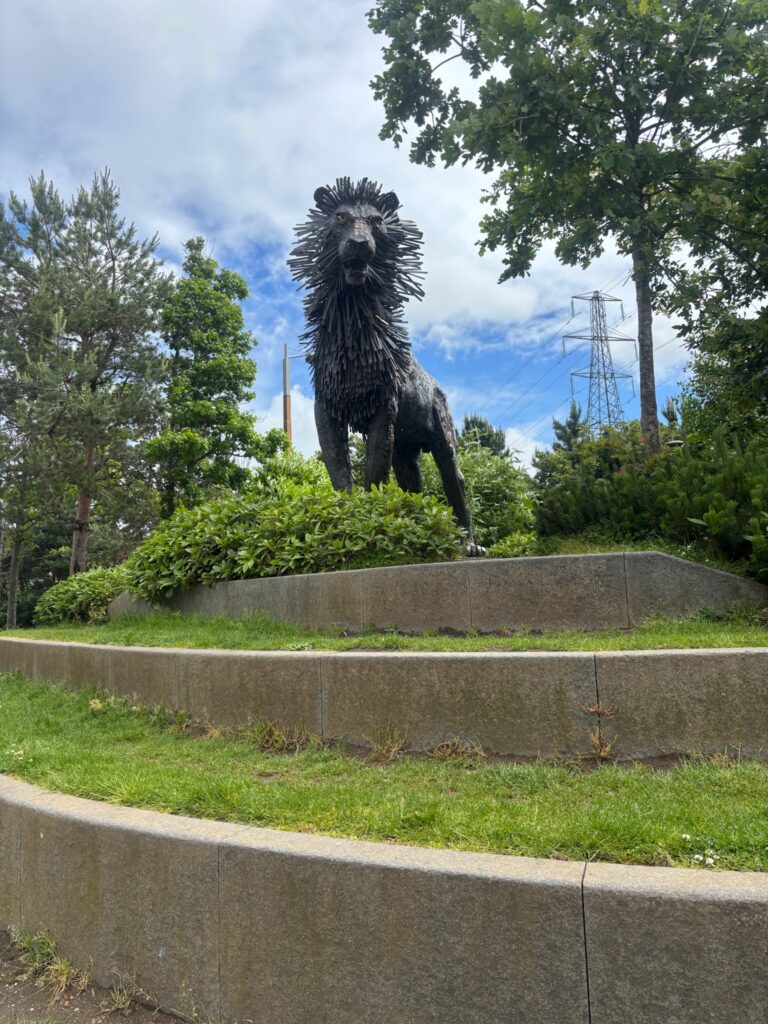
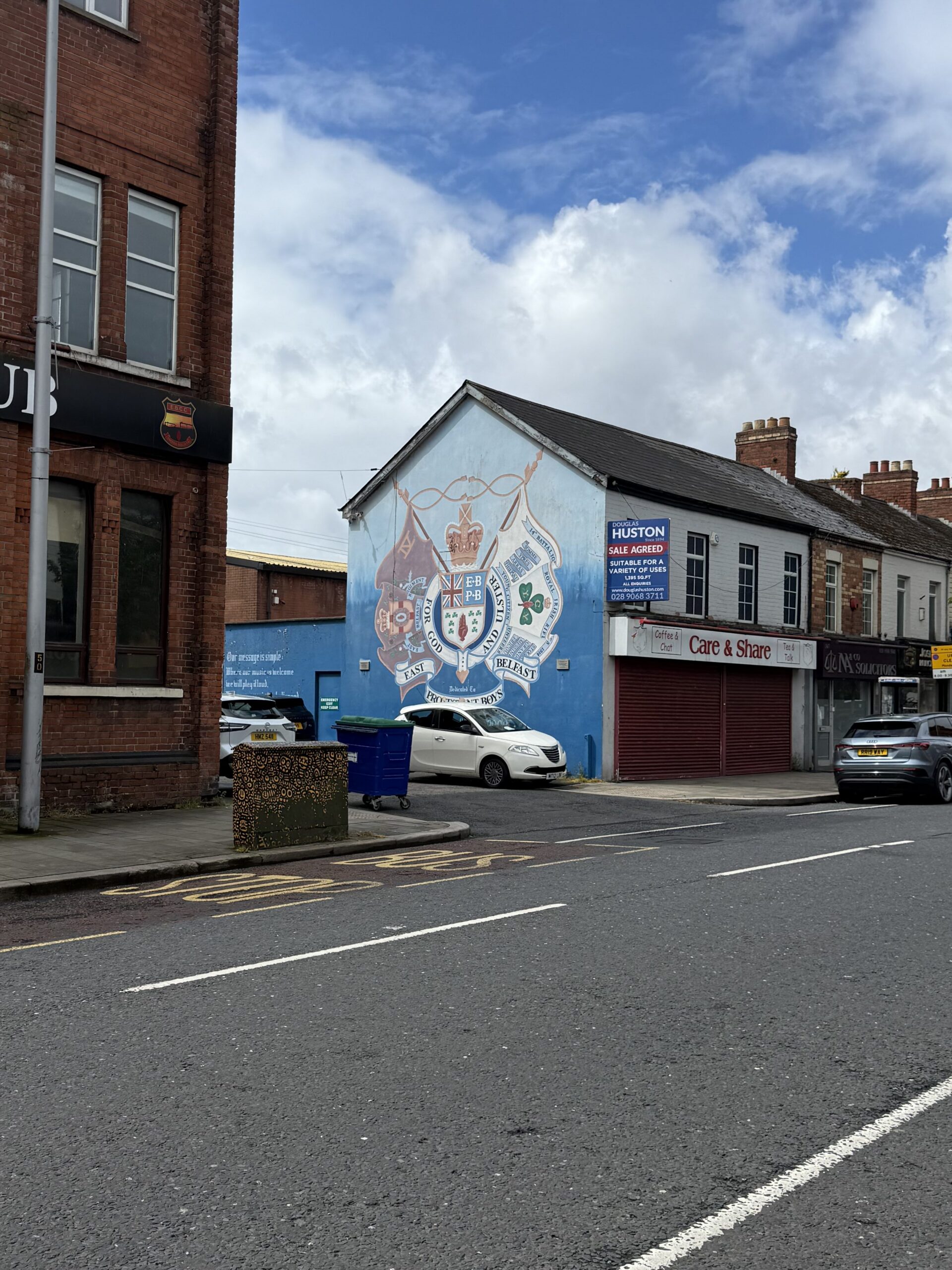
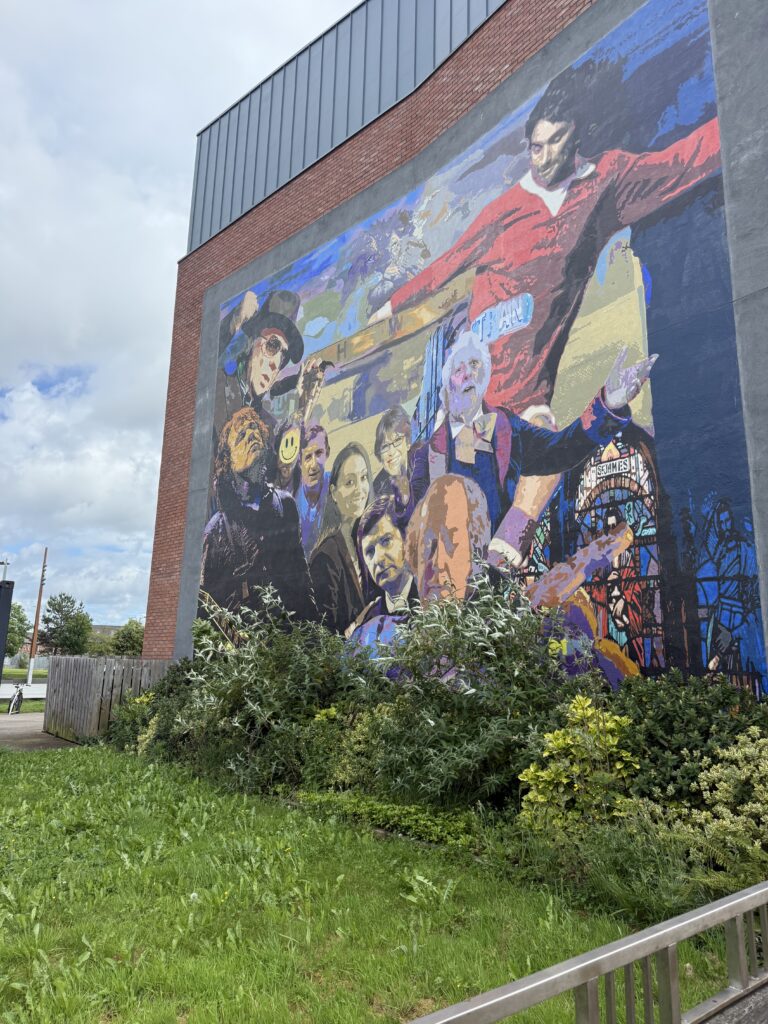
After our visit to Langan College, we walked through C.S Lewis Square, a park that commemorates the work and literary masterpieces produced by C.S Lewis throughout his lifetime, specifically The Chronicles of Narnia. Within this area of East Belfast, you were able to find many Loyalist banners and flags to represent the locals’ support of the British government and paramilitary groups. It was shared with our group that the Irish movement was born within the area, and a place where you can find integrated schools that teach the Irish language.
Photo taken by Daniel Wehrenfennig (6/3)
Photo taken by Kaite Clark (6/3)
Photo taken by Kaite Clark (6/3)
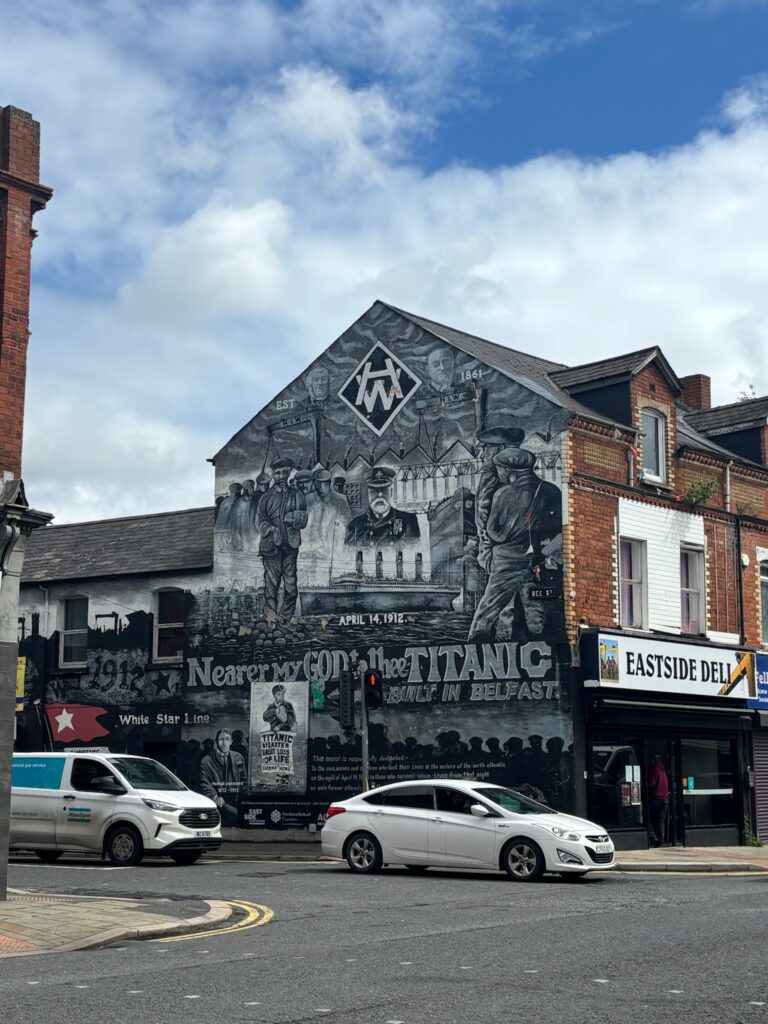
One of the murals we walked past in East Belfast!
Photo taken by Kaite Clark (6/3)
As we navigated East Belfast, we passed through historic shipyards that were operating up until the 1960s. The community wanted to commemorate the working class history, so they preserved a large yellow crane to recognize the labor industries that have shaped Belfast. This crane is known as the Samson and Goliath Crane at the Harland & Wolff shipyard. Notably, it is also the shipyard that produced the Titanic, which at the time in 1912, was the largest passenger ship and designed to carry wealthy travelers and emigrants from England to New York.
Photo taken by Sam Rokoszewski (6/3)
We then met with Linda Ervine, “an activist who has campaigned for the de-politicisation of the Irish language by supporting cross-community healing through provision of and access to Irish language lessons in majority Protestant/Unionist areas” (extraORDINARYwomen, 2026). During her presentation, “The Miracle that is Turas,” she discussed the mission she started in 2012 that supported and advocated for the preservation of the Irish language, and made its education accessible to all. Ervine stated, “This is our journey of reconciliation. Every word spoken in Gaelic is another brick in the bridge that unites us as people living on this island” (Ervine, 2026). She also spoke on the support from grassroots organizations for the integration of learning spaces in programming, such as Turas, as well as local schools. With this, she did raise awareness and concerns around the lack of funding for her program, and how politicians tend to shy away from programs that don’t involve military action. Within the politics of it all, her courage to combat those who marked her as a “terrorist” or “radical” was admirable. She gave us a small perspective into the threats, danger, and fear that have followed her since the beginning of her mission, but she also spoke of her ‘why’ behind fighting it all.
Linda Ervine is a remarkable woman, who embodies that of a modern, inclusive way of living and teaching. The way she spoke about initiative was inspiring to say the least. Not only was she able to recognize the conflict between the people of Northern Ireland, but understood it from an empathetic lens, for both sides. With this recognition came a want and need for inclusive education that was hopeful for a future that represents all personalities and backgrounds present in Northern Ireland, specifically Belfast. We loved getting the opportunity to talk to Ervine, ask questions, and leave knowing that there are strong female leaders sharing the gift of education and culture daily, even in the midst of complex times.
Afterwards, we stopped and got lunch at Refresh Cafe in Skainos! Yum.
Photo taken by Kaite Clark (6/3)
Photo taken by Kaite Clark (6/3)
Photo taken by Kaite Clark (6/3)
In the afternoon, our class attended a meeting with the Chairman of the RUC Foundation, Stephen White (bio), at the Royal Ulster Constabulary (RUC) Memorial, along with two of his colleagues, Allan and Ernie. We gathered in a small office within the memorial building and had the opportunity to learn more about the perspective of the RUC/Police Force during the Troubles. Firstly, Mr. White was extremely charismatic and very open to sharing his experiences/opinions with our class, and did so in a way that was both educational and respectful to all parties involved. Mr. White shared his extensive knowledge and background in serving the RUC for more than forty years, continuing a multi-generational familial legacy, which is also continued by his son.
Although he talked much about the conflict and his experience within it, he focused much of his time in having our class understand the true problems seen during the time of the Troubles, and why the conflict was such a distressing and emotional time for both sides. He didn’t push politics on us at all, but encouraged us to take on a considerate mind to further understand just how distraught the situation came to be. He shared his own personal fears and experiences with our class, and also his connection with those whom he was “fighting against.”
One of his main focuses was paying tribute to the men and women who lost their lives due to the Troubles. He took the time and care to lay the foundation of the Troubles, explaining both the religious and civil conflicts it brought about. He expressed that both sides were wrong in their execution of ideas, beliefs, passions, and frustrations. White and his colleagues later explained that, “it is a gradual process in achieving a post-conflict, peaceful society, especially when the police force has been dehumanized and polarized from civilians. Community relations is the utmost important part of the job… we are the community” (White, 2026). They later shared that there were 4-5 murders daily during the Troubles, including both civilians and police officers.
Other important statistics to note is that women in the police force weren’t armed until 1994, and the average age of officers in 1980 was 25 years old, and only 10% of the force was Catholic-Nationalist, 90% being Protestant-Loyalist.
Another few aspects of Mr. White’s talk was what successful, good policing does look like. He showed us a 6 point model: accountable, open and transparent, representative, impartial and free from partisan control, respect for and protection of human rights, community service oriented, and effective. He also shared the key checks of reform: leadership, political will, legislation, and time and security.
He related these structures to the Troubles, but also to what we are currently seeing in the United States. Mr. White posed the question, “What comes first, the state or the police?” I think this comparison of the two situations was vital for our understanding of the gravity of the Troubles, and how the encouragement and continuation of sectarian violence does nothing but cause true harm to communities and those living within. He also spent time discussing the notion of depicting the police as military troops, and its reinforcement hierarchy and fear.
Because of the conflicts seen in Belfast and largely Northern Ireland, the Police Act of 2000 was proposed and passed as a new generation of safety, security, and trust, as a result of the Good Friday or Belfast Agreement. Mr. White further explained that, “maximizing public trust was the most important piece coming out of the agreement deal” (White, 2026). He also spoke on the current status of the perception of police in Belfast, and that it has been a slow, gradual process in making amends, but one that officers are dedicated and hopeful about achieving in the future.
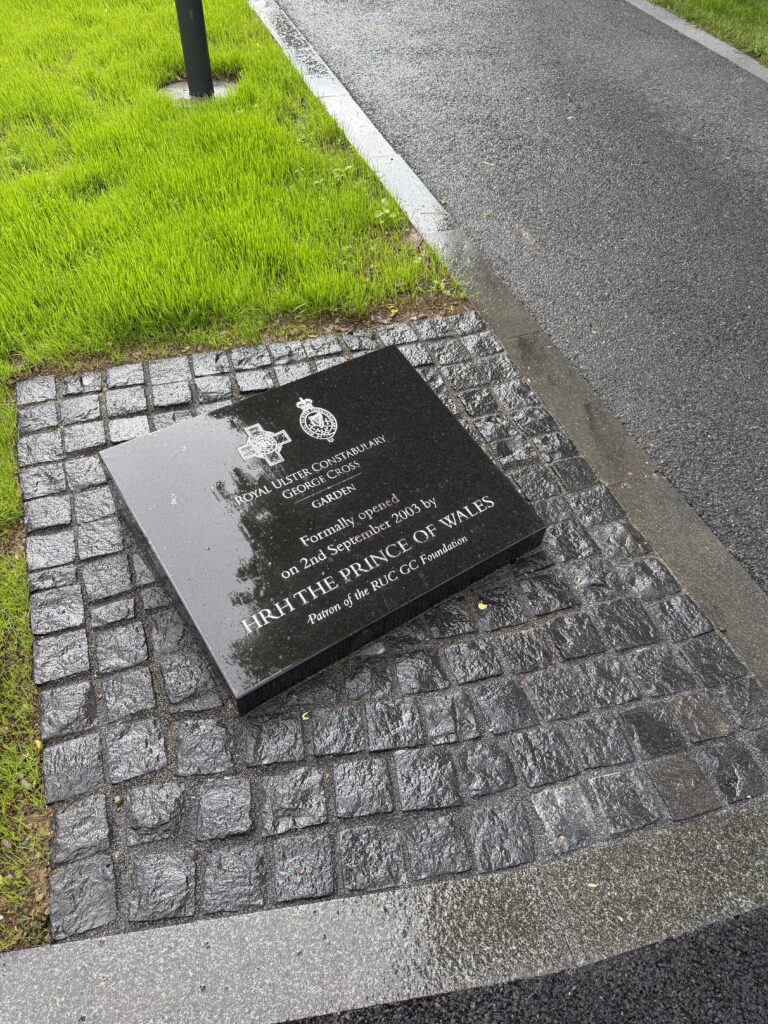
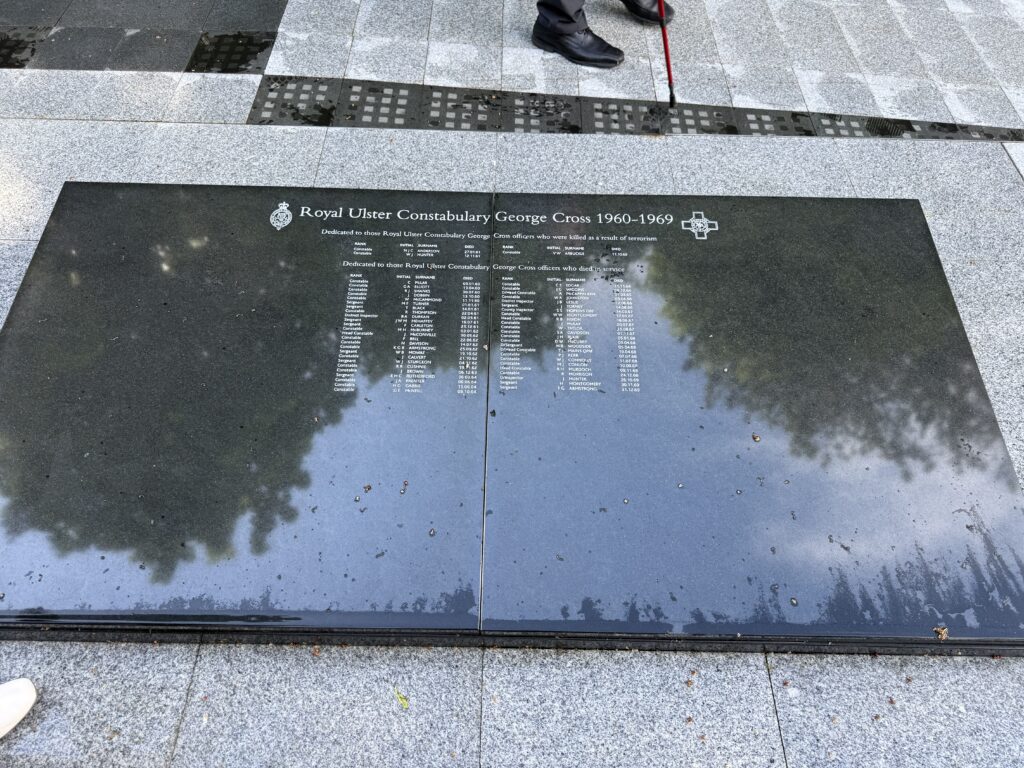
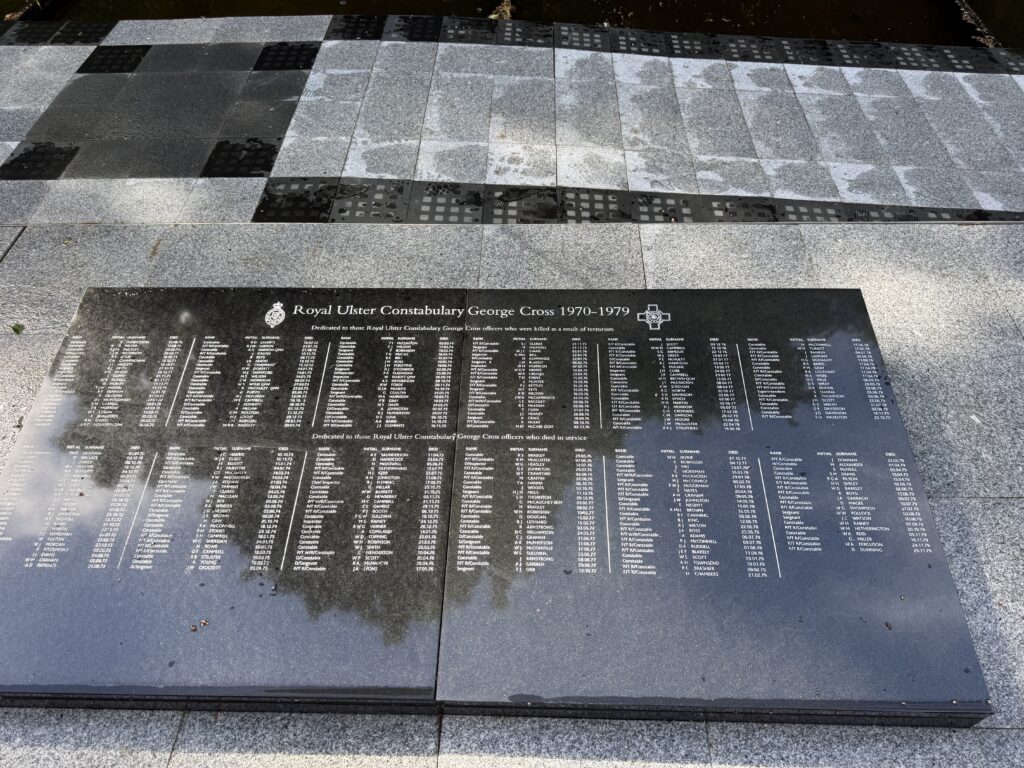
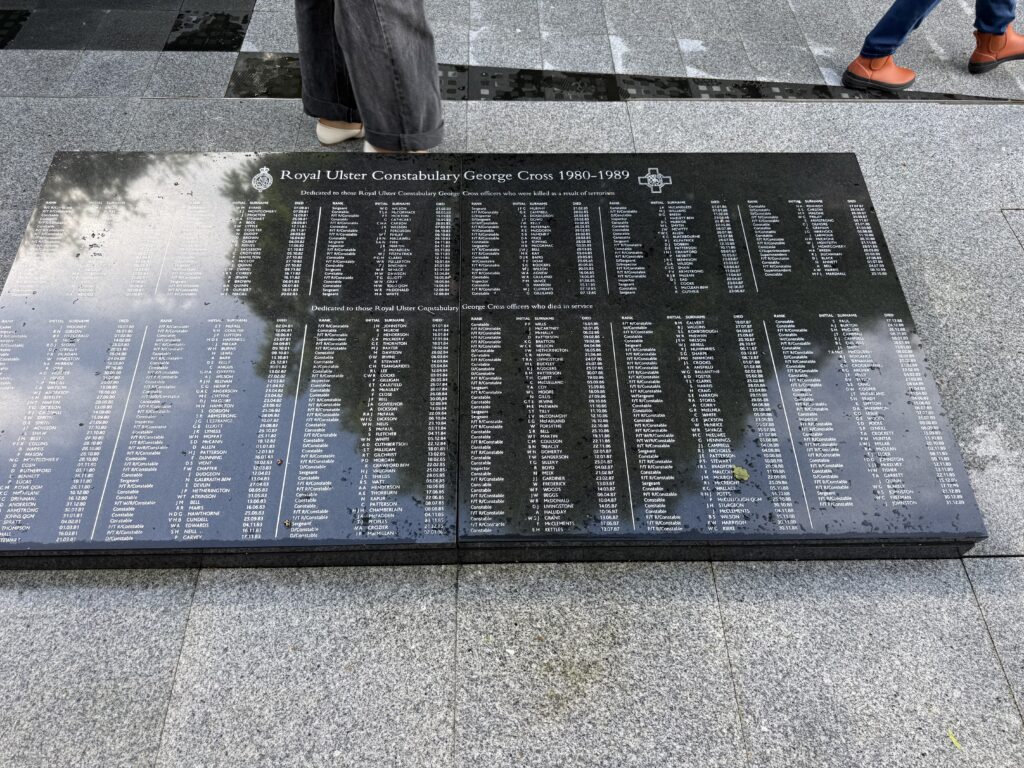
After our meeting with Chairman White, his colleague Allan took us on a rainy tour of the Memorial Garden, a place of tribute to the 312 men and women who lost their lives during the conflict. More information in regards to background and purpose can be found on their website. During his time as a police officer, Allan specialized in crowd control and protest management. On our tour, he shared that he knew many of the officers who had been killed. His vulnerability in sharing his story with us was deeply appreciated, and helpful in understanding a perspective that we wouldn’t normally focus on during a polarized conflict such as this. With this, in the garden, there is a trail parallel to the walkway that is a “windy road” that represents the epitome of life, and its unpredictability. The memorial was made to acknowledge the grief of the past, while not glorifying it. It represents how costly conflict and violence truly can be, especially when misunderstanding and misrepresentation are involved.
All of the following pictures were taken by me, Kaite Clark (6/3).
Note the quantitative difference in the listed deaths in the following images.
A major theme that we saw during Day 3 was framing and the power that specific narratives, when pushed by the right people, have in shaping the interpretation and education of a conflict. In the research article authored by Rafferty (2020), understandings of conflict absolutely influence how society interprets historical events and reconciliation efforts, much of what we heard Ms. Ervine speak during her explanation of the mission of Turas and Mr. White’s breakdown of the polarization between civilians and the police force during the Troubles. Although they approach the conflict from different perspectives, they both also sought to reframe assumptions and encourage an educational dialogue across communities. Rafferty (2020) reinforces the notion that the ways in which we approach history impact how individuals become engaged in the reconciliation efforts, which is why it needs to be the most accurate.
For example, Linda Ervine’s use of framing allows for a more inclusive, nuanced understanding of language and how its teaching does not need to include political undertones. With this, Mr. White allowed our class to take on a more educated approach to understanding the violence and collective policing efforts used during the conflict. Rather than presenting and forcing a “correct” version of history, our speakers challenged us to consider experiences that have been misunderstood or never considered before. Peacebuilding, according to Murphy et al. (2021), means straying away from the rigidness that often comes alongside identity and grief.
One strength of framing, when held in an inclusive and educational context, is that it encourages the creation of shared space and understanding of lived experiences, rather than a competitiveness of victimhood and rightness. Framing is a great tool that, when used appropriately, can bridge communities for a more peaceful life for future generations.
After our tour, we had dinner at the hotel, reflected on our days in groups, and had free time to explore the city! It was an honor to learn about integrated schools, inclusive and progressive learning, and the importance of consideration and empathy during troubling times.
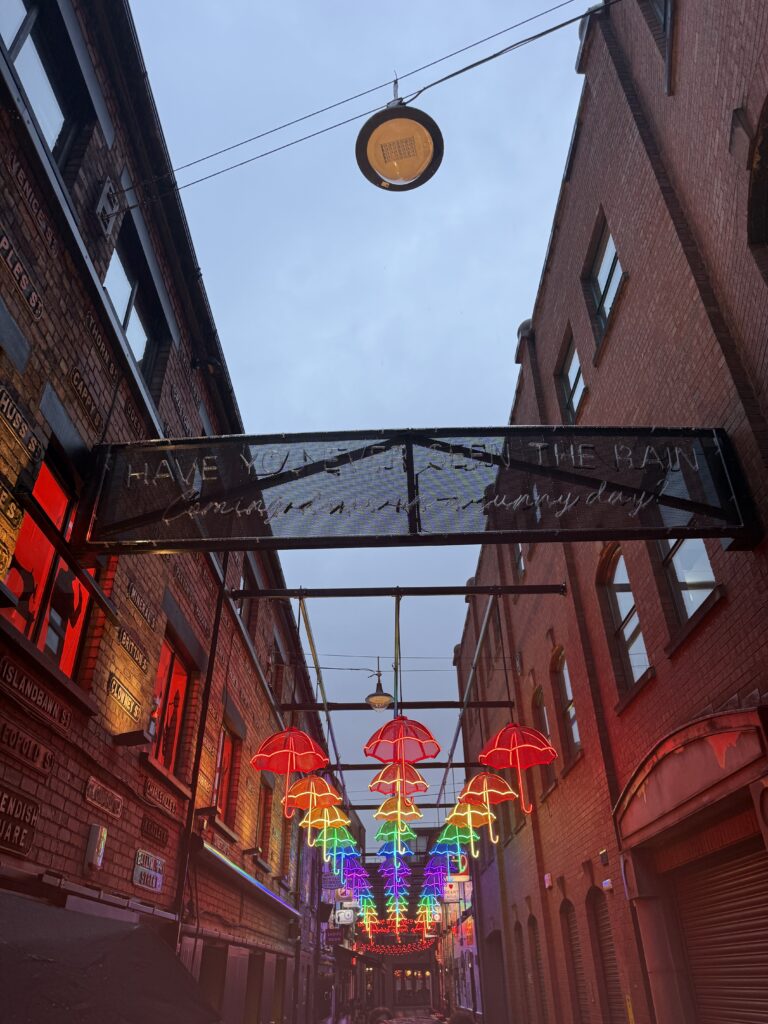
Photo taken by Kaite Clark (6/3) in Cathedral Quarter, Belfast.
Murphy, J., Denyer, D., & Pettigrew, A. (2021). The role of framing mechanisms in explaining system-wide change: The case of the Northern Ireland conflict and peace process. British Journal of Management, 32(2), 322–341. https://doi.org/10.1111/1467-8551.12393
Rafferty, R. (2020). Conflict narratives, action frames, and engagement in reconciliation efforts among community activists in Northern Ireland. Peace and Conflict: Journal of Peace Psychology, 26(1), 9–21. https://doi.org/10.1037/pac0000398
Royal Ulster Constabulary George Cross Foundation. (2026). Royal Ulster Constabulary George Cross Foundation. https://rucgcfoundation.org/
White, S. (2026, June 3). Policing Northern Ireland: A Story of Service and Sacrifice. Peace Communication in Northern Ireland Study Abroad Program, Belfast, Northern Ireland.
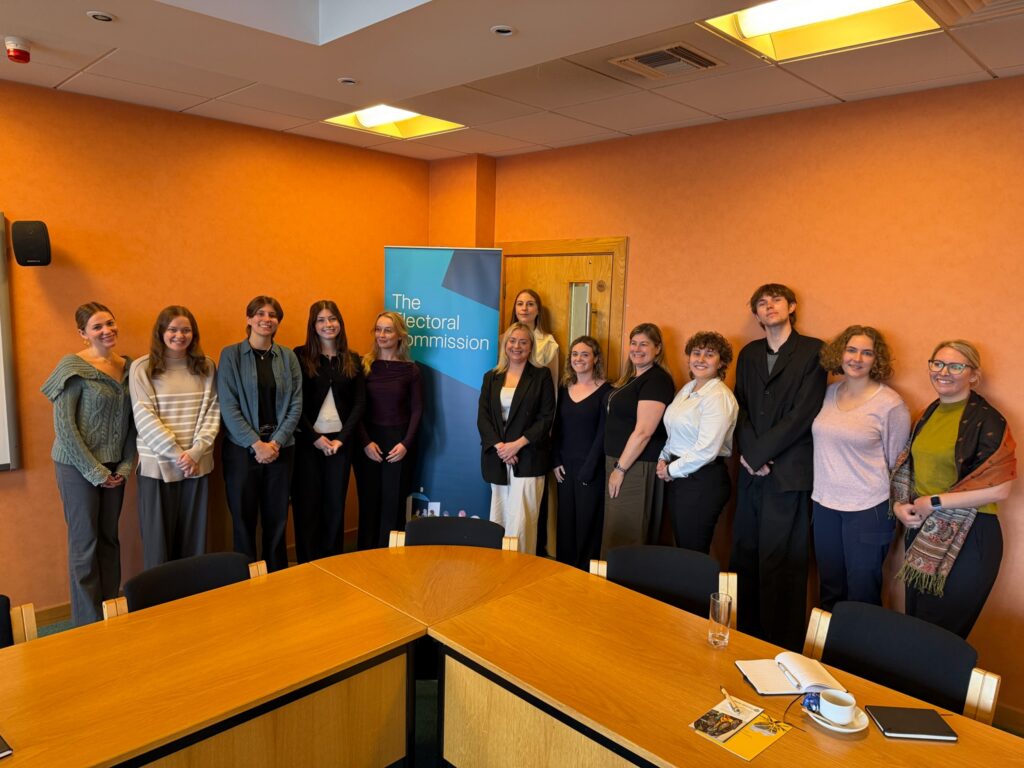
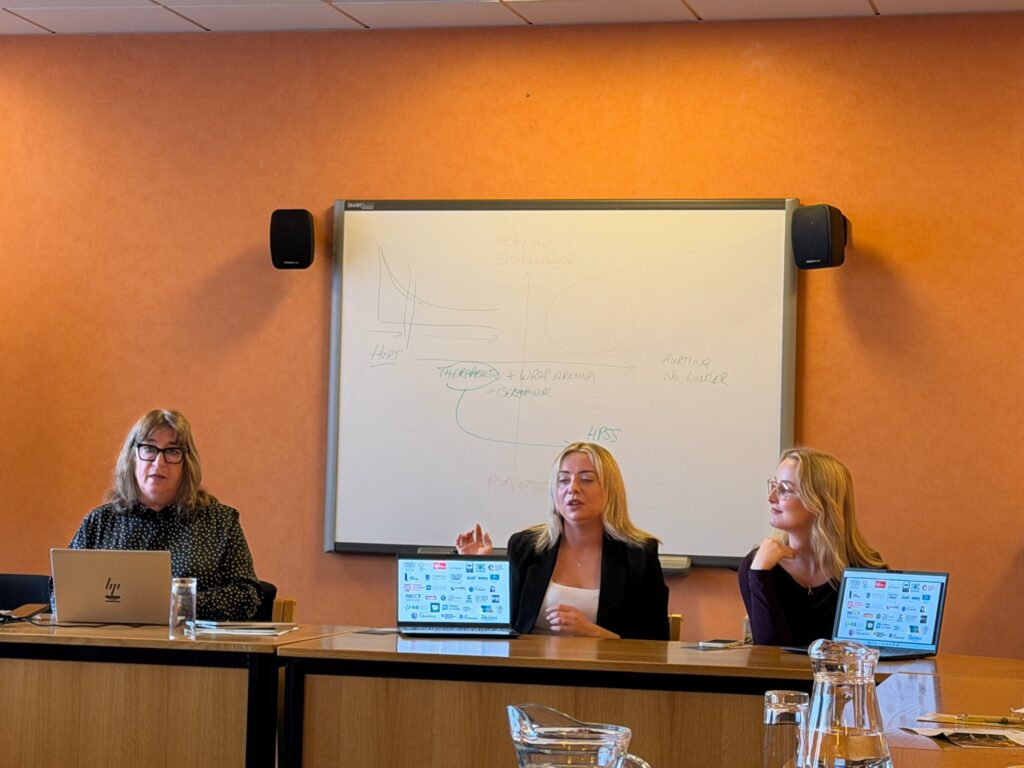
One of the most interesting parts of the day was seeing how different organizations are working toward the same goal: helping Northern Ireland move from a divided past toward a shared future. Throughout the day, we met with representatives from the Irish Language Commissioner, the Ulster Scots/Ulster British Commissioner, the Electoral Commission, and the Commission for Victims and Survivors. Even though each organization focuses on different issues, I noticed that all of them were concerned with identity, representation, and creating relationships that allow people with different backgrounds to coexist peacefully.
A concept from our readings that connects to these experiences is reconciliation. According to Bloomfield, reconciliation is “a process through which a society moves from a divided past to a shared future” (Bloomfield, 2003, p. 12). Rather than ignoring differences, reconciliation involves finding ways for communities to live alongside one another while acknowledging the past. After listening to the speakers throughout the day, I realized that many of the organizations we visited are contributing to that process in different ways.
During our meeting with Terry and the Irish Language Commission, we learned about efforts to preserve and expand the use of the Irish language. I was surprised to learn how political support for the Irish has changed over time and how much work goes into translation, education, and media production. One story that stood out was hearing how just five families helped create an urban Irish-speaking community, showing how cultural change can begin at the local level. Terry also spoke about language as an important part of identity and culture. Hearing this made me realize that preserving a language is not only about communication but also about helping people maintain a connection to their history and community.
We also met with Lee, the first Ulster Scots and Ulster British Commissioner. His presentation added another perspective on identity in Northern Ireland. One point that stood out to me was when he said that the Good Friday Agreement did not fully resolve questions surrounding identity. He discussed the importance of culture, heritage, arts, and language, and used a pond analogy to explain how communities need ongoing care and investment in order to thrive. Lee also spoke about programs such as NICE (National Identity and Cultural Expression), which encourage conversations about cultural and national identity. His emphasis on connectedness and empathy reminded me of the game we played at Corrymeela, where understanding another person’s perspective was necessary for cooperation. Listening to both Terry and Lee helped me understand that reconciliation does not require people to abandon their identities. Instead, it creates space for different identities to exist alongside one another.
The Electoral Commission presentation focused on democracy and civic participation. Representatives discussed their efforts to increase voter turnout, educate young people about elections, and combat misinformation online. I found it especially interesting that 16- and 17-year-olds will be able to vote in future elections. The commission’s outreach through schools, social media, and programs like Welcome to Your Vote Week reflects the idea that democracy depends on participation. Our reading explains that democracy is a way of managing differences without violence and allows different viewpoints to coexist peacefully (Bloomfield, 2003, p. 10). Seeing how much effort goes into encouraging participation made me appreciate the role democratic institutions play in maintaining peace.
The presentation from the Commission for Victims and Survivors was probably the most impactful part of the day. Andrew discussed the lasting effects of the Troubles and the reality that many people continue to live with trauma decades after the conflict ended. One statement that stayed with me was when he said, “Peace isn’t the absence of violence; it’s the presence of justice.” The commission works to ensure that victims and survivors receive support, recognition, and dignity. Hearing about counseling services, survivor stories, and efforts to address generational trauma demonstrated that reconciliation is not about forgetting the past. Instead, it involves acknowledging painful experiences while creating opportunities for healing and coexistence.
Overall, today’s visits showed me that reconciliation happens in many different ways. It can involve preserving a language, celebrating cultural traditions, encouraging democratic participation, or supporting people who have experienced trauma. Although these organizations approach peacebuilding from different angles, all of them are helping Northern Ireland continue the difficult process of moving from a divided past toward a shared future.
Work Cited
Bloomfield, D. (2003). Reconciliation: An introduction. In D. Bloomfield, T. Barnes, & L. Huyse (Eds.), Reconciliation after violent conflict: A handbook (pp. 10–18). International IDEA.
As the peace communication class embarked on our first in-depth exploration of the city of Derry, I couldn’t help but notice the sheer differences between this historical hub and the bustling city that’s Belfast, not just by appearance but marked by complex respective healing processes effectively rethreading the fabrics of their communities in a now modern, post-conflict setting. Derry struck me as both progressive and truthful, a society that had shifted into robust cooperation between previously unwavering and polarized identities, while platforming narratives that don’t seek to hide too much grit and accountability, leaving the wires exposed. Starting the day off observing murals scattered around the city, I began to understand the significance of their murals. Where Belfast’s murals primarily served as a means of pushing political messaging and agendas, Derry’s murals seemed to lack (or at least be more discrete with) those undertones and instead preserved history. The majority of the murals are historical documentation, serving to preserve stories and moments from The Troubles, telling stories that were left untold, and immortalizing its victims. I found so many of these murals to be quite moving, especially the newest mural ‘Goodnight Sisters’ (https://extramuralactivity.com/2025/03/24/goodnight-sisters/) which highlighted the stories of women that often were erased and untold during the conflict. This mural in particular spotlights the Irish Women’s Liberation Movement and Nell McCafferty, a powerful female figure having worked as a journalist, writer, and activist. Another mural called ‘Bernadette’ (https://extramuralactivity.com/2017/08/21/bernadette/), showing metal bins used as a warning system during the conflict, was very interesting to me, as it included female narratives of women on the front lines resisting soldiers and alerting others that soldiers were infiltrating the space.
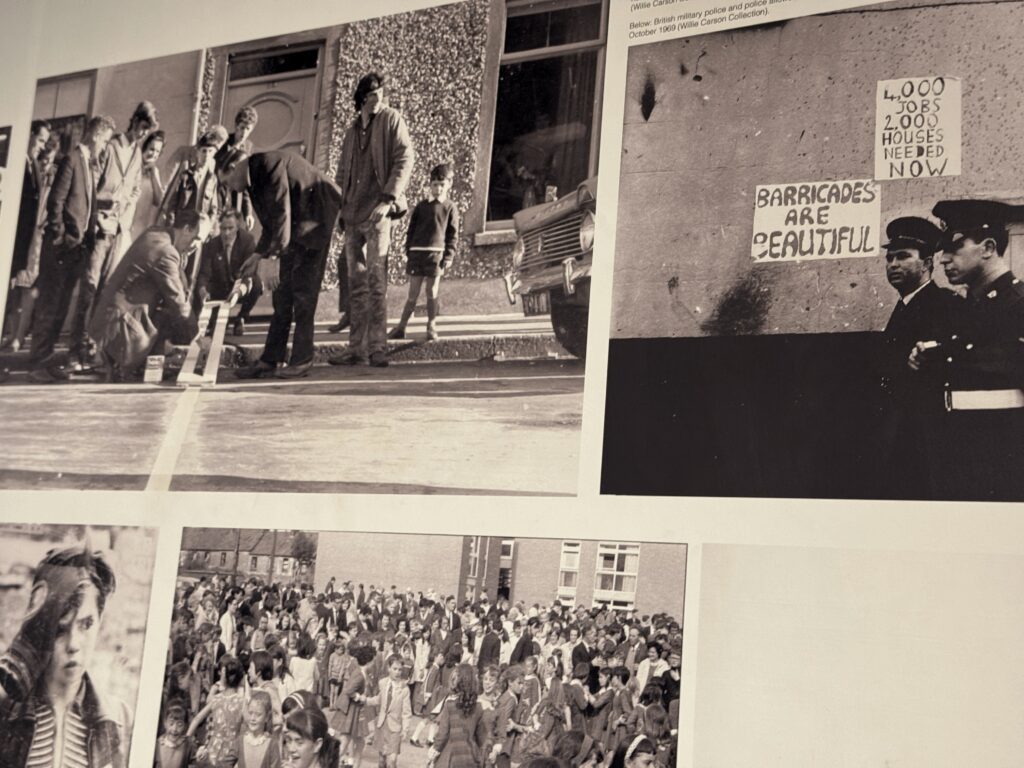
As we made our way to the Free Derry museum, I paced about the space met with a plethora of information, equally jarring and fascinating. Protest banners, funeral invitations, rusted helmets, hefty databases of victims (many being children, photographs with maroon pigmented blood spilled in the foreground of them. Echoes of various videos rang through the hall, explaining the post-partition oppression of nationalists, discriminatory gerrymandering, unemployment, the rise of groups like the NICRA organizing widespread protests inspired by the United States Civil Rights movement, and the lingering demand of accountability for perpetrators years after the Good Friday Agreement. Hearing stories like those about post-Bloody Sunday Justice campaigns and Soldier F having his charges against him dropped even though there has been community awareness of his role as a key perpetrator in Bloody Sunday, it all reminded me that unresolved tensions still exist in some degree even after the peace process, setbacks to justice have been present, and that the effects of violent conflict often seep into present-day affairs and infrastructure. This takes me to one of the most recurrent themes I observed during this jam-packed day: transgenerational trauma. According to Mohn (2026), transgenerational trauma is defined as trauma that passes from one generation to the next through biological mechanisms and, more importantly, through lived experiences. Coping styles, parenting behaviors, and emotional communication are all impacted by transgenerational trauma and their patterns can be picked up by children, especially children whose parents have been directly impacted by colonization, impoverishment, and war (Mohn, 2026). The latter was explored by speaker Caitlin Askin in a meeting that occurred just after we explored the museum. Caitlin from the Bloody Sunday Trust (https://museumoffreederry.org/bloody-sunday-trust/), brought a younger and nuanced perspective to light, diving into the implications of transgenerational trauma on daily life and some building blocks that enabled this passage of trauma. As violence was normalized in her parents’ lives and cold, unpredictable killings like the Rising Sun Massacre unfolded around them, the horrors they had witnessed became repressed by them and many other community members out of fear that informing their children of everything would contribute to the brewing of transgenerational trauma. Interestingly, this approach by parents can often work in an opposite way, with silence fueling ambiguity and household distress, as seen in Caitlin’s experience. Caitlin also touched on the push for justice by families years later and the still prevalent animosities within Derry and broader Northern Ireland communities. She spoke about the political system and how highest authority positions must be held by either unionist or nationalist parties, furthering a sense of polarization and a two-sided identity split.
As the time on my wristwatch passed and new knowledge was cultivated, we found ourselves meeting Glenn, an intelligent storyteller with the swagger of a Laurel Canyon rockstar, welcoming us on a tour of the place he grew up in. This largely loyalist community saw enclaves like The Fountain, guarded by dauntingly tall peace walls. Here, he spent many days of his youth, with the terrifying blasts of machine gun bullets soundtracking his upbringing and the routine checks of bombs underneath his father’s car being normal activity. This normalization of violence that Caitlin also spoke on through her family’s experience stood as a theme explored a lot during the duration of the day. As Glenn brought forth his lens and perspective of the conflict, a rather compelling puzzle piece belonging to the wider jigsaw of his story stuck out to me. Glenn had a really unique example of intergroup communication during his time joining the local goth scene, something he later expanded on during a personal interview I had with him where he deemed it detrimental to his “experimentation of identity, allowing the fostering of connection” on a basis outside of cultural identity (loyalists and unionists) and rather through music taste and being a kind, down-to-earth individual. Intergroup communication, according to Chen (2017), involves the exchange of beliefs and values between different cultural groups to bridge a shared identity. In Glenn’s case, because of his experiences being in the goth scene, where people of both protestant and catholic backgrounds befriended one another and found shared identity, this personal anecdote helped make my understanding of the concept more comprehensive. He expanded on a larger scale about his intergroup communication experiences during his adolescence and early adulthood, describing his life at a strong mixed-identity school, stressing its importance in inflating his open-mindedness, with him making many friends with complex personal identities different than his own. To him, this constant diversity in his daily life helped dismantle prejudice and mold him into someone accepting of differences, willing to listen and learn from what sets them apart.
Whether it was traversing through the city with Glenn taking the lead, or moving through the museum trying to soak all of the information in, or the moments inbetween, it was an amazing day for hearing diverse perspectives and reshaping my view of the conflict to be more multidimensional. Overall, this day taught me so much about perspectives, centering mainly on transgenerational trauma, intercultural communication, conveying to me the complex nature and human cost of it all. With Caitlin and Glenn both coming from different backgrounds, analyzing the overlapping themes of trauma and a normalization of violence in their stories has led me to understand that this conflict deeply harmed both sides, inflicting irreparable damage on children, families, and ordinary civilians. The conversations, especially my interview, will always stick with me, reminding me of how important it is to engage in dialogue with people impacted by the hardships like those in Northern Ireland.
-Ryder
References:
Ling Chen. (2017). Intercultural Communication (Vol. 00009). De Gruyter Mouton.
Mohn, E. (2026). Transgenerational trauma. Salem Press Encyclopedia.
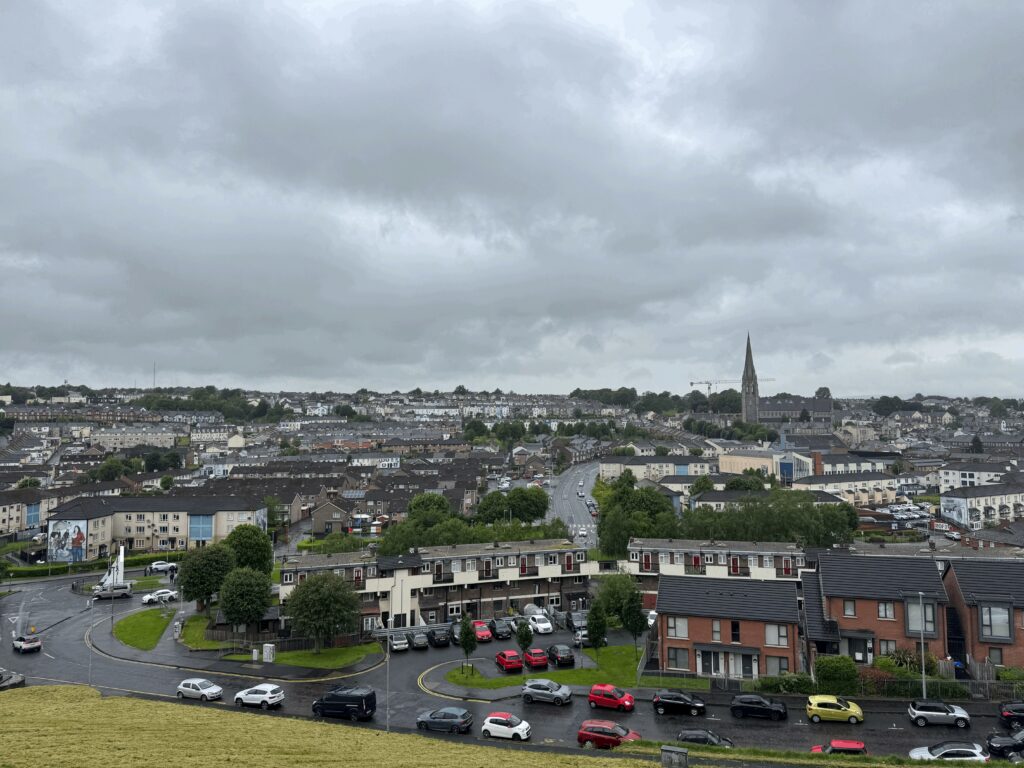
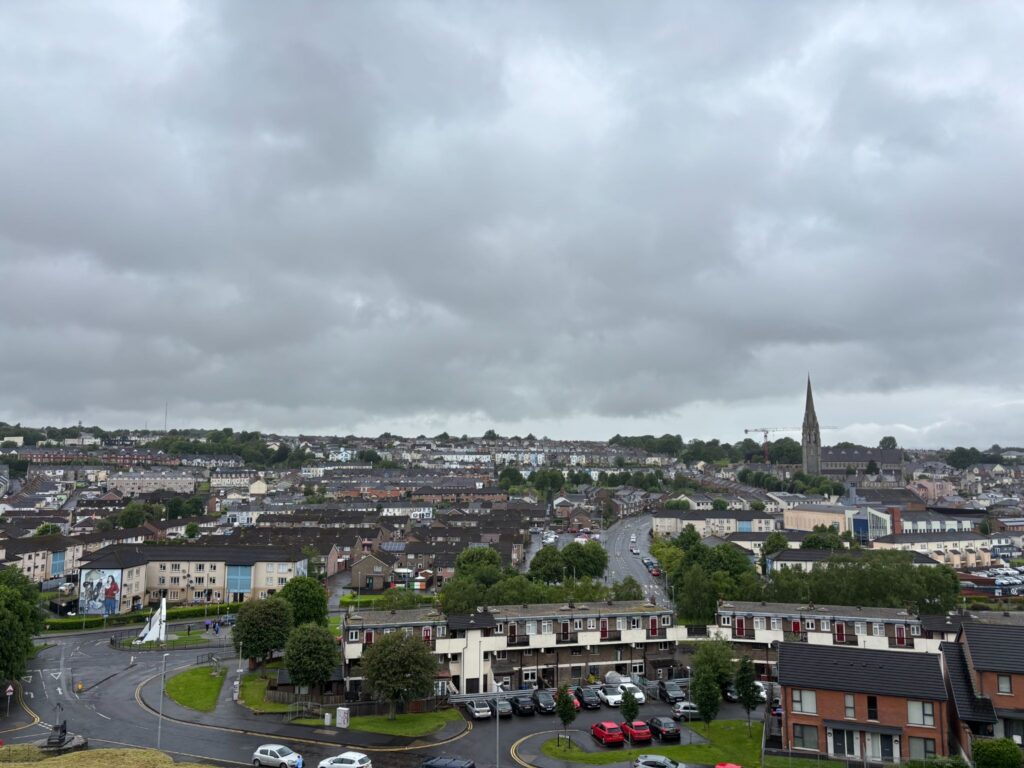
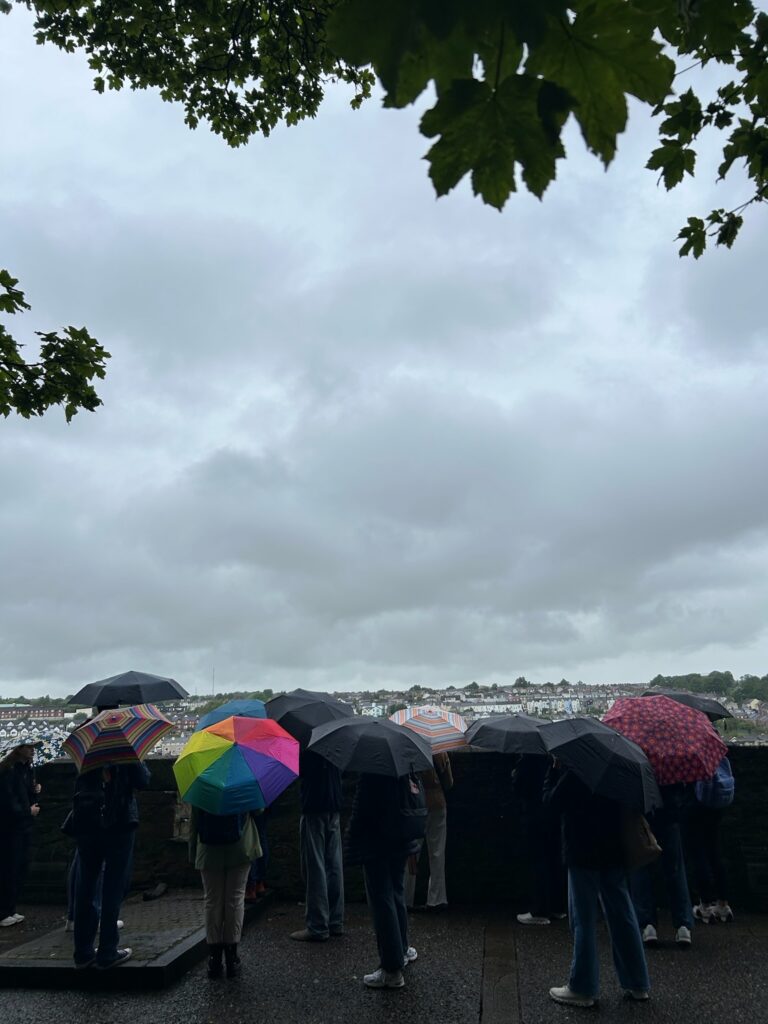
Above, an image of the bog side from the walled city, taken by me.
Above, an image from the Free Derry Museum, showing scenes of protest and policing, among other scenes.
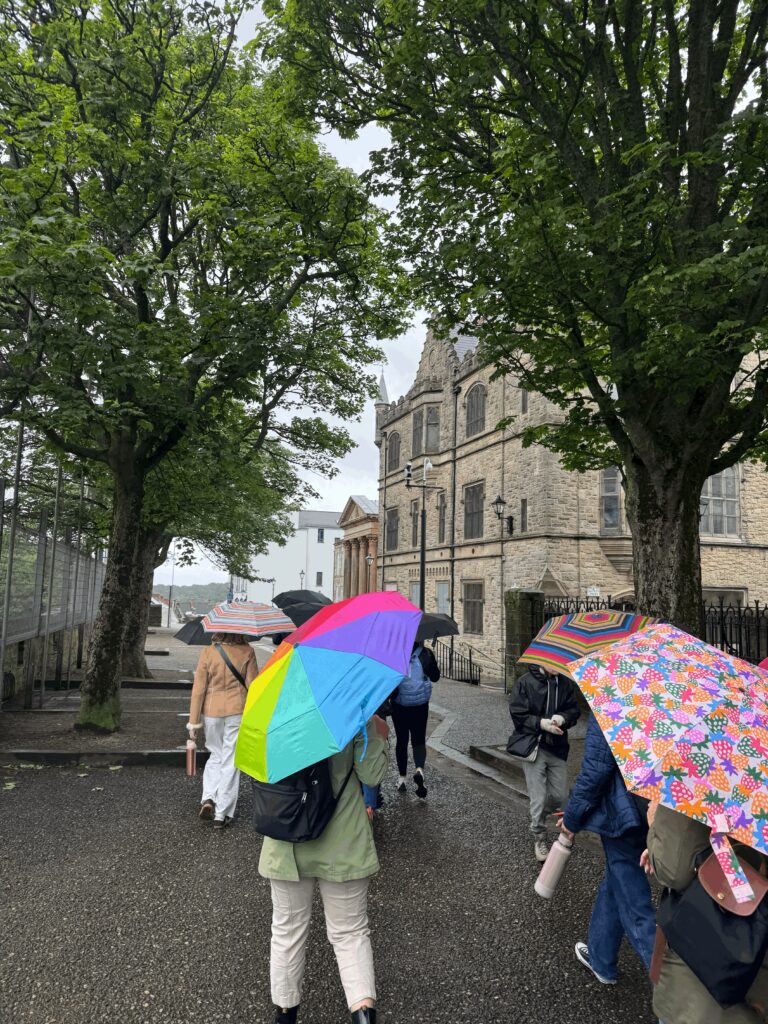
Above, an image of our group walking through the streets of Derry, learning about the city’s history and groups like the Apprentice Boys.
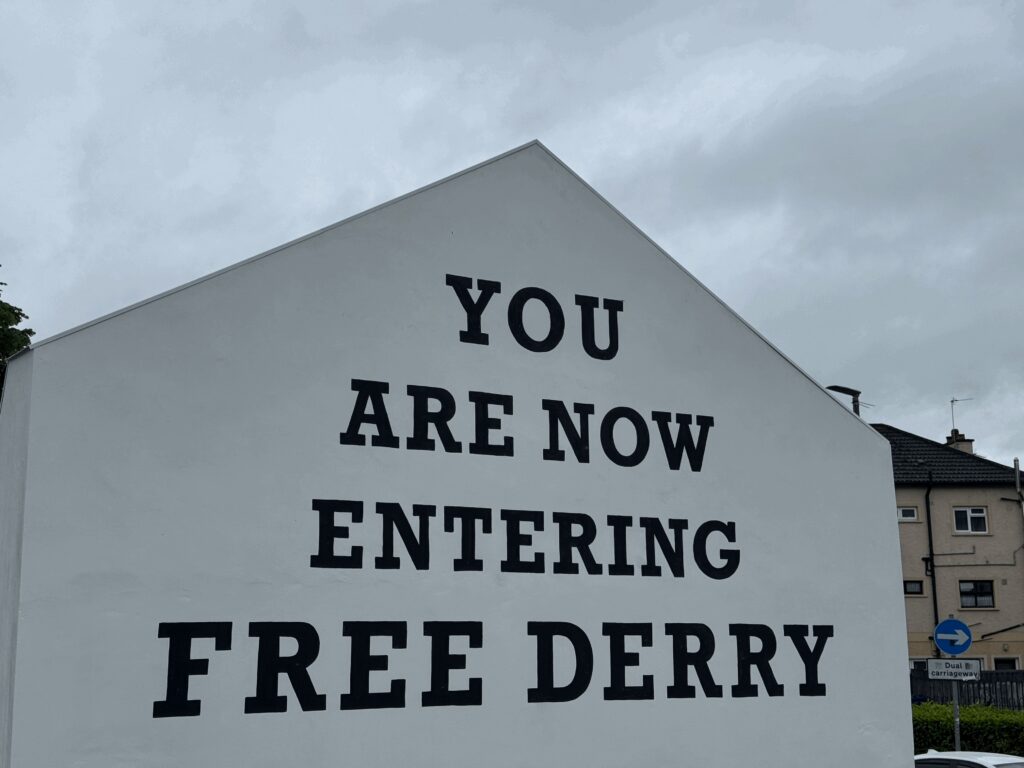
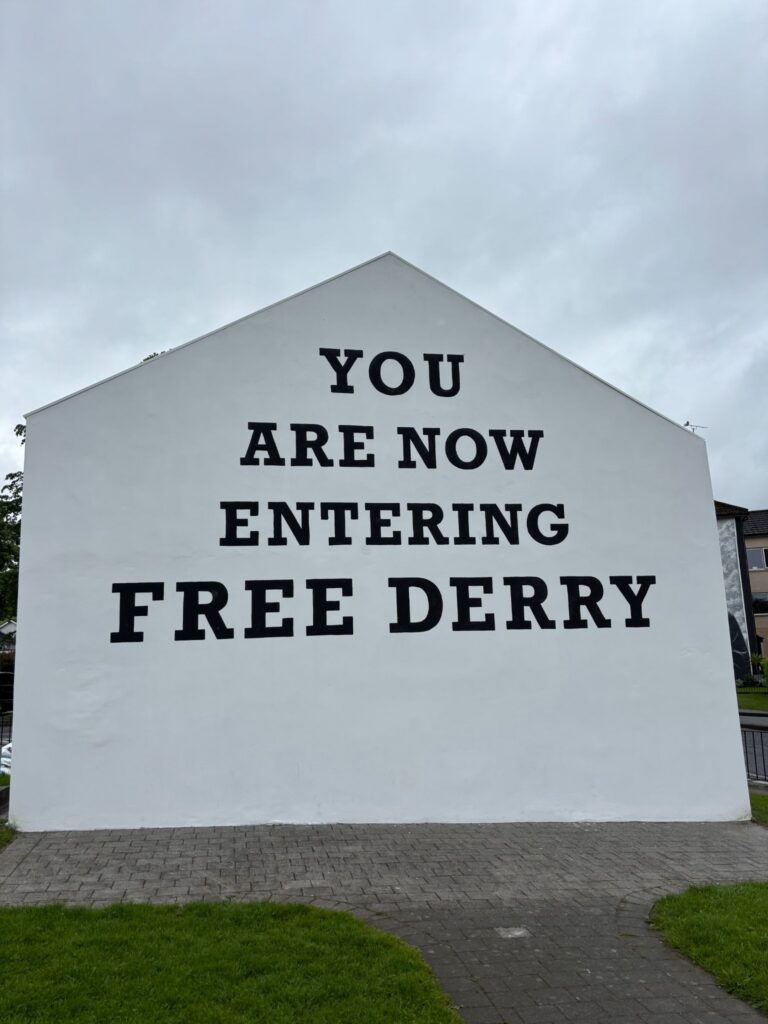
Above, an image of the sign welcoming us to Derry, standing tall all of these years later and reminding us of the history that has shaped the town.
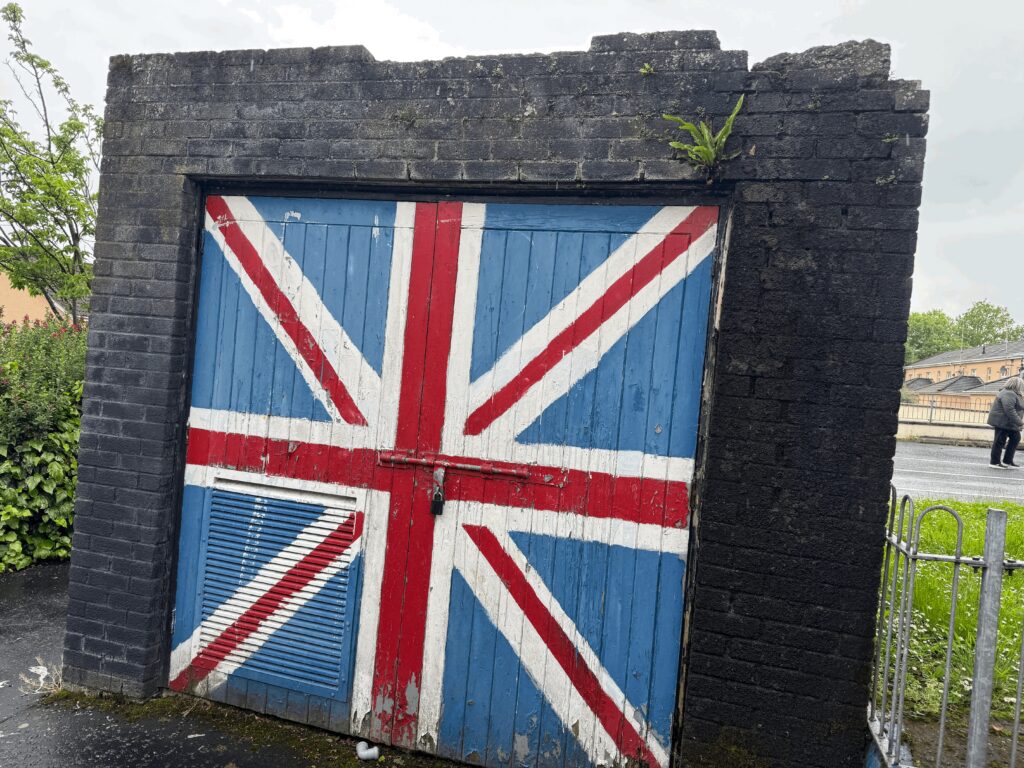
Above, an image of a building close to Glenn’s childhood community, representing loyalist patriotism.
Beginning our afternoon with a Tour of the Fountain Estate, our lovely tour guide, Glenn, described the deep social divisions between Loyalist and Republican areas, revealing certain tells of which side you were on. Ranging from the type of clothes you wore to what instrument(s) you played, early memories of Glenn growing up in a Protestant family and in high conflict areas were marked by running into his Grandma’s house with the sound of gunfire in the background, to looking underneath his Dad’s car every morning for a “box” (aka a bomb, considering his Dad was a member of the UDR and was a common target for the IRA).
Although there is only one serious peace wall in the area, gates that would be shut during curfew can still be seen; the walls are entirely open and fully walkable, as contrasted with Belfast’s gates still closing every night. The estate itself is built with a defensive architecture, with houses facing inward in a circular fort, symbolizing the metaphorical idea of “your backs to the rest of the world” (Glenn, Personal Communication, June 6, 2026). In this sense, there is a safety in ignoring what was going on outside the gates and the peace wall, bringing forth a childhood of gates, fences, and no-go areas. This, combined with the constant British symbols and paintings in Protestant communities (such as the red, white, and blue on sidewalk curbs), represents a claim to the territory.
Following the tour, in an interview with Glenn, topics such as removing the peace wall, politics, music, and Northern Ireland’s representation globally were discussed. However, the discussion on music in particular reminded me of Social Identity Theory (SIT). Social Identity Theory proposes that individuals define themselves partly through the social groups they belong to, using group membership to understand their place in the world and to achieve a positive sense of self (Tajfel and Turner, 1986). Music at the time was a subculture deemed completely separate from the ongoing violent conflict between the two communities, and was a way for individuals to shed a dominant social mask. Music was separate from reality, offered as a distraction that let you be whoever you wanted to be. While the common social identities of being either Protestant or Catholic, Unionist or Loyalist, and British or Irish commonly developed many individuals’ sense of purpose, the actions they took, and the communities they belonged to, music offered a rare space that existed outside of those rigid categories. In a society where identity was so heavily policed, literally and socially, the ability to step outside of your assigned group, even temporarily, was significant. This complicates a straightforward reading of SIT. Rather than simply reinforcing this idea of in-group belonging, music served as a form of resistance to an individual’s dominant social identity when the stakes of that identity felt too heavy to carry.
Taking a look into the Peacebuilder Exhibition (housed in the Gasyard Centre in the Bogside), this museum traces 30 years of conflict, community resilience, and the long road to peace in Northern Ireland, told largely through the lens of 3 Derry men: John Hume, Martin McGuinness, and Mitchel McLaughlin. The story the museum tells begins on August 1, 1972, the day after Operation Motorman, when thousands of British soldiers invaded Free Derry, dismantling the barricades that had turned the Bogside, Creggan, and Brandywell into a self-governing no-go zone since 1969. From there, insight into political conflicts with the British government, the intense hunger strike strategy for political prisoner status (March 1981), the development of Sinn Féin and its growing political status, the 1994 ceasefire, and the eventual road toward the Good Friday Agreement in 1998 was displayed.
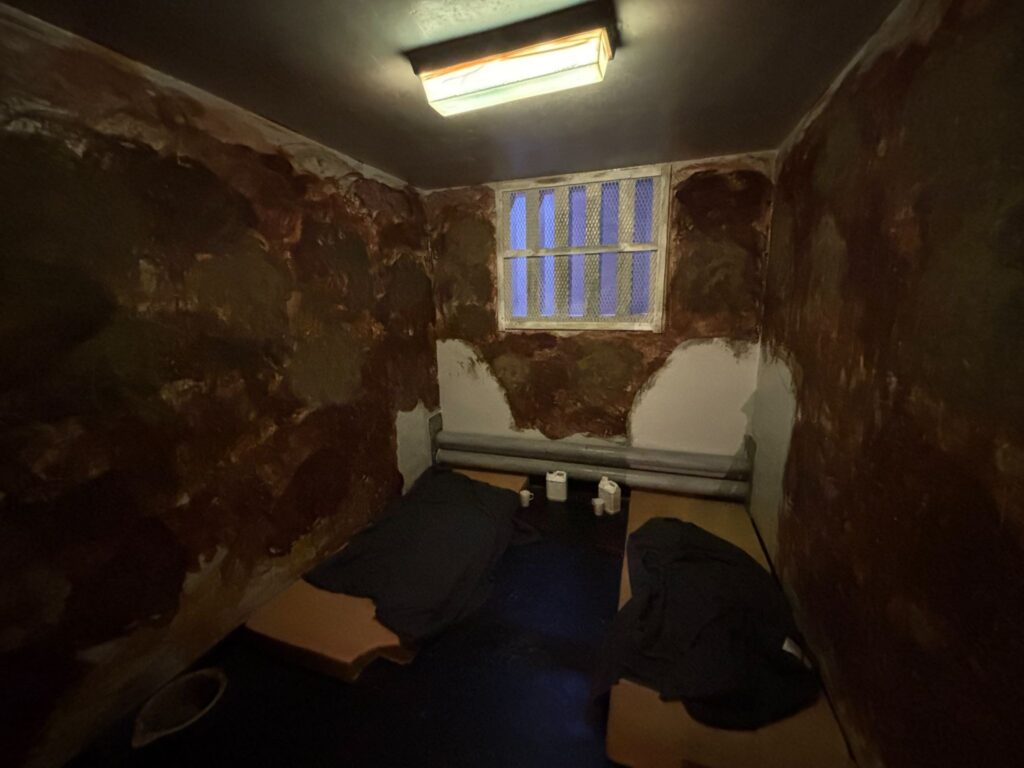
*A recreation of what a prison cell would’ve looked like during the “Dirty Protest” lasting from 1978-1981 in the Peacebuilder Museum
After finishing up exploring the exhibit, we then had an insightful conversation with Glenn and his wife, Aiveen, at Gasyard. Being a mixed couple, Glenn from the Protestant community and Aiveen from the Catholic community, their insight into growing up with violence and prejudice established a struggle for identity, the social pressure to remain divided (or be ostracized), and frustrations over how Northern Ireland is represented to others. While the Troubles/Conflict is an important aspect of history to be reviewed and remembered, Glenn and Aiveen shared how hundreds of years of Ireland’s overarching history and culture should be more recognized. Further topics, such as “trauma tourism” and the exploitation of violence for revenue, showed how identity in Northern Ireland becomes simplified to a 30-year period in time. Additionally, Glenn and Aiveen’s hopes for further investment in the arts and wider accessibility for creation and expression, the idea of reunification and the creation of a “New Ireland,” as well as paving a new path for their daughter amidst a struggling economy and the region’s “up in the air” future, allowed our group to deeply reflect. If culture is continuous, how will it develop in Northern Ireland?
References
CAIN Web Service. (n.d.). Conflict and politics in Northern Ireland. Ulster University. https://cain.ulster.ac.uk
Tajfel, H., & Turner, J. C. (1986). The social identity theory of intergroup behavior. In S. Worchel & W. G. Austin (Eds.), Psychology of intergroup relations (pp. 276–293). Nelson-Hall. https://christosaioannou.com/Tajfel%20and%20Turner%201986.pdf