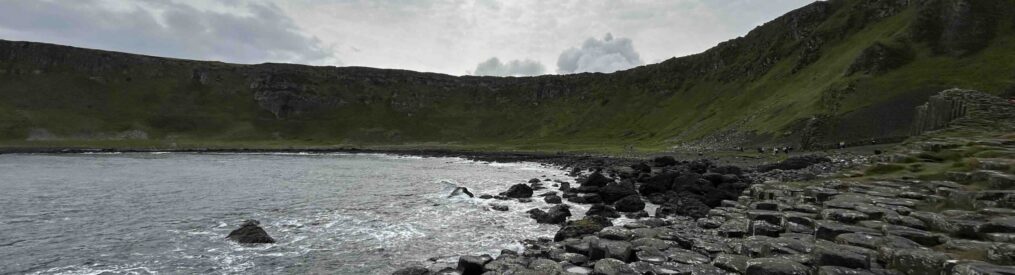
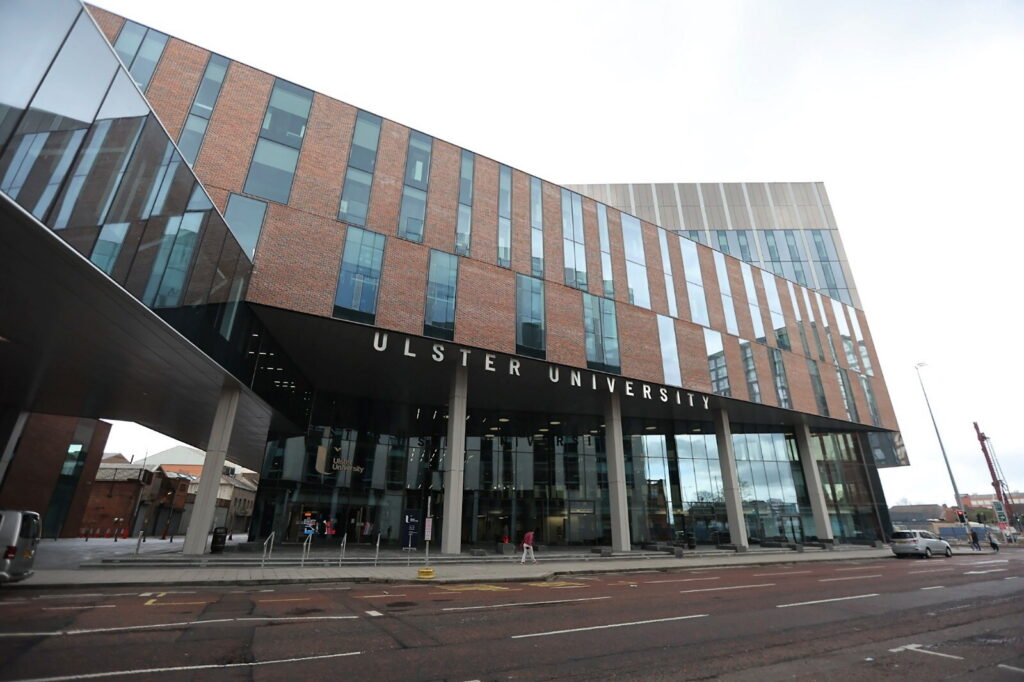
Tuesday, June 9th was our first day back in Belfast after spending about three days in Derry/Londonderry. In the morning, we walked to Ulster University to meet with Kate Turner and Brandon Hamber. Ulster University is the largest university in Northern Ireland, with three campuses across the country. It also stands as a testament to the progress made in Northern Ireland, as the building is made mostly of glass and stands in what was a historically violence-prone area of Belfast.
After exploring a local shopping mall’s food court for lunch, our group met with Avila Kilmurray to discuss her role in community peacebuilding in Northern Ireland. The day ended with a group reflection and a free evening exploring Belfast. However, it would be remiss of me not to address that that evening was the start of what would be several days of violent anti-immigration rioting across the country, centered in Belfast, in response to a stabbing on June 8th. The week ended with hope, though, as thousands gathered at Belfast’s City Hall to participate in an anti-racism protest on June 13th. While not directly related to our studies, the events of our last week in Northern Ireland added to our conversations about the ongoing and evolving tensions still present in the country.
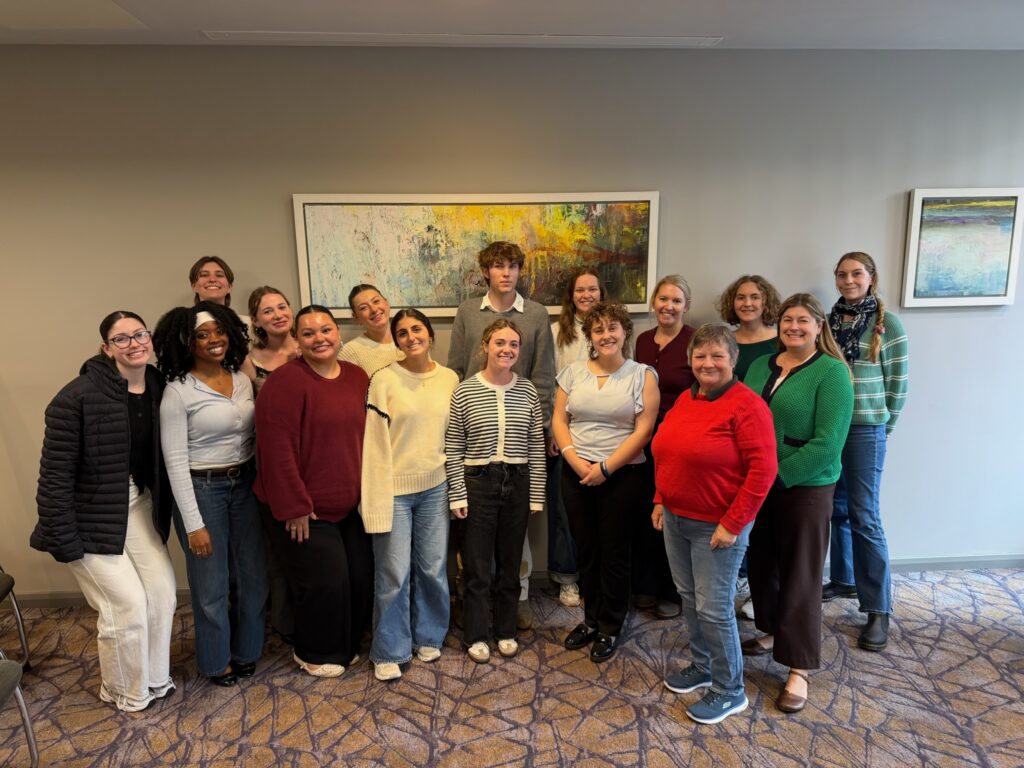
This blog will focus mainly on our group’s conversations with Brandon Hamber and Avila Kilmurray, as our discussion with Kate Turner will be covered by another blog post. Brandon Hamber is a professor and holds the John Hume and Thomas P. O’Neill Chair in Peace, which is based at the International Conflict Research Institute (INCORE) at Ulster University. INCORE has groups studying migration and heritage, gender, oral history, archives, and storytelling, and remembering the past. In regards to the conflict in Northern Ireland, one of Hamber’s areas of study is in the complex forms of masculinity present during and after the conflict. Avila Kilmurray is a prominent women’s activist still active in Northern Ireland today. She is the former director of the Community Foundation for Northern Ireland, and helped found both Derry Women’s Aid and the Women’s Coalition. Our meeting with Kilmurray was much needed as she brought to our studies the overlooked roles women played throughout the peace process.

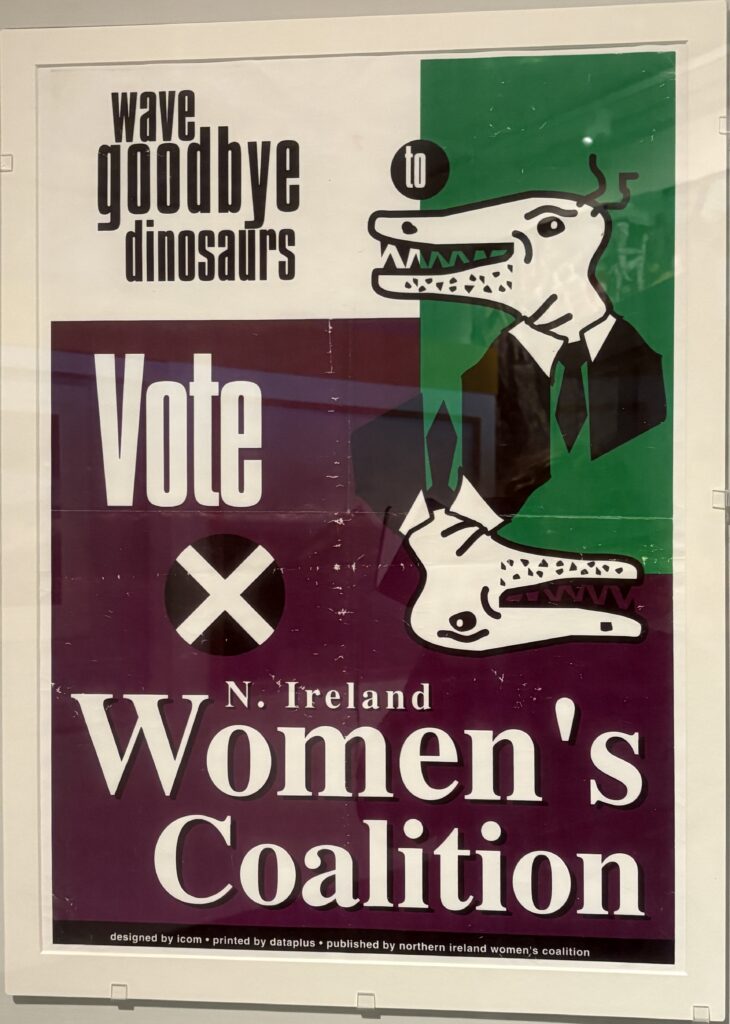
One of the most common concepts we encountered during our time in Northern Ireland was framing. Framing is the way that people perceive and interpret different ideas and experiences (Benford & Snow, 2000). Frames give different meanings to these ideas and experiences, which guides how people act and communicate (Benford & Snow, 2000). Throughout our conversations with Hamber and Kilmurray, the concept of framing kept coming up. Particularly in relation to the way that certain voices and stories have been left out because of the way the conflict has been framed, and how both of their work is focused on shifting the narrative to bring light to those hidden experiences. A common framing of the conflict is of paramilitaries as the defenders of their communities. This framing comes with a perception of paramilitaries as being of the macho-masculine inclination. Hamber explains that another form of masculinity was present during the conflict in the form of boxing clubs that provided a caring, protective form of masculinity as an alternative to the paramilitaries that were framed as the ideal form of masculinity. Part of Hamber’s work studying masculinity is to bring light to stories like those of the boxing clubs that have been overlooked because of the way the popular narrative has been framed. On the topic of gender, Kilmurray has long been engaged in the work of bringing attention to the experiences of women during the conflict and peace process that have mostly been ignored due to male-centered framing. The conflict and peace process in Northern Ireland have largely been framed as occurring between men, different armed groups and different political leaders, respectively; the involvement of women being mostly framed as normal domestic roles. As our group learned, women were much more involved in both the violent conflict and the peace process than is commonly acknowledged. The Women’s Coalition, and Kilmurray’s contributions to it, are proof of that. The Women’s Coalition was a political party founded in 1996 by women of both Catholic/Nationalist and Protestant/Loyalist backgrounds who felt that women’s voices had been left out for long enough. They were integral to the peace process and the Good Friday Agreement’s success, as they contributed not only policies about victim support, integrated education, and civic forums to the agreement, but also supported back channel peace negotiations when ceasefires fell through. The framing of the peace process as having been a product of male political and paramilitary leaders has resulted in a lack of acknowledgment and attention to the roles that women have played in ensuring a successful and inclusive peace process.
Our conversations with Brandon Hamber and Avila Kilmurray introduced our group to the understanding that the way the conflict in Northern Ireland has been framed, historically and presently, has resulted in an ongoing process to uncover the hidden stories and experiences of people throughout Northern Ireland’s history. Understanding the way events have been framed allows us to develop a deeper understanding of the past, present, and future of Northern Ireland. Beyond Northern Ireland, understanding that different events and groups are framed in different ways encourages us all to go beyond the black and white, and look deeper for a more nuanced understanding of the world around us.
References
Benford, R. D., & Snow, D. A. (2000). Framing processes and social movements: An overview and assessment. Annual Review of Sociology, 26, 611-639. https://www.jstor.org/stable/223459