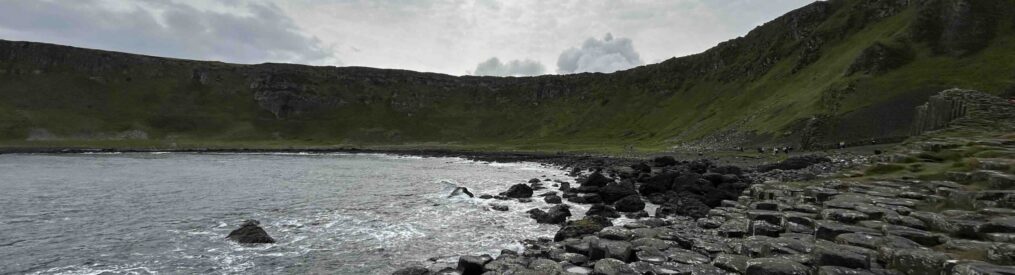
Day 1
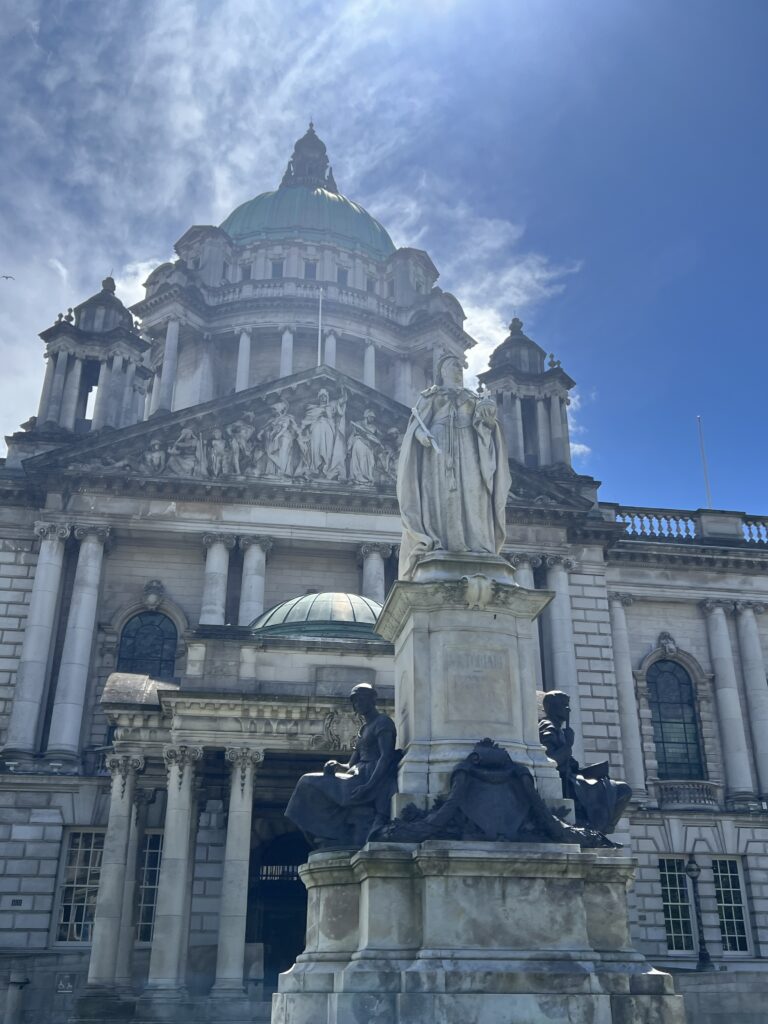
When I first arrived in Belfast with my study abroad group, I was struck by the city’s cultural ambiguity. The first thing I saw as I left the train station was a mural of William of Orange staring imposingly. I kept asking myself, “What is the identity of Belfast?” Little idiosyncrasies stood out to me, like the pink double-decker buses—it looks like a London double-decker tour bus, but it is noticeably pink instead of red. The ambiguity of the city is most obvious when you visit Belfast City Hall, where a statue of Queen Victoria stands at the center, but no single flag stands to represent the city or the constituent country. I wondered if Belfast identified as British, Irish, or both. Aspects of cultural ambiguity and social identity theory followed me throughout my first two days in Belfast.
Image 1: Belfast City Hall
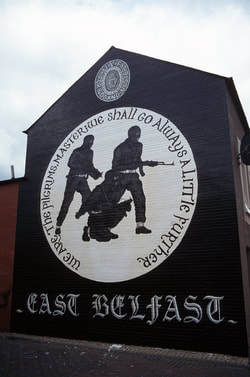
On day two, we met with Bill Rolston, a former professor of sociology and Director of the Transitional Justice Institute at the University of Ulster. Notably, Dr. Rolston is a nationalist who photographs a broad range of murals in Northern Ireland. For example, murals honoring William of Orange, memorials of Bloody Sunday victims, and depictions of paramilitary groups and activists. Dr. Rolston gave Chapman students a very informative history lesson about Ireland from the 1066 Norman Invasion of England to the 1921 Partition of Ireland, “The Troubles,” and the Good Friday Agreement. Significantly, message framing is employed to minimize the conflict in Northern Ireland by reducing it to “The Troubles.” (Smith & Petty, 1996) From 1968 to 1998, Northern Ireland became embroiled in a fight for civil rights and urban warfare between paramilitaries, state police, and the British Army.
Image 2: 1996 Armed loyalists, UVF emblem. ‘We are the pilgrims, master; we shall go always a little further. East Belfast.’
Following our history lesson, we went on a mural tour with a former UVF combatant, and I immediately noticed a contest for meaning, memory, and culture between Catholic/Nationalist/Republican (CNR) and Protestant/Unionist/Loyalist (PUL). (Gallagher, 1989) While the Catholic, Nationalist community remembers over 800 years of British oppression, the Protestant, Loyalist community remembers the Ulster Plantation as the birthplace of their culture. While walking to each mural in Shankill, the former UVF soldier emphasizes that the Loyalist community is distinctly British and that his heritage and culture are important.
Notably, the community separates itself from Irish culture, including the Gaelic language and musical traditions. On the Loyalist side of the sectarian community, only English is spoken and written, and the music is distinctly Ulster-Scottish in origin, specifically the flute and drums. In murals, the IRA is often demonized as “terrorists” while the Ulster Volunteer Force is portrayed as knights in a Holy War, fighting mythical dragons. These murals often feature the Ulster Banner, represented by the English flag with the Red Hand of Ulster superimposed at the center. The Ulster-Scots remember an idealized version of historical events based on their ingroup. (Harwood, 2020)
Image 3: UVF Mural

The descendants of the Ulster plantation are aware that their ancestors took the land and feel the tension within the sectarian city. But instead of reconciling with the past and their positionality, they dig their heels in the land and identify with the British. In terms of social identity theory, “People may adopt a social mobility strategy, essentially ‘leaving’ one ingroup for a different, more socially valued group.” (Harwood, 2020) Claiming a British identity offers a connection to a more powerful social group that can protect the Ulster-Scots in the region. Ulster-Scots defend the walls to protect the identity they have constructed for themselves, as well as the memories and history passed down that inform their identity.
Image 4: Peace Walls

At the end of the tour, we parted ways at the “peace walls” which divide the neighborhoods into sectarian spaces between the CNR and PUL. This is where Jake traded off the tour to former IRA combatant, Padr, who literally shared his side of the story within the CNR community.
Immediately, Padr elucidates the community’s struggles through cultural landmarks and his own life experience. As an oppressed community, the Gaelic language and culture were forbidden in public spaces, including schools. Kids could not engage in Gaelic sports, and the community as a whole could not openly play Irish music and song. English dominated public life, so many did not grow up learning Gaelic in schools, and Gaelic survived only in private spaces within family homes. Furthermore, the Catholic community faced significant job discrimination that limited job opportunities for social mobility.
Image 5: Clonard Monastery, Belfast

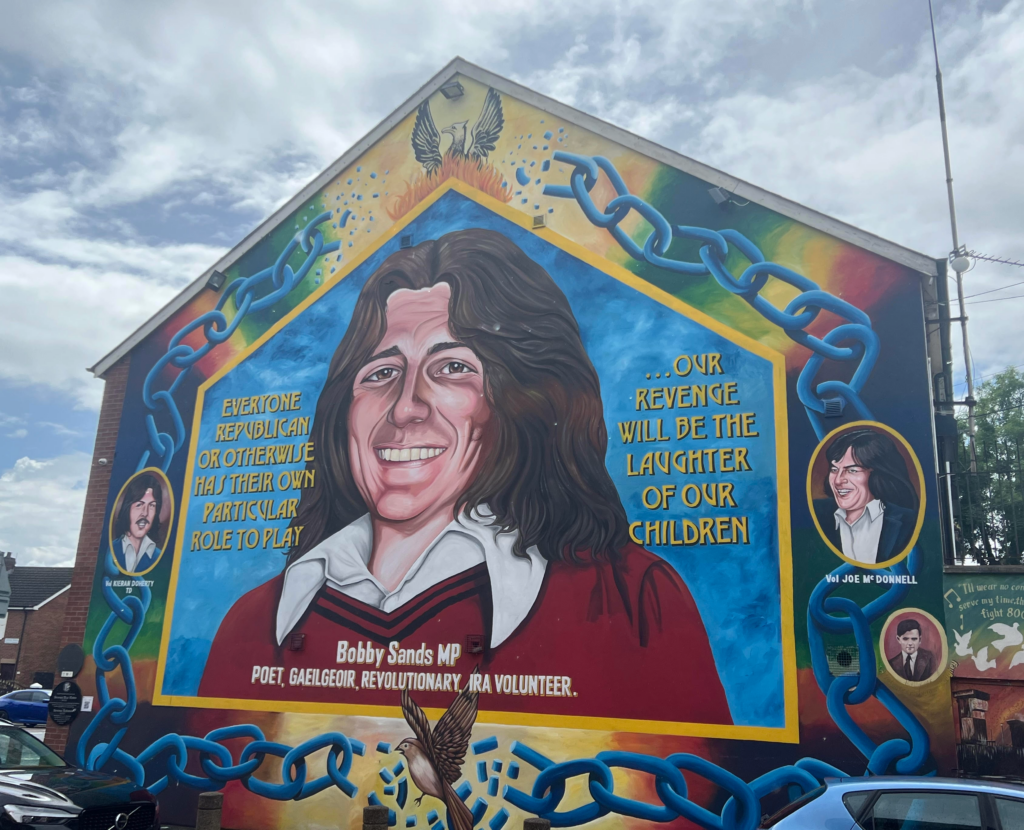
Notably, Padr grew up working class and struggled in school. So when Padr was recruited to join the IRA, it was not just a matter of desperation, but an initiative to right the wrongs of national suppression in the community. Significantly, Padr possessed a social change belief system, where instead of “abandoning their group for a more desirable outgroup, they instead attempt to make their ingroup’s position more desirable.” (Harwood, 2020) For instance, the fight for civic and human rights became a major point of national struggle from 1968 to 1998, and political prisoners like Padr staged several protests while being imprisoned by the British Army. Padr describes the various strikes in great detail, even recalling his compatriot, Bobby Sands, who died during a hunger strike to achieve human rights for political prisoners. For example, freedom of association among fellow prisoners and a decriminalized status for IRA prisoners.
Image 6: Memorial of Bobby Sands, a political prisoner and hunger striker.
The ambiguity of Belfast stems from two communities sharing a city mired in historical tension, and fighting to tell its story through message framing and persuasion. (Smith & Petty, 1996) The contrast between national suppression and civil rights versus UVF depictions of gallant holy warriors and English heritage demarcates the division of historical remembrance. The division between historical narratives depicted in murals illustrates biases and shared experiences of violence. A step towards reconciliation can begin with sharing and accommodating one another’s personal histories in narratives. Creating a history that tells both sides of the story will elucidate Belfast’s ambiguity and initiate a shared construction of national identity.
References
Gallagher, A. M. (1989). Social identity and the Northern Ireland conflict. Human Relations, 42(10), 917-935. https://research-ebsco-com.chapman.idm.oclc.org/c/wnnu3f/search/details/2s3k27ivqz?db=buh
Harwood, J. (2020). Social Identity Theory. In The International Encyclopedia of Media Psychology, J. Bulck (Ed.).https://onlinelibrary.wiley.com/doi/10.1002/9781119011071.iemp0153
Smith, S. M., & Petty, R. E. (1996). Message framing and persuasion: A message processing analysis. Personality and Social Psychology Bulletin, 22(3), 257-268. ttps://doi.org/10.1177/014616729622300