Looking back on the days through our blog has made me nostalgic of it all, and just grateful for everything I got to experience within this two-week course. I am a Health Science Major, and Nutrition minor, so coming into this course I only knew from the pre assignments for what to expect, and I learned so much more than I thought I would. In the health industry, you will come across so many hardships and choices that will need to be made on a daily. These choices will affect our lives for the better or worse. Coming out of this course, I understand so much more when it comes to why decisions are made from the communications aspect but also looking into a person more deeply rather than their outside “appearance” coming from the peace and justice side. I want to be an occupational therapist and help people learn to walk again coming out of a traumatic event. From this course, I realize how much depth there is to the word trauma, and how over generations, trauma can still be going on. It is imperative to be able to work together with each other well and learn about one another to be able to come together and strive forward in this evolving world.
From the day-to-day perspective, it has been so rewarding being able to see new sights like Shank hill and the Falls roads, the peace walls, Corry Meela, and Giants Causeway. Looking at murals and realizing how their reality is different from ours in the United States and just knowing that their conflict is still going on in some ways, just not violent. One moment that changed my mind set a lot on war was the game we played in Corry Meela. I have never been so invested in a game, and how my colleagues were talking about it after, it made them think differently as well. It made my colleagues, and I realize that war is never the answer, and it does not solve anything. Communication is a huge factor that can cause so many slip ups, and quick decision making from a lack of knowledge, that causes wars like the troubles to happen. The game showed me that communication is incredibly hard to do, and in the middle of a war, trying to call a ceasefire must be on another level of difficulty.
While there were so many highlights to this trip, there were also some challenges that I came across during it. Our days were long, and our brains were on constantly, making it difficult sometimes to be able to focus on the minute details that may have missed during important conversations with the people of Ireland. Coming from a completely different major, it was hard to switch my mindset of anatomy, physiology, and nutrition, to the mindset of war and communication. Once we had a few conversations with some of the people, and specifically the panel with Lee Lavis in it, I was hooked on learning about his story, and the many hardships he came across in his life of being a British soldier. These conversations of learning, and talking made the tiredness, and overfilled brain information worth it because of all the lessons I was able to take away from it.
Coming into college, I knew I wanted to be a health science major, but I had to work incredibly hard to be able to stay within the major because science does not come easy to me, so I was surprised that I could not switch my brain as easily as I thought to a subject different from the past years. The first couple of days, like I mentioned, were difficult, but after getting some much-needed background information, and lots of repetition of the history of Ireland, it became a lot easier to learn more.
In conclusion, I loved taking this course because it opened my eyes to a world outside of the United States and showed me that a post conflict world is achievable. Ireland is a beautiful country that I loved exploring with my many new friends that helped push me learn even more. I truly enjoyed my experience during the 2 weeks that this course took place, and I am grateful for everything that I was able to take away from it!
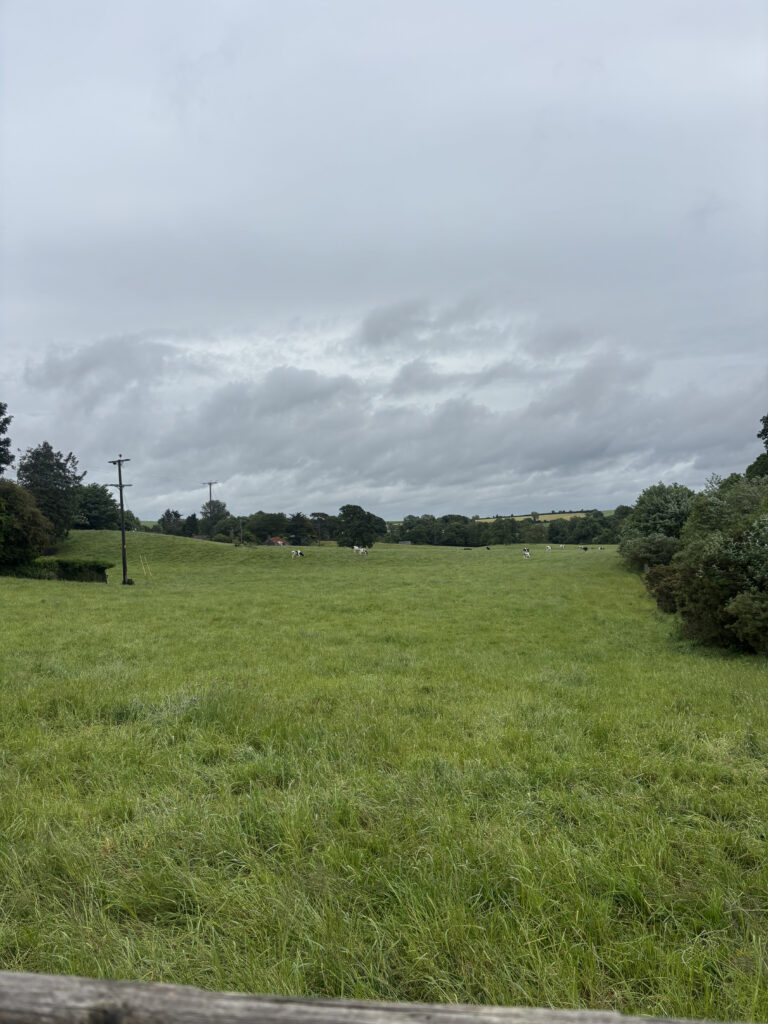
Hello, My name is Faith Dunscombe and I did June 4th and 5th of our Ireland trip! On June 4th of our trip in Northern Ireland, we stopped on the Border Region getting to Derry/London Derry. When talking to a British Soldier about this area, in which he emphasized it as the “Gate Way to Hell.” This was because this area was heavily militarized to reduce paramilitary attacks or the smuggling in of arms. This was the only main road because most other roads were blocked off, causing everyone to have to go through this checkpoint. This area was used mainly up until 2007.
Photo Taken by Faith Dunscombe (6/4)
The British Soldier, Lee Lavis, talked about how there would be a helicopter pad in that grass area, and most helicopters would be coming in and out of this area, stopping at this checkpoint. Behind this grass area was the building that housed all the British soldiers in it. Food, clothing, and beds were all at the military base, and how the British soldiers ensured safety was by having 2 helicopters to a patrol at a time, or people by foot as well.
This area was mainly the IRA army against the Royal Ulster Constabulary according to the Lee Lavis. The British army helped the Royal Ulster Constabulary establish bases since they could not do it on their own. Which led to the British controlling the watchtowers, helicopter pads, and heavily fortified military bases.
Relating this back to what we have been learning in our class, I would like to talk about the reading, Working Together in a Divided Society: A Study of Intergroup Communication in the Northern Ireland Workplace”, authored by researchers Owen Hargie, David Dickson, and Seanenne Nelson. This reading taught me many things about the inter communication between different sides, but also the deeply rooted, not talked about, rules that the people of Northern Ireland started taking on. In these heavily militarized areas, there was lots of fear, anxiety, and hyperawareness of what was going on. People in nearby areas were then starting to avoid a couple subjects when conversing with people they are not familiar with. They avoided talking about politics, religion, their historical background, or what schools their family or children are attending. All these subjects would be dead give aways for what side of the conflict they were on, and it could have led to more violence and anxiety, so people avoided the conversation overall. Instead of asking these questions, there were plenty of other ways one could go about finding which side someone was on. Pronunciation, for example, was a big give away, in which if you were on the Catholic side, you usually pronounced your H’s like “Haitch,” but if you were on the Protestants side, it was usually pronounced “Aitch.” (Hargie et al., 2003)
This is just one example of the many things people looked out for in Northern Ireland during their jobs, which had people from both sides within it. These people would work their 9-5 jobs, working together, then go home to their segregated lives. Their jobs were like a neutral zone, that should have acted to bridge the way to more integration and acceptance of differences, but it just led to more silence, and ways around being segregated.
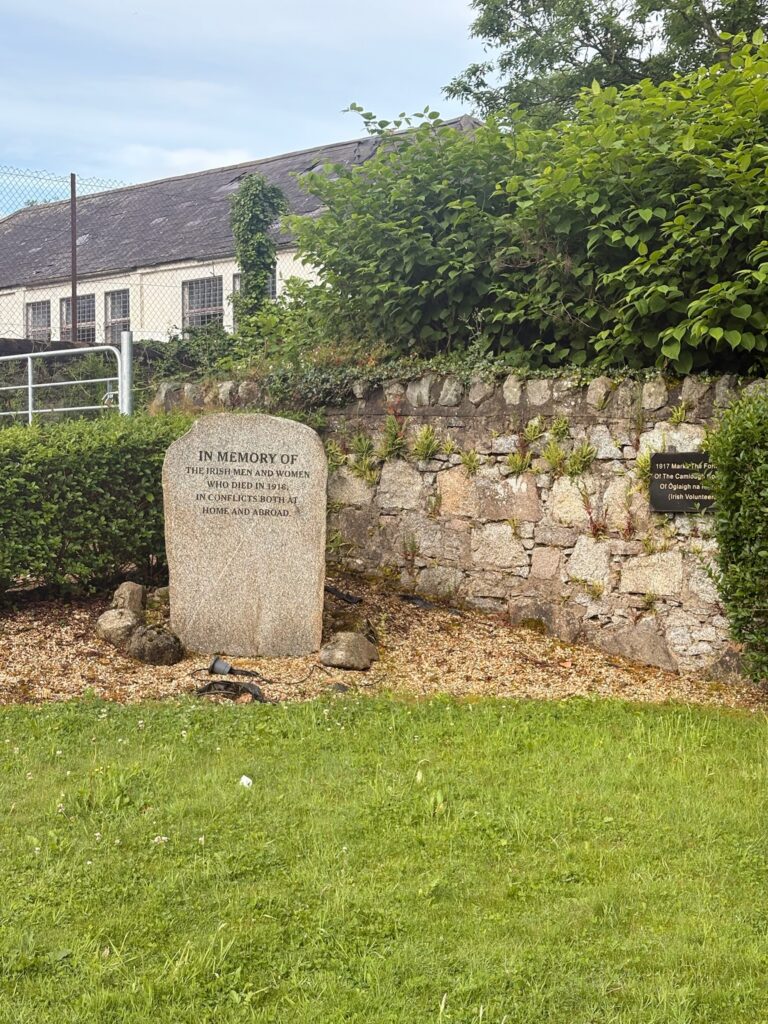
After we were done talking about the deep history within the border region, Declan Murphy, a politician, then took us to the Wee Garden. This Garden was made in 2016, and it commemorates all the people who fought, or were lost during the conflict. Declan Murphy talks about how a lot of people just wanted to forget about the war, but there was so many good people lost during it, so it was important that they had a landmark to look back on and remember the people who could not be there with them today.
Photo Taken by Faith Dunscombe (6/4)
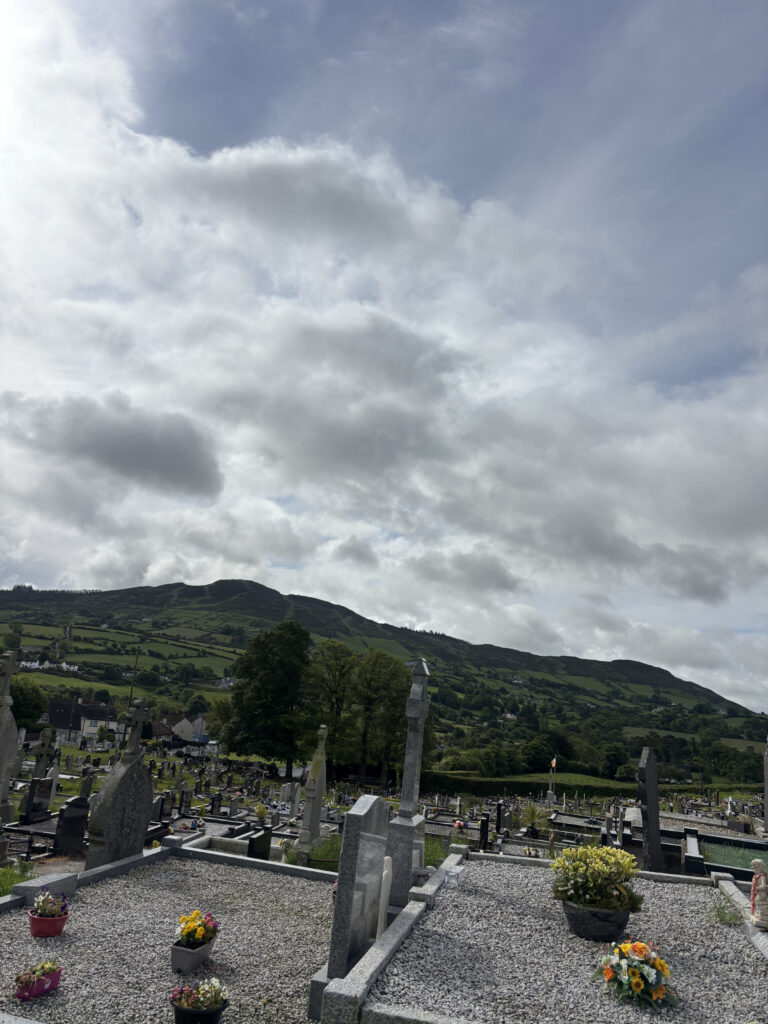
Next, we were then taken to the cemetery. In this cemetery, Declan and Lee talked about the many more lives lost during this hard time. They talked about how the British army were under so much pressure, and they thought that if they could criminalize the people, it would lessen the war, which did not work. It led to hunger strikes, which Declan talked about one of his colleagues Raymond McCreesh, who he went to school with. Declan and Raymond were both criminalized by the British, but Raymond ultimately died due to the hunger strikes. It just goes to show how personal this war was getting, and how so many people lost good friends and family members during this conflict. Declan was only released after the Good Friday Agreement was curated, and has been out since, being able to tell us his story.
The Parasocial Contact Hypothesis, which states that if there is personal contact between two different groups, prejudice can be reduced (Schiappa et al., 2005). This Theory is not very prevalent within these times that Declan and Lee are illustrating. There is so much war, and segregating, making this theory very hard to take place.
June 5th, Giants Causeway
Photo taken by Faith Dunscombe (6/5)
Photo taken by Daniel Wehrenfennig (6/5)
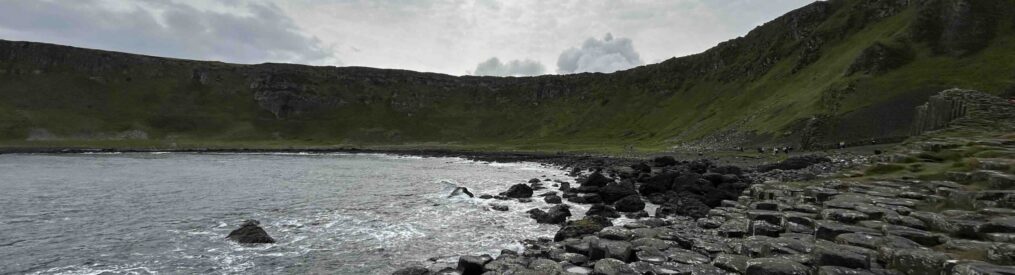
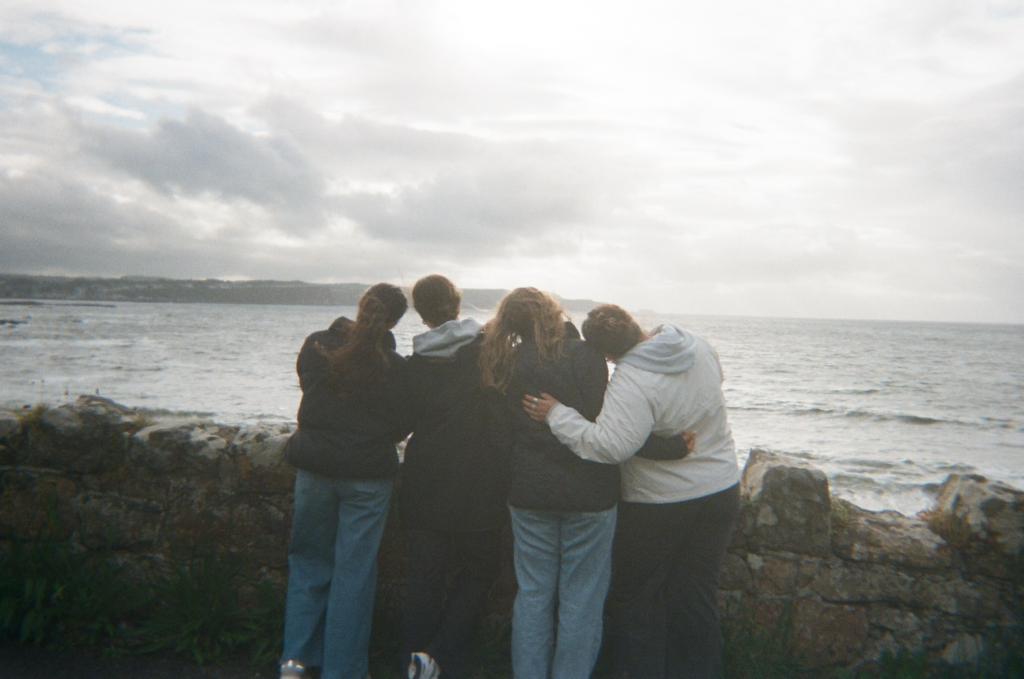
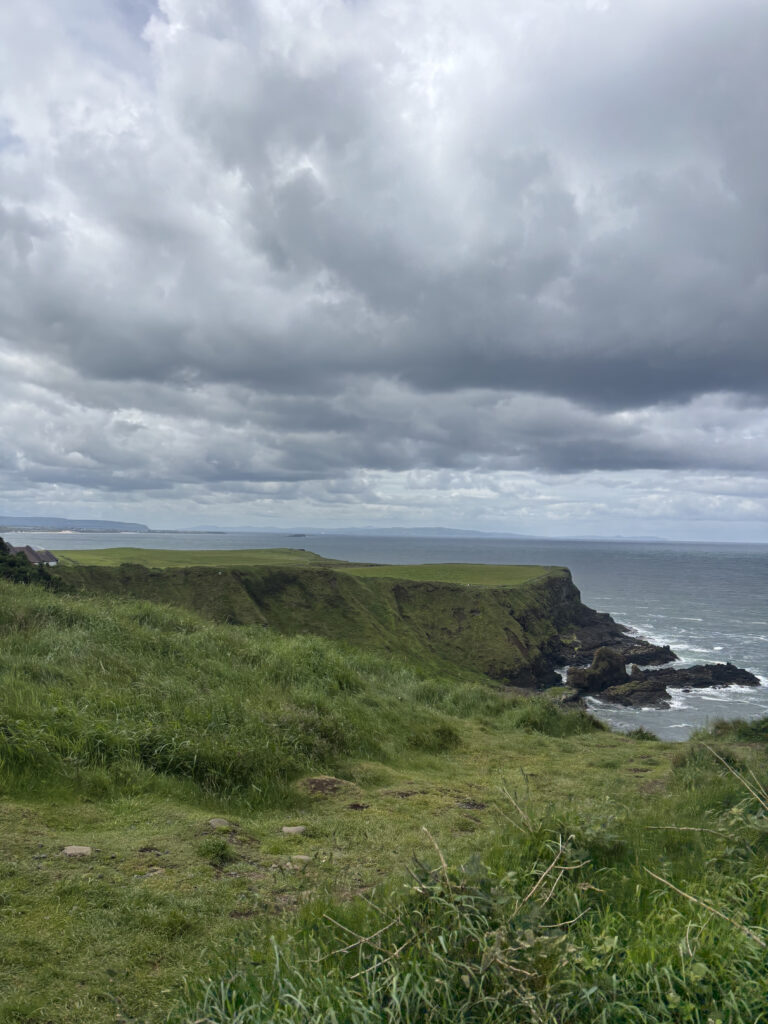
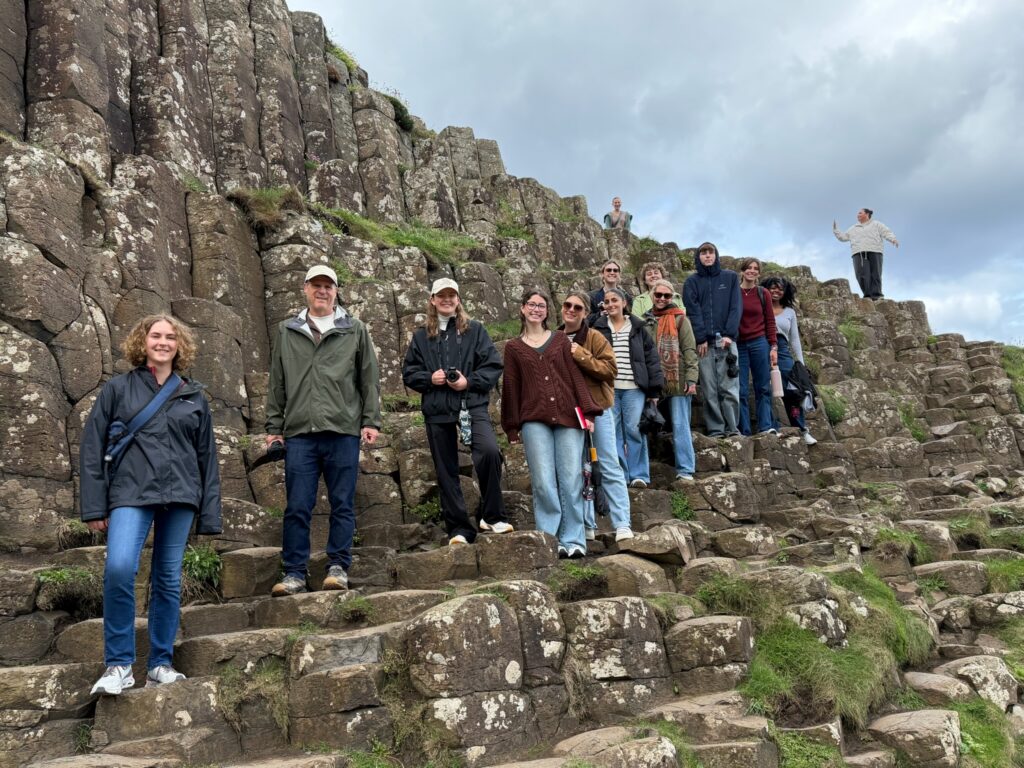
During our travels to Derry/London Derry, we stopped at Giants Causeway. This place was so beautiful and filled with greenery and water on the horizon. It allowed for us, the students, to get a break from the constant everyday learning, but also still do something fun and filled with tourist pictures!
Daniel Wehrenfennig, one of our Professors and CIEL guides told us a story first before we took our excursion to the rocks. This story is said that Finn McCool, a giant, built pathway to Scotland, but found out that there was another way bigger giant on the other island (Scotland.) Finn’s Wife thinks quickly, and dresses up Finn as a baby. When the other giant comes over to Ireland, he sees Finn and thinks if this baby is already this big, then the father must be much bigger than him, so the giant flees back to Scotland. Now, there is just these steppingstones left over from his pathway to Scotland, known today as Giants Causeway.
To finish up our more relaxing days, we learned all about traditional music and dancing.
Photo Taken by Faith Dunscombe (6/5)
Photo Taken by Faith Dunscombe (6/5)
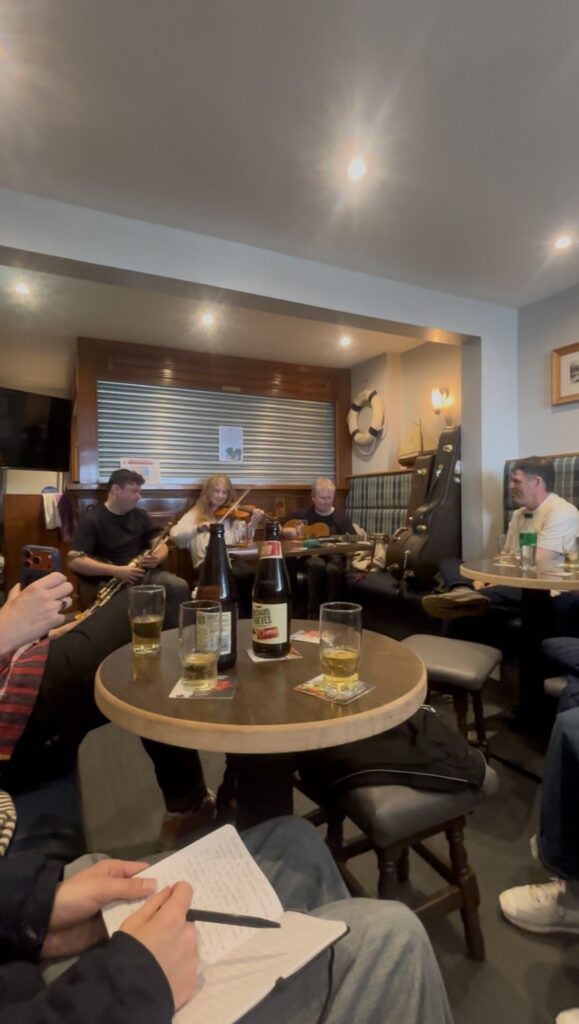
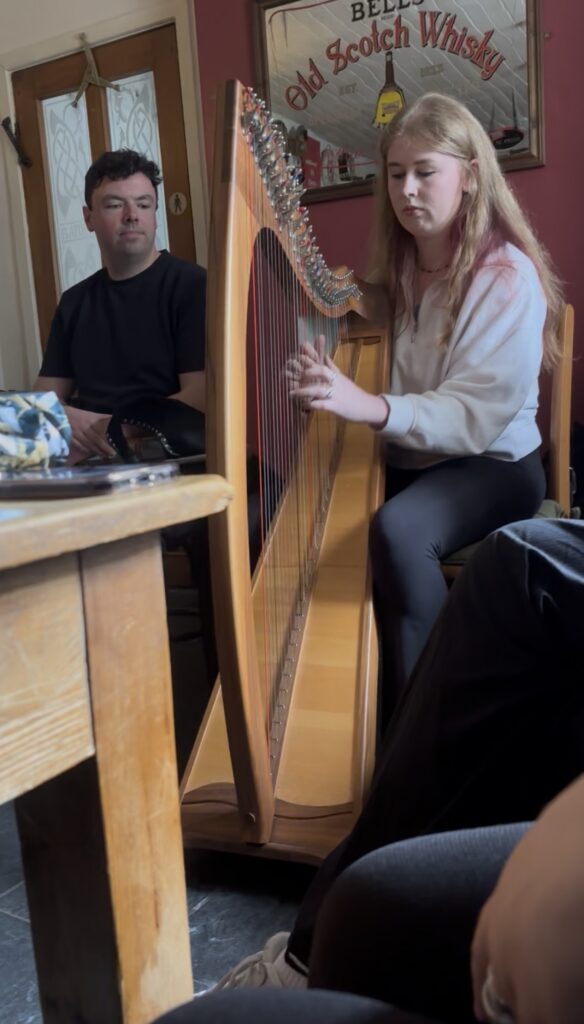
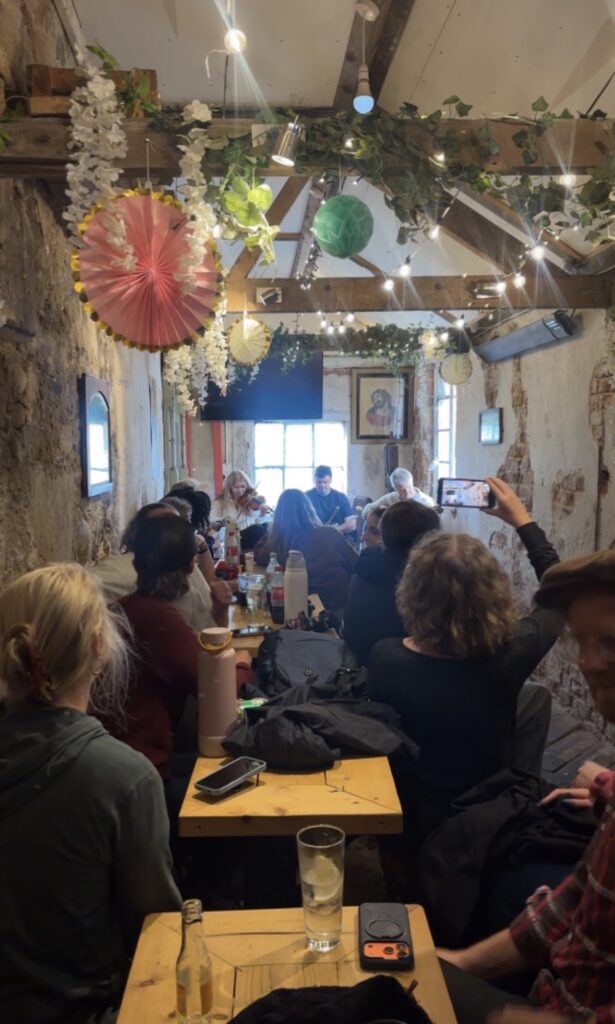
The three lovely musicians taught us about the organization called the Comhaltas Ceoltóirí Éireann. This organization is used to preserve traditional Irish music and commemorate how much music has brought together people during many hard times, especially during the conflict. The most common places you will find traditional music (or more well known as trad) is in a bar. Traditional music is played most every day to carry out its traditions and allow the future generations to also learn about it and enjoy its rhythm. Traditional musicians tend to be super close together since a bar is packed full of people, and just to feel the music and dance it out.
The musicians played a couple of pieces for us in the first two bars, in which they were super high beat, and fun to listen to. One thing they told us to do is when you get super into the music, you can say “hip” which is a traditional thing to do when listening or playing Irish music. While it is something fun to do, it could also be a way that the musicians are going to change key, and the word “hip” signifies that they are going to change key soon, so the others should be more cautious to ensure they are staying within rhythm and key.
In the second bar, the harp and Ellen pipes were played briefly. Both were so unique, and the musicians played them very beautifully. The harp was very elegant, while the Ellen pipes had such a unique sound to them, I had never heard in person before.
In the Last bar, we learned about traditional dancing.
Photo Taken by Faith Dunscombe (6/5)
Traditional Dancing has more than one category to it, in which most people outside of Ireland think it is the stiff arms and leg dancing that is traditional. While this is one of the categories to dancing, there is another one called Set dancing, which we learned and tried. It consisted of lots of hopping, cuffing, and turning around. This dancing could be carried out alone, or with a dance partner. We learned with a dance partner, which made it fun with a lot of mistakes on the learning curve.
These two days first focused on the segregated societies that took place during the troubles, then how they used music and dancing to be able to bring people together and live out happy lives. Stereotyping is extremely prevalent and ingrained into the people of Irelands brains due to so many years of war. In one of the readings defining stereotyping, it entails more. “…defined stereotypes as ‘pictures in our heads’ when we think about a particular social group.” (Shibboleth Authentication Request, 2026) We put these initial thoughts of how people are in our heads, but like the Northern Ireland people, they are all the same. They go to a 9-5 job and can keep conversations non-controversial by avoiding certain subjects. These people are much more similar than they realize, and it was hard for them to overcome it when they had these deeply rooted political beliefs.
Traditional Music and Dancing is one of the ways they can bring people together and just be one group enjoying each other. This can cause the Parasocial Contact Hypothesis to really become integrated within the people of Ireland and help them realize their differences are not as big as they seem. Us being hand in hand while learning Set dancing is the perfect example for how to break those walls down and learn about something that they both have heritage within.
References:
Comhaltas Globally Promotes Traditional Irish Music Dance Culture for Students, Educators, Visitors, Musicians & Journalists. (n.d.). Comhaltas.ie. https://comhaltas.ie
Hargie, O., Dickson, D., & Nelson, S. (2003). Working Together in a Divided Society. Journal of Business and Technical Communication, 17(3), 285–318. https://doi.org/10.1177/1050651903017003002
Schiappa, E., Gregg, P. B., & Hewes, D. E. (2005). The Parasocial Contact Hypothesis. Communication Monographs, 72(1), 92–115. https://doi.org/10.1080/0363775052000342544