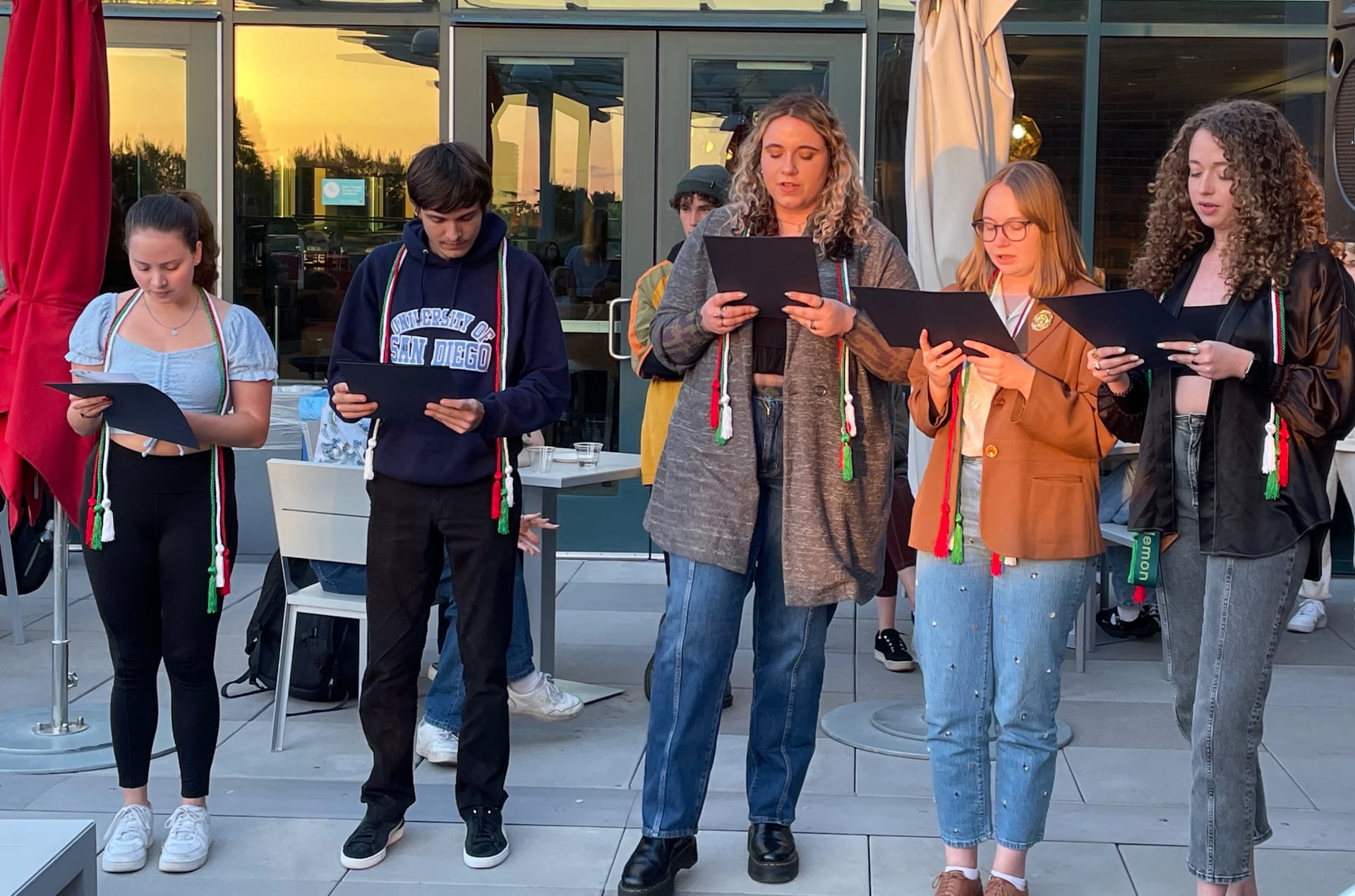
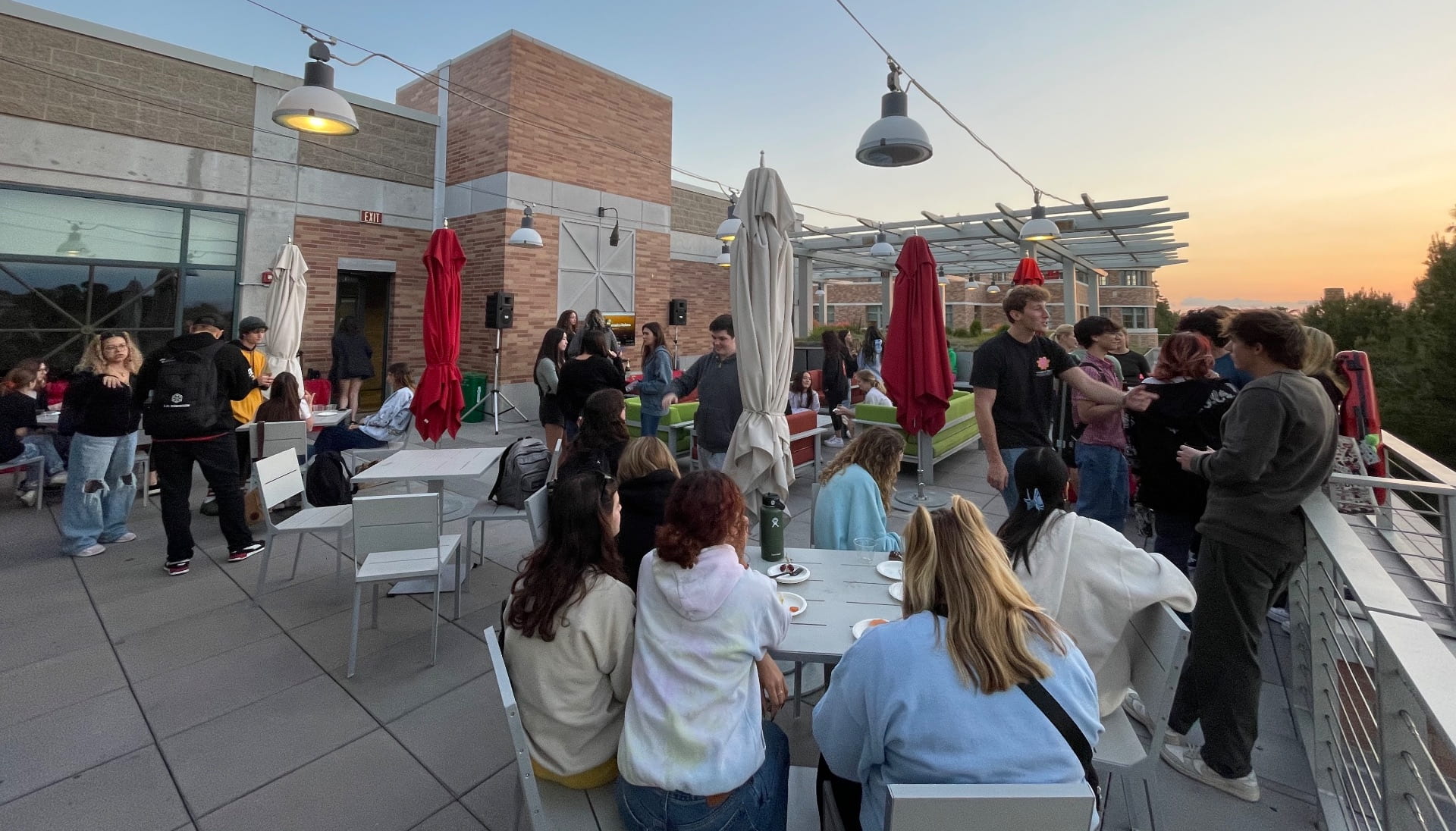
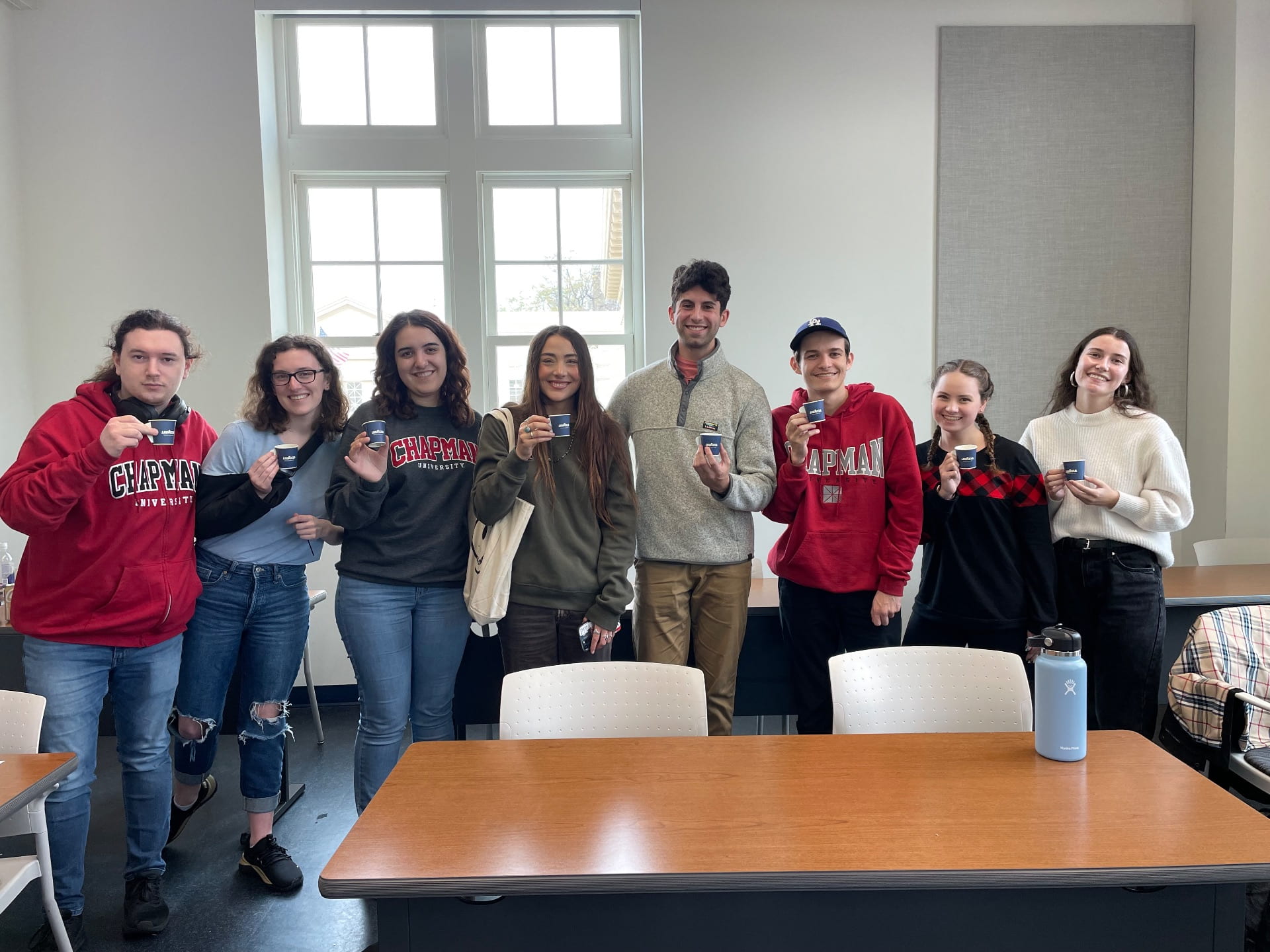
The Italian Studies program proudly houses a chapter of the National Italian Honor Society, Gamma Kappa Alpha which recently held its inaugural induction ceremony. On May 10th, seven undergraduate students were formally inducted into the prestigious honor society, recognizing their outstanding academic achievements in the field of Italian Studies.
The Italian Program wholeheartedly congratulates Chapman University’s first inductees into Gamma Kappa Alpha:
Bella Ocana
Lauren Moyle
Sofie Kassaras
Hannah Prince
Owen Glidewell
Isabella Brancato
James Cigliano
From left: Isabella Brancato, James Cigliano, Sofie Kassaras, Lauren Moyle, Bella Ocaña
The Italian Studies program proudly houses a chapter of the National Italian Honor Society, Gamma Kappa Alpha which recently held its inaugural induction ceremony. On May 10th, seven undergraduate students were formally inducted into the prestigious honor society, recognizing their outstanding academic achievements in the field of Italian Studies.
The Italian Program wholeheartedly congratulates Chapman University’s first inductees into Gamma Kappa Alpha:
Bella Ocana
Lauren Moyle
Sofie Kassaras
Hannah Prince
Owen Glidewell
Isabella Brancato
James Cigliano
From left: Isabella Brancato, James Cigliano, Sofie Kassaras, Lauren Moyle, Bella Ocaña
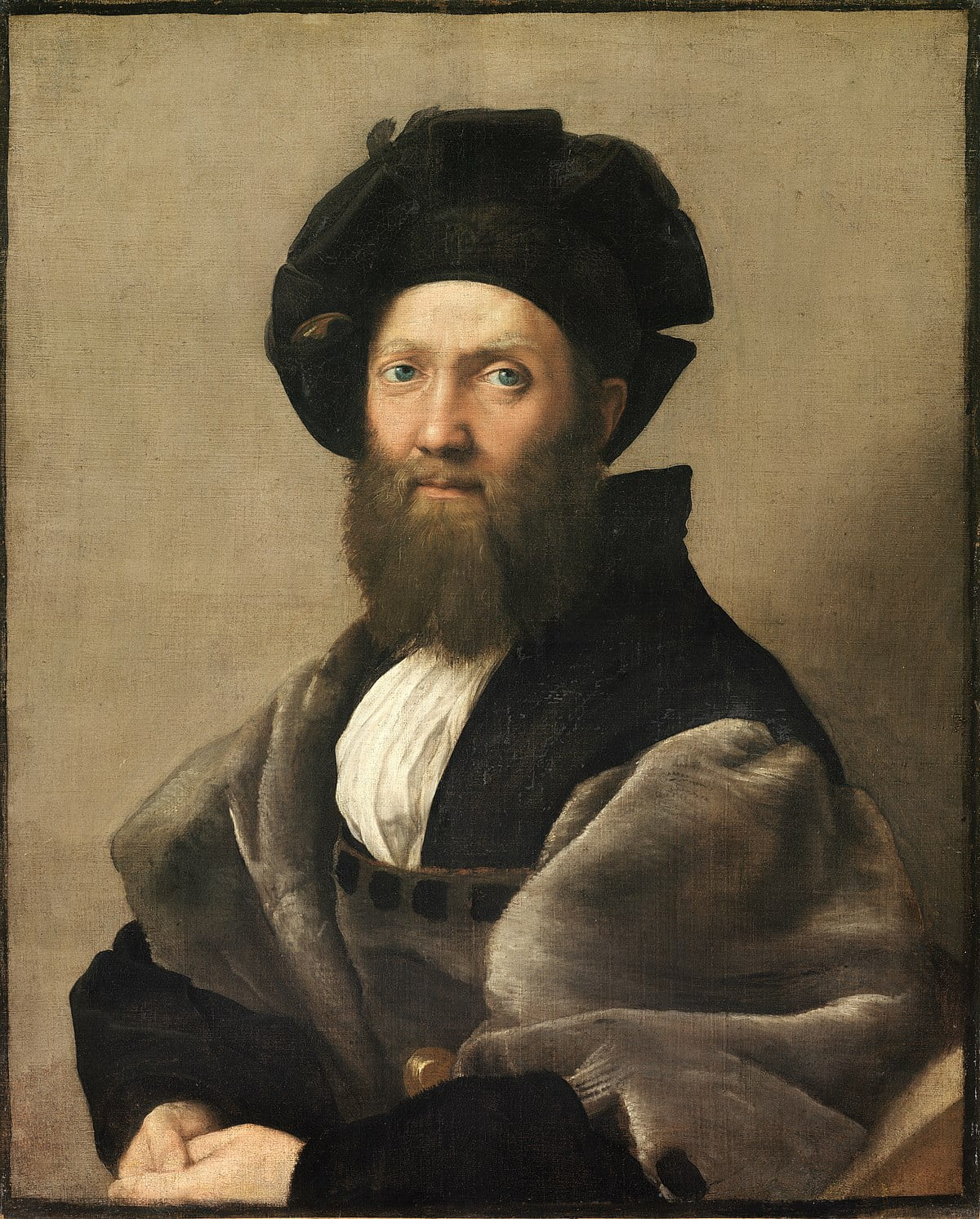
This Spring, Italian Studies students have participated in various courses ranging from Renaissance culture to contemporary film. Students in the honors program and advanced Italian Studies had the opportunity to attend the interdisciplinary course “Power and Imagination in the Italian Renaissance, ” analyzing literary, philosophic, and scientific texts foundational to humanistic legacy, and exploring themes such as caution, resoluteness, heroism, conformity, orthodoxy, and innovation.
“This class brings about a whole new understanding of the Italian Renaissance. It illuminates the powerful interconnectedness of art, literature, science, architecture, economics, politics, and more. The interconnectedness between these elements of society and culture reveals a new understanding of the Italian Renaissance and our own society and culture today. Perhaps most importantly, this class reveals patterns in the human experience throughout the course of history that we can connect to now with our own experiences as people. It is a connection that enriches the mind, body, and soul.”
– Lauren Moyle, Chapman Italian Studies Minor.
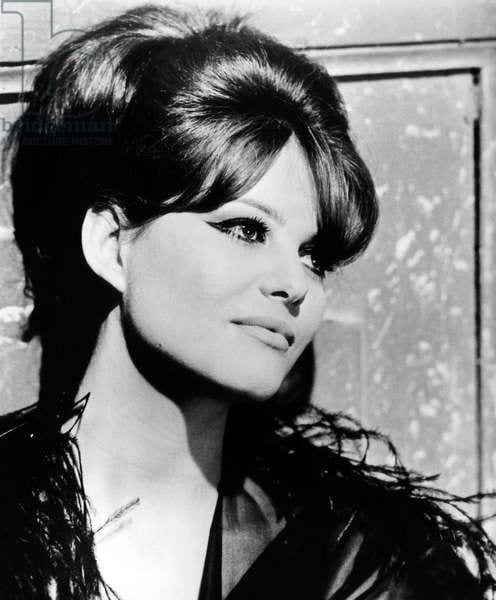
In addition, students have explored Italian Cinema and its relation to politics, art, and industry. This course surveyed Italian cinema history, examining its evolution from the silent period to today, and its relationship to other national cinemas and Hollywood. Students analyzed aesthetic and ethical legacies connecting classical and recent films and learned about the stylistic and cultural underpinning of neorealist cinema, various genres, and poetic cinema.
The course “History and Culture of Food in Italy” comprehensively explored the rich history of Italian food cultures from multiple perspectives. Students delved into the histories of certain Italian staple foods, regional gastronomical traditions, and socio-political movements that have shaped the country’s culinary landscape. In addition, the course covered contemporary sustainability issues and analyzed food’s role in Italian art, advertisement, and literature.
“The Italian Food course expanded my understanding of topics I rarely thought about or considered in Italian culture. For example, the history of coffee in Italy is so much more complex than I could have imagined, with various experiments by numerous inventors leading to the making of the perfect espresso machine or the ingenious creation of the Moka Bialetti for people at home to make their favorite coffee. Topics like this are what drew me to the class in the first place, and I think anyone interested in food culture or Italian culture should definitely consider it.”
– James Cigliano, Chapman Italian Studies Minor
Looking forward to the Summer, students are excited for the journey ahead. There’s no better way to learn a language than by immersing yourself in the language and culture. Students of all levels will be participating in three different programs across Italy. Stay tuned for more!
This Spring, Italian Studies students have participated in various courses ranging from Renaissance culture to contemporary film. Students in the honors program and advanced Italian Studies had the opportunity to attend the interdisciplinary course “Power and Imagination in the Italian Renaissance, ” analyzing literary, philosophic, and scientific texts foundational to humanistic legacy, and exploring themes such as caution, resoluteness, heroism, conformity, orthodoxy, and innovation.
“This class brings about a whole new understanding of the Italian Renaissance. It illuminates the powerful interconnectedness of art, literature, science, architecture, economics, politics, and more. The interconnectedness between these elements of society and culture reveals a new understanding of the Italian Renaissance and our own society and culture today. Perhaps most importantly, this class reveals patterns in the human experience throughout the course of history that we can connect to now with our own experiences as people. It is a connection that enriches the mind, body, and soul.”
– Lauren Moyle, Chapman Italian Studies Minor.
In addition, students have explored Italian Cinema and its relation to politics, art, and industry. This course surveyed Italian cinema history, examining its evolution from the silent period to today, and its relationship to other national cinemas and Hollywood. Students analyzed aesthetic and ethical legacies connecting classical and recent films and learned about the stylistic and cultural underpinning of neorealist cinema, various genres, and poetic cinema.
The course “History and Culture of Food in Italy” comprehensively explored the rich history of Italian food cultures from multiple perspectives. Students delved into the histories of certain Italian staple foods, regional gastronomical traditions, and socio-political movements that have shaped the country’s culinary landscape. In addition, the course covered contemporary sustainability issues and analyzed food’s role in Italian art, advertisement, and literature.
“The Italian Food course expanded my understanding of topics I rarely thought about or considered in Italian culture. For example, the history of coffee in Italy is so much more complex than I could have imagined, with various experiments by numerous inventors leading to the making of the perfect espresso machine or the ingenious creation of the Moka Bialetti for people at home to make their favorite coffee. Topics like this are what drew me to the class in the first place, and I think anyone interested in food culture or Italian culture should definitely consider it.”
– James Cigliano, Chapman Italian Studies Minor
Looking forward to the Summer, students are excited for the journey ahead. There’s no better way to learn a language than by immersing yourself in the language and culture. Students of all levels will be participating in three different programs across Italy. Stay tuned for more!
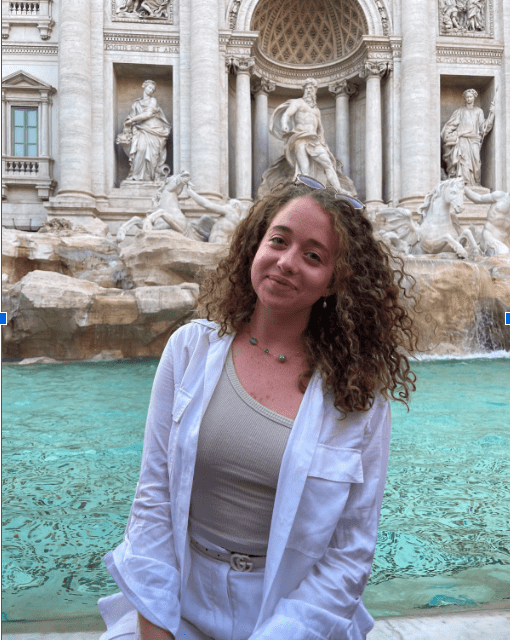
Dulcie and Lawrence Kugelman have been underwriting the Annual Kugelman Arts and Humanities Awards Ceremony for over a decade in the Wilkinson College of Arts, Humanities, and Social Sciences. The Kugelman Awards celebrate and acknowledge the top academic students within the departments of Art, English, Philosophy, Religious Studies, and World Languages and Cultures. This year, Bella Ocaña, graduating this spring with a major in Art History and a double minor in Advertising and Italian Studies, is one of the recipients of this prestigious award.
Recalling Bella Ocaña’s success in the Italian program, Professor Pacchioni and Professor Mattavelli stated: “She successfully completed advanced coursework in Italian language, including translation methods and business language, and deepened aspects of the culture through seminars on Etruscan and Roman Art and Italian cinema. Bella successfully participated in an intensive language immersion travel course in the southern Italian region of Puglia where she lived with a local family, advanced linguistically, and was introduced to the region’s identity. In addition, Bella was instrumental to the life of the Italian Studies student community by leading the student club for two years. We are proud of her academic success, the level of knowledge and skills she has achieved, and her commitment to the Italian community on campus and beyond. Congratulazioni e auguri, Bella!”
Bella conveys her experience in the program as follows. “To receive this award is an incredible honor. I started taking Italian courses in my Sophomore year hoping to enrich my Art History degree and learn a fun and new language. Little did I know that I would meet some of my best friends at Chapman, get close to the Italian faculty, and actually get to study abroad in Italy for a summer. My learning went beyond simply learning a language but enriched me with a beautiful culture filled with incredible people, food, and history. Over the years professors such as Dr. Paduano, Dr. Pacchioni, and more recently, Dr. Mattavelli have guided me through this process and have truly made me feel at home. I cannot count how many times we’ve all shared laughs in class or how much they have supported me through difficult times – to say I am grateful for the Italian department is an understatement. It is a bittersweet moment to graduate and leave the department, but I know I’ll be keeping in contact with all of them!”
Mr. Razzano is a third-generation Italian American with ancestral roots in Campania, Italy. In 2018, he met Dr. Federico Pacchioni, the founding director of the Ferrucci Institute for Italian Experience and Research, while attending the Italian Perspectives series. Impressed by the Italian Studies Program at Chapman, the two men struck up a friendship. After a distinguished career in business, Mr. Razzano retired in 2021 and became more fully engaged in the Italian Studies program as a patron, volunteer, and student. He currently serves as the Chair of the Leadership Board of the Ferrucci Institute.
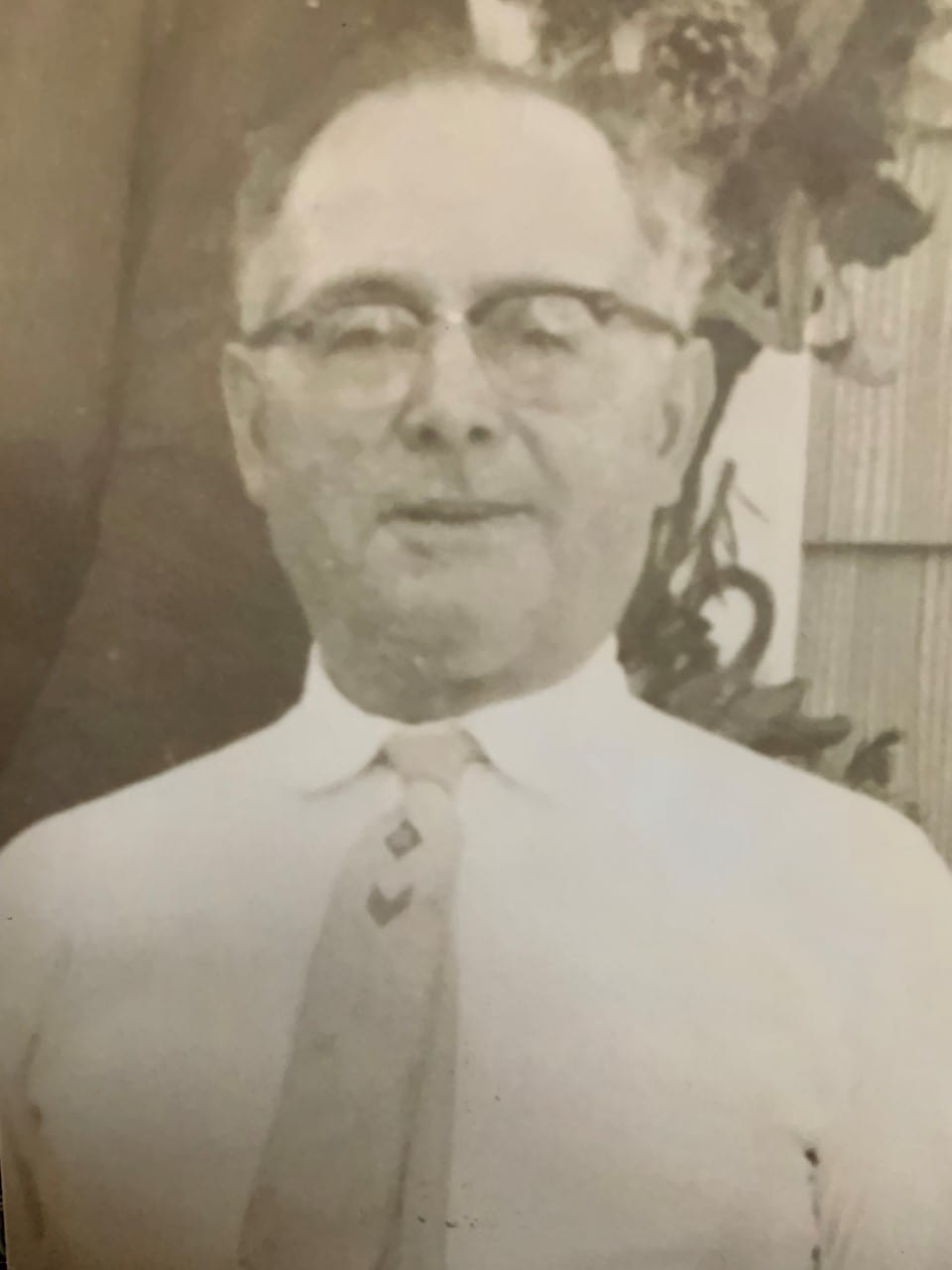
Mr. John Razzano’s grandfather, Giuseppe Razzano.
In making this gift, Mr. Razzano shared: “When my grandparents emigrated here early in the last century, they wholly embraced their adopted country but also instilled in the family a love for and appreciation of our Italian heritage. It is an honor to continue and support the work of my grandfather Giuseppe to promote an appreciation and understanding of Italian language, history, and culture to future generations.”
Mr. Razzano has been a resident of Orange County since 1980, where he raised his family with his late wife, Mary. Currently, Mr. Razzano resides in Newport Beach.
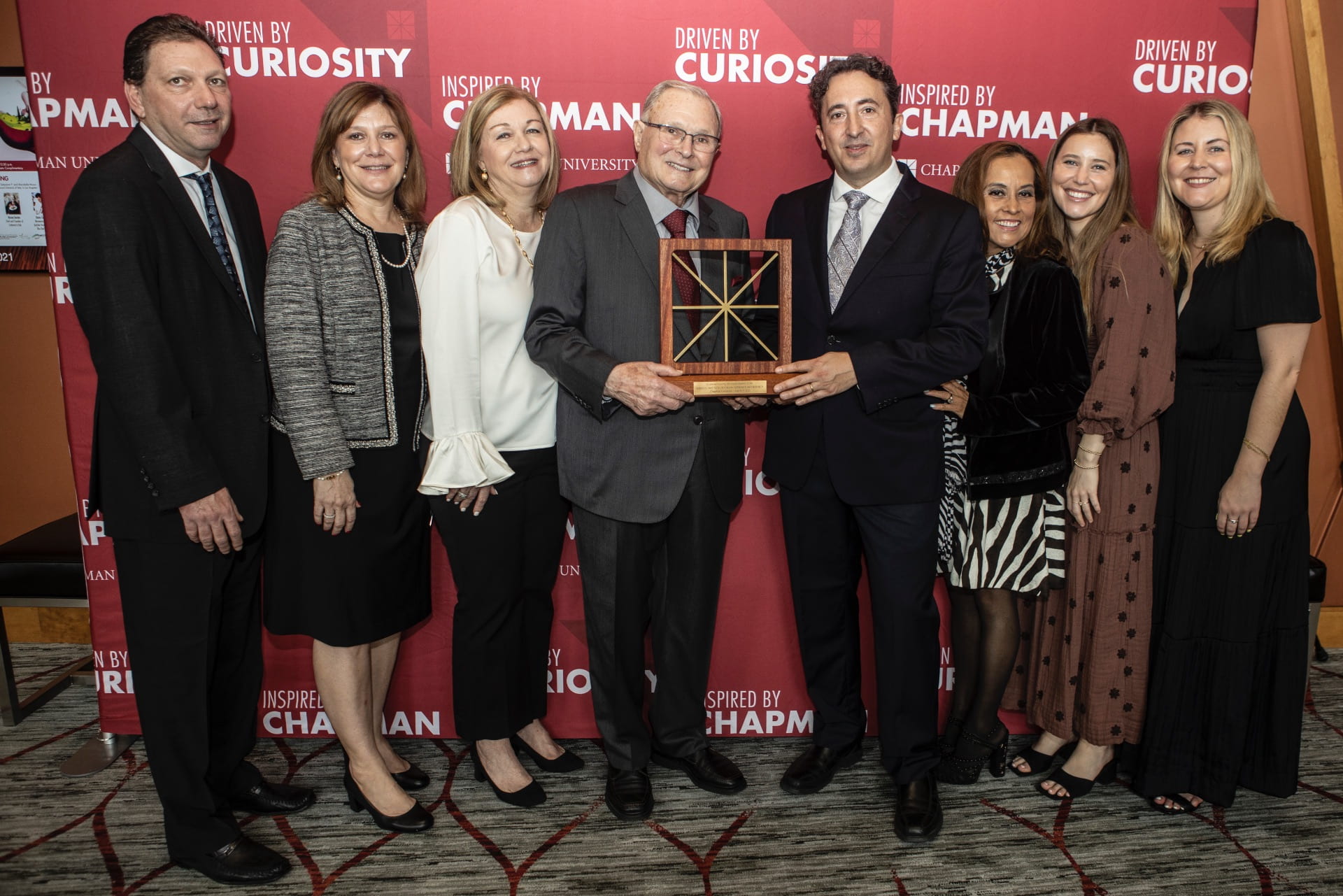
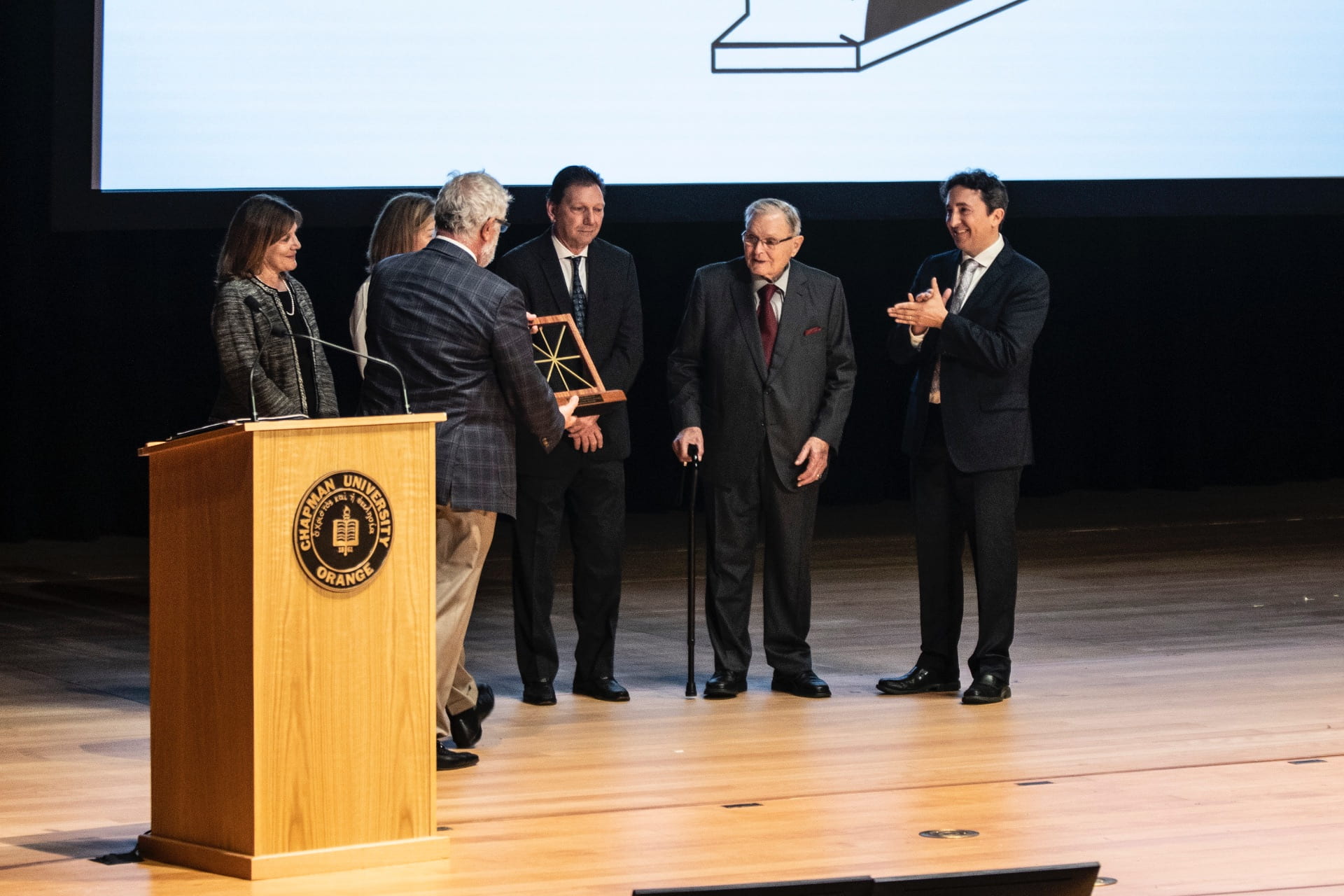
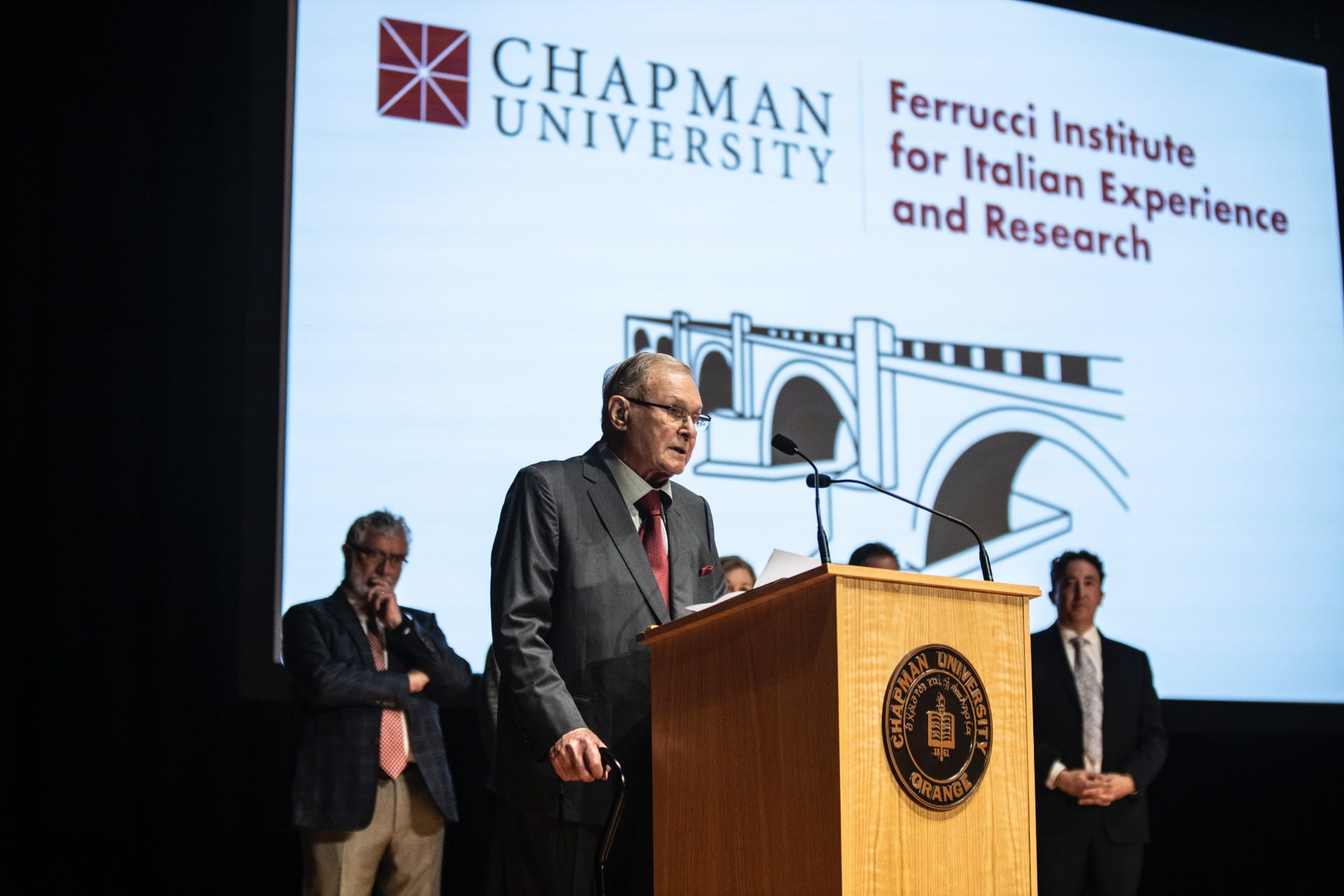
Chapman University is pleased to announce the creation of the Ferrucci Institute for Italian Experience and Research, thanks to a $1.5 million donation from the Ferrucci family. The gift was announced March 11 during the annual Italian Perspectives event at the Musco Center for the Arts. This is the second major gift announced in as many months.
A Bridge Between Chapman and Italy
The new institute will support the creation of courses that relate to Italy across departments and schools and focus on cross-disciplinary scholarly and creative work.
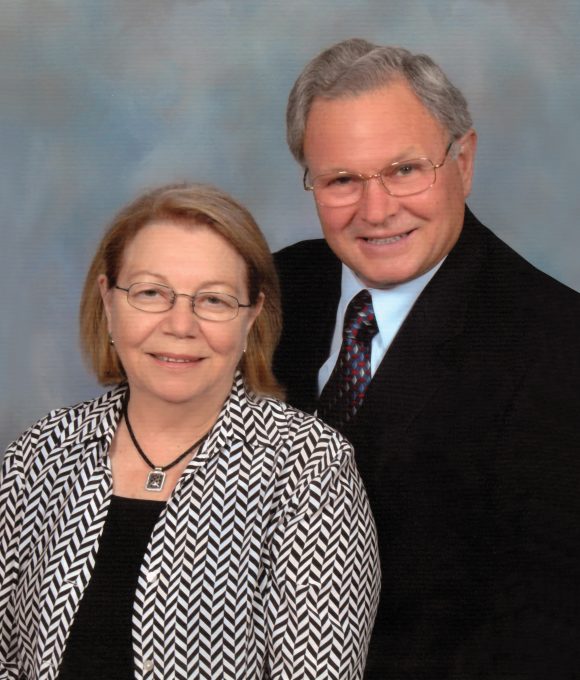
Gabriel Ferrucci and his late wife, Maria Ferrucci, emigrated from Italy to the U.S. in the 1950s.
“As an immigrant from Italy, I am proud of the rich Italian culture, and I have always been interested in higher education. I consider my education through college in Italy a very significant asset, which, combined with subsequent college education in the United States, constituted a strong base for my business life,” says Gabriel Ferrucci, who emigrated to the U.S. from Amorosi, Italy, in 1957. Ferrucci’s career in the auto and aerospace industries culminated in the purchase of Los Angeles-based Keystone Engineering, which he sold in 1998 to focus on charitable projects.
“When I learned in recent years that Chapman University offered Italian Studies, I was excited and decided to support the program financially. It is a high honor for me to leave a legacy, which will enable future students to explore the richness of Italian culture,” says Ferrucci.
“This Ferrucci Institute enables us to create a strong connection with another country and to leverage new intellectual and cultural resources to advance knowledge and research,” says Federico Pacchioni, who holds the Sebastian P. (Paul) and Marybelle Musco Chair in Italian Studies at Chapman and is the institute’s founding director. “The institute will become a bridge connecting Chapman University with Italy, different disciplines and generations.”
Trailblazing Interdisciplinary Studies in the Humanities
“The humanities are an anchor on the deeper meaning of things,” says Pacchioni. The institute represents a new approach to Italian Studies in higher education and will show how the humanities can serve as a foundation that benefits all disciplines.
The institute’s inaugural faculty includes professors from fields such as film, literature, music and theatre but also faculty members who study areas such as history, philosophy and food science. Affiliated faculty members will pursue their research and teaching projects, working collaboratively within the institute through a wider cross-disciplinary network.
Projects already in the works include: an examination of the Italian/Jewish experience in World War II by Shira Klein, professor of history in Wilkinson College of Arts, Humanities, and Social Sciences; the translation of Italian plays by Nicholas Gabriel, assistant professor of theatre in the College of Performing Arts; and a study of the peculiarities of Italian food culture and food production by Anuradha Prakash, professor of food science in Schmid College of Science and Technology.
Chapman University President Daniele C. Struppa and Provost Norma Bouchard also will serve on the institute’s faculty. Struppa’s research will focus on the history of mathematics, while Bouchard is an expert on the Italian American diaspora.
“The institute is a great opportunity for Chapman to lead the way in this new approach to academic inquiry,” says Bouchard. “When we say we are committed to academic excellence, this is what we mean. It’s not just hiring great faculty and putting them in the classroom. We want to give them the resources and opportunities they need to pursue profound ideas and to engage with other scholars in ways that produce exciting new paths of inquiry across fields.”
Why Italy? The country has a rich history of cultural and intellectual discourse. “The Italian ground is so rich, it’s a good place for minds to come together,” says Pacchioni.
Along with supporting interdisciplinary faculty research, the institute is developing multiple travel courses to Italy, offering new opportunities for students to learn and study abroad.
Italian Studies Donations Fund Academic Excellence at Chapman
“Gifts like these allow us to be creative in the pursuit of academic excellence,” says Jim Mazzo, who is co-chair of the campaign along with Lisa Argyros. “Faculty and students will have more opportunities than ever to connect what they are learning in the classroom with real-world experiences while cultivating a global awareness that will help them become leaders in their fields.”
This is not the first major gift Chapman has received to support Italian Studies. Donations from the late S. Paul Musco, emeritus trustee, established both the Musco Endowed Chair in Italian Studies and the Musco Endowment for Travel Courses in Italian Studies. The annual Italian Perspectives event is the result of the ongoing collaboration between the Muscos and the program.
“What the Muscos have started, the Ferruccis are continuing,” said Pacchioni. “The Musco Chair in Italian Studies has allowed the program to grow and expand its footprint on campus and in the community. The Ferrucci family is now taking Italian Studies to the next level, and in a way that strongly aligns with the university’s mission and strategic plan.”
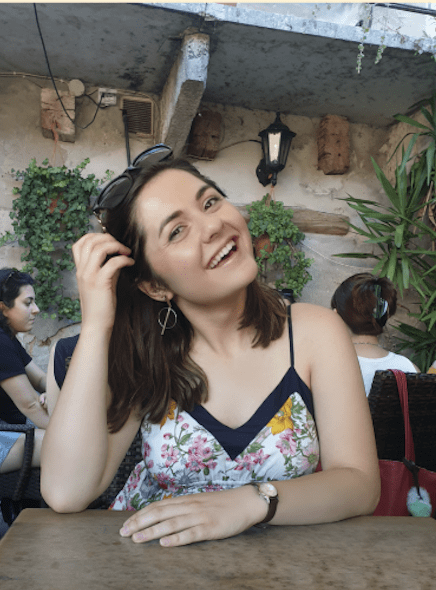
It was a joy hosting Italian Studies/Theater alumna Melissa Marino this week and having her give career advice to our current students! Melissa is one of our successful alum, she lives and works in Italy in her sector of choice, theater.
Melissa is an Italian-American theatre organizer and creative. Born and raised in California, she received her B.F.A. in Theatre Performance and B.A. in Italian Language and Culture from Chapman University in 2017. She then earned her Masters in Performing Arts Management from Accademia Teatro alla Scala in Milan, Italy. In the past, she’s worked with Teatro alla Scala and Milano Off Fringe Festival, and she currently works with Piccolo Teatro di Milano. While at Chapman, Melissa studied abroad in Italy, was Vice President of the Italian Club, and was selected to be a National Collegiate Representative for the National Italian American Foundation.
It was a joy hosting Italian Studies/Theater alumna Melissa Marino this week and having her give career advice to our current students! Melissa is one of our successful alum, she lives and works in Italy in her sector of choice, theater.
Melissa is an Italian-American theatre organizer and creative. Born and raised in California, she received her B.F.A. in Theatre Performance and B.A. in Italian Language and Culture from Chapman University in 2017. She then earned her Masters in Performing Arts Management from Accademia Teatro alla Scala in Milan, Italy. In the past, she’s worked with Teatro alla Scala and Milano Off Fringe Festival, and she currently works with Piccolo Teatro di Milano. While at Chapman, Melissa studied abroad in Italy, was Vice President of the Italian Club, and was selected to be a National Collegiate Representative for the National Italian American Foundation.
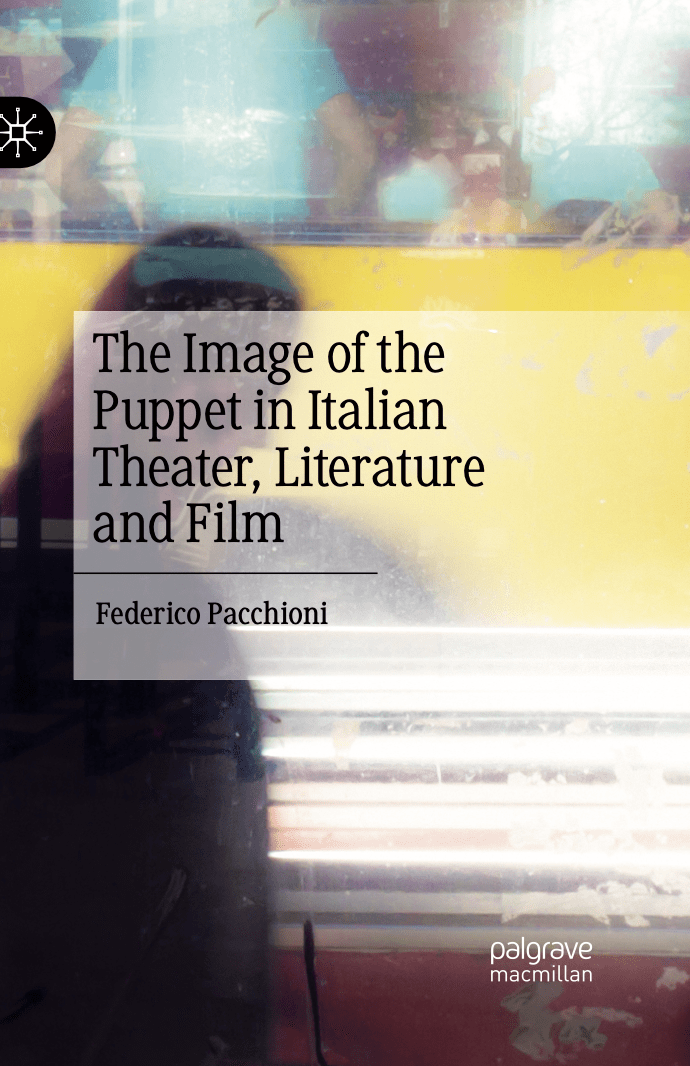
Palgrave Macmillan recently published an English translation of Dr. Pacchioni’s study The Image of the Puppet in Italian Theater, Literature, and Film. During the past two weeks, Dr. Pacchioni was invited to speak about the popular Italian puppet theater and its artistic and cultural influence in scholarly and cultural venues.
Dr. Pacchioni spoke about puppetry’s significance in the search for an Italian global identity at the virtual international panel Italy by Design, organized by the University of Edinburgh, Scottland, which gathered leading Italian Studies scholars worldwide. He also spoke about the transmedial history and potential of Italian puppetry at the annual conference of the California Interdisciplinary Consortium of Italian Studies hosted by the Graziadio Center for Italian Studies at California State University-Long Beach. Finally, Dr. Pacchioni spoke about the broader puppetry tradition underpinning the figure of Pinocchio at the Italian American Museum of Los Angeles, which currently hosts the exhibit A Real Boy: The Many Lives of Pinocchio.